Intended for healthcare professionals
Restricted access
Research article
First published online December 2, 2023

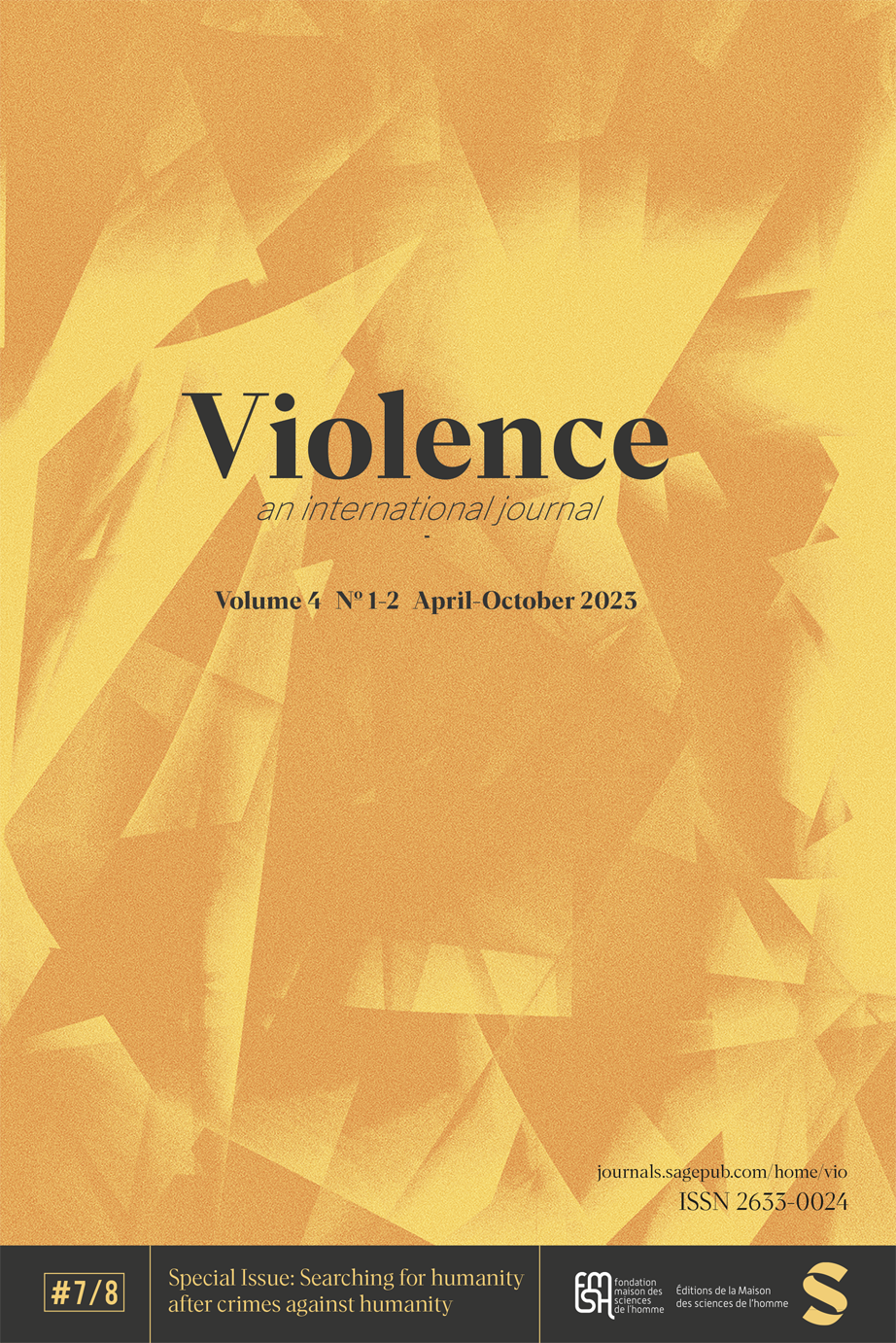
Enduring violence and commemoration: Korea’s Cheju April 3 Incident

Abstract

Post-atrocity survivors construct spaces of being through various levels of visibility and stages of construction. Those with inherited memories of their ancestors from mass atrocities share the ability to exert their postmemories that mediates the past memory in its affective force to restore their sociability with their relatives, neighbors, community, and nation. A central medium of postmemory typically comes in the form of commemorative ritual practices that contain a mixture of mourning and re-creation of family and community. Ritual engages informal sociocultural processes outside the purview of the state. Commemoration rituals reflect ordinary people’s attempts to seek moral renewal and social repair to promote social reconstruction and recovery of humanity. This essay considers feminist interventions of intimate memorial scales, enabling us to envision potential alternative historical trajectories in post-massacre commemorations, memorials, reburials, and as mnemonic locations for agonistic testimonies to emerge around a mid-century massacre in South Korea called the “Cheju April 3 Incident.” We take into consideration how the postmemory of the Cheju April 3 Incident is intergenerationally transmitted and ritually re-enacted through family ancestor worship, and the reburial of remains after the exhumation of mass graves. The lessons of postmemory practices are crucial to the foundation of humanity after atrocity.

Get full access to this article

View all access and purchase options for this article.

References

Alexander J (2004) Cultural Trauma and Collective Identity. Berkeley: University of California Press.
Caruth C (1995) Trauma and experience: introduction. In: Caruth C (ed) Trauma: Explorations in Memory. Baltimore: The Johns Hopkins University Press, pp. 3–12.
Chang J (2011) National Narrative, Traumatic Memory, and Testimony: Reading Traces of the Cheju April Third Incident, South Korea, 1948 (Ph.D Dissertation). New York: New York University, Proquest, Umi Dissertation Publishing.
Cumings B (1981) The Origins of the Korean War. Princeton: Princeton University Press.
Cumings B (2016) American responsibility and the massacres in Cheju conference on overcoming the past: healing and reconciliation – Cheju and the world in comparison. World Environment and Island Studies 6(4): 203–209.
Cumings B (2018) The Jeju april 3rd mass killing and the U.S. responsibility. In: Jeju 4.3 Peace Foundation (ed) The Jeju 4.3 Mass Killing: Atrocity, Justice, and Reconciliation. Seoul, South Korea: Yonsei University Press, pp.3–32.
Dragojlovic A, Samuels A (2021) Tracing silences: towards an anthropology of the unspoken and unspeakable. History and Anthropology 32(4): 417–425.
Falola T (2020) Ritual archives. In: Wariboko N, Toyin F (eds) The Palgrave Handbook of African Social Ethics. Cham, Switzerland: Palgrave MacMillan, pp. 473–497.
Feuchtwang S (2011) After the Event: The Transmission of Grievous Loss in Germany, China and Taiwan. New York, Oxford: Berghahn Books.
Gwon G (2011) “Apangdo ŏpgo hŏnan pabdo ŏpgo” - Cheju 4.3ui yŏsŏngsa (“Due to husband’s absence, no rice available”: Cheju women’s history). 4.3kwa yŏksa (4.3 and History) 11: 65–88.
Gwon G (2013) Remembering 4/1 and resisting the remilitarisation of Jeju: building an international movement. In: Broudy D, Simpson P, Arakaki M (eds) Under Occupation: Resistance and Struggle in a Militarised Asia-Pacific. Newcastle, UK: Cambridge Scholars Publishing, pp. 238–270.
Gwon G (2014) Cheju 4.3 ŭi chinsang kyumyŏng kwa chendŏ yŏnku (Cheju 4.3 truth investigation and gender studies). Tamna munhwa (Tamna Culture) 45: 169–198.
Hertz R (1960) Death and the Right Hand. Illinois: The Free Press.
Hirsch M (2002) Marked by memory: feminist reflections on trauma and transmission. In: Miller NK, Tougaw J (eds) Extremities: Trauma, Testimony, and Community. Urbana and Chicago. University of Illinois Press, pp. 71–91.
Hirsch M (2012) The Generation of Postmemory: Writing and Visual Culture after the Holocaust. New York: Columbia University Press.
Hirsch M (2019) Introduction: practicing feminism, practicing memory. In: Altinay A (ed) Women Mobilizing Memory. New York: Columbia University Press, pp. 1–22.
Hirsch M, Spitzer L (2006) Testimonial objects: memory, gender, and transmission. Poetics Today 27(2): 353–383.
Hyŏn K (2012) Suni Samch’on (Aunt Suni). Seoul, South Korea: Asia Publishers.
Hyun H (1998) Cheju nongch’on maŭl ŭi kijesaŭirye pyŏnhwa - Hwach’ŏn maŭl sarye (Transformation of ancestral Ritual in Cheju farming Village-the Case Study of Hwach’ŏn Village). Cheju, South Korea: Cheju Taehakkyo, Sŏksa Nonmun: Cheju National University.
Hyun H (2008) Cheju 4.3 sagŏn kinyŏm ŭirye ŭi hyŏngsŏng kwa kujo (Transformation and Structure of Cheju April third incident memorial ceremony). Kwangju, South Korea: Chŏnnam Taehakkyo Sahoehak Paksa Nonmun: Chŏnnam National University.
Jeju 4.3 Commission National Committee for Investigation of the Truth about the Jeju April 3 Incident (2014) The Jeju 4.3 Incident Investigation Report. Cheju City, South Korea: Peace Foundation.
Jeju 4.3 Commission National Committee for Investigation of the Truth about the Jeju April 3 Incident (2019) The Jeju 4.3 Incident Additional Investigation Report 1. Cheju City, South Korea: Peace Foundation.
Jeju 4.3 Research Institute (1989) Ijesa Malhaeng Suda: 4.3 Chŭngŏn Jaryojip 1. (Now We Speak: 4.3 Testimony Sourcebook 1). Seoul, South Korea: Hanul ch’ulp’ansa (Hanul Publisher).
Kang H (2021a) Kyŏnghapjŏk p’yŏnghwaron ŭi Hanbando p’yŏnghwa kuch’uke ŭi hamŭi: kyunghapjŏk tawŏn juŭi rŭl chungshim ŭro (Agonistic peace and its implications for peacebuilding in the Korean Peninsula: perspectives of agonistic pluralism). Tamron 201 (Discourse 201) 25(1): 79–111.
Kang H (2021b) Enforced silence or mindful nonviolent action: everyday peace and South Korean victims of civilian massacres in the Korean War. Peacebuilding 10: 297–312.
Kim Y (1981) Han maek won ryu: Han’gukin, maŭm ŭi ŭng’ŏri wa maejhim. Vein of Grievance and Flow of Resentment: Emotional Baggage and Knotting in Korean Minds) Seoul. South Korea: Chuwoo Publisher.
Kim D (2009) The Unending Korean War: A Social History. Larkspur, CA: Tamal Vista Publications.
Kim D (2010) The truth and reconciliation commission of Korea: uncovering the hidden Korean war. The Asia-Pacific Journal – Japan Focus 8.9(5): 1-11.
Kim E (2016) 4.3 Holŏmŏng’ui ‘malhag’i’ wa mom ŭi chŏngch’i (the Politics of the Jeju 4.3 holŏmŏng bodies: ‘speaking’ and emotion as embodied language). Han’guk munhwa illyuhak (Korean Cultural Anthropology) 49(3): 313–359.
Kim H (2013) Trial and error in transitional justice: learning from truth commissions. Buffalo Human Rights Law Review 19: 125–167.
Kim H (2014) The Massacres at Mt. Halla: Sixty Years of Truth Seeking in South Korea. Ithaca: Cornell University Press.
Kim J (1999) 4.3 ihu 50nyŏn, Cheju 4.3 che (fifty years after the Cheju April 3). In: Cheju 4.3 Yŏngu (Cheju 4.3 Research) (ed) 50nyŏn Kinyŏmsaŏp Ch’ujin Pŏmgukmin Wiwŏnhoe Yŏksa Pip’yŏngsa (Pan-National Committee for Cheju 4.3 50th Anniversary Memorial. Seoul, South Korea: Yoksapipyongsa (Historical Critique): 338–424.
Kim J (2018) Seventy years after the Jeju April 3. In: Jeju 4.3 Peace Foundation (ed) The Jeju 4.3 Mass Killing: Atrocity, Justice, and Reconciliation. Seoul, South Korea: Yonsei University Press: 115–152.
Kim J (2020) Early Cold War Genocide: The Jeju 4.3 Massacre and U.S. Responsibility. Korea Policy Institute. Available at: https://www.kpolicy.org/post/early-cold-war-genocide-the-jeju-4-3-massacre-and-u-s-responsibility (accessed 5 July 2023).
Kim N (2015) Memory, Reconciliation, and Reunions in South Korea: Crossing the Divide. Lanham: Lexington Books.
Kim N (2016) Reuniting families, reframing the Korean War: inter-Korean reconciliation and vernacular memory. In: Kim M (ed) Routledge Handbook of Memory and Reconciliation in East Asia. London, UK: Routledge, pp. 336–353.
Kim SN (2000) Mourning Korean modernity in the memory of the Cheju April Third Incident. Inter-Asia Cultural Studies 1(3): 461–476.
Kim SN (2002) Yŏsŏngjuŭi kusulsa ŭi pangbŏpronjŏk sŏngch’al (Methodology of feminist oral history). Han’guk munha illyuhak (Korean Cultural Anthropology) 35(2): 31–64.
Kim SN (2013) The work of memory: ritual laments of the dead and Korea’s Cheju massacre. In: Boddy J, Lambek M (eds) A Companion to the Anthropology of Religion. New York: John Wiley and Sons, pp. 223–238.
Kim SN (2014) Women, mourning, and the ritual for the death of family. In: Tam S, Wong W, Wang D (eds) Gender and Family in East Asia. New York: Routledge, pp. 213–225.
Kim SN (2019) Placing the dead in the postmemory of the Cheju massacre in Korea. The Journal of Religion 99(1): 80–97.
Kim SN (2021) Memory politics and the emergence of a women’s sphere to counter historical violence in Korea. In: Boesten J, Scanlon H (eds) Gender, Transitional Justice and Memorial Arts. New York: Routledge, pp. 75–96.
Kim SN, Yoo C, Kim E, et al. (2001) Cheju 4.3 ŭi kyŏnghŏm kwa maŭl kongdongch’e ŭi pyŏnhwa (A changing village community in a living history of Cheju April Third incident). Han’guk munhwa illyuhak (Korean Cultural Anthropology) 34(1): 89–137.
Koh S (2018) Trans-border rituals for the dead: experiential knowledge of paternal relatives after the Jeju 4.3 incident. Journal of Korean Religions 9(1): 71–103.
Koh S (2021a) 4.3 “Hŭisaengja” ŭi pyŏnyong kwa hwalyong - mujangdae ch’ulsinja ŭikwagŏch’ŏngsan kyŏnghŏm ŭl sarye ro’ (The Transformation and utilization of 4.3 ‘‘victims’: a case study of government’s past liquidation of former armed forces). Sahoe wa yŏksa (Society and History) 129: 263–292.
Koh S (2021b) 2ki 4.3 t’ŭkbyŏlbŏp ch’eje ŭi chaengjŏm kwa nanjŏm (Issues and struggles in the second phase of Jeju 4.3 Special Act). T’ongil inmunhak (Unification Humanities) 88: 193–221.
Kwon H (2015) Healing the wounds of war: new ancestral shrines in Korea. The Asia-Pacific Journal 7(24/4): 1–16.
Kwon H (2020) After the Korean War. Cambridge, MA: Cambridge University Press.
Lee S (2011) Military occupation and empire building in cold war Asia: the United States and Korea, 1945–1955. In: Hasegawa T (ed) The Cold War in East Asia, 1945–1991. Stanford, CA: Stanford University Press, pp. 98–119.
Merrill J (1980) The Cheju-do rebellion. Journal of Korean Studies 2: 139–197.
Park M (2018a) Introduction and atrocity, forgiveness, and reconciliation: a case of the Jeju 4.3 mass killing. In: Jeju 4.3 Peace Foundation (ed) The Jeju 4.3 Mass Killing: Atrocity, Justice, and Reconciliation. Seoul, South Korea: Yonsei University Press, pp. 351–376.
Park M (2018b) Towards a universal model of reconciliation: the case of the Jeju 4.3 Incident. Journal of Korean Religions 9(1): 105–130.
Ricoeur P (2004) Memory, History, Forgetting. Blame K and Pellauer D (Trans). Chicago, IL: University of Chicago Press.
Ringelheim J (1985) Women and the Holocaust: a reconsideration of research. Signs: Journal of Women in Culture and Society 10(4): 741–761.
Sa Y (2022) P’ongnakŭi Aidŭl (Hackberry’s Children) Feature Film, 84 Minutes HD. Cheju City, South Korea: Sayujin.
Steedly M (2013) Rifle Reports: A Story of Indonesian Independence. Berkeley, CA: University of California Press.
Verdery K (1999) The Political Lives of Dead Bodies: Reburial and Postsocialist Change. New York: Columbia University Press.
Wright B (2021) Kinship killings, Taesal and biologized state violence during the Korean Civil War. Journal of Genocide Research 25: 157–171. (accessed 5 July 2023).
Yoo C (2004) Kusŭldŭn kyŏnghŏm ilgi: Cheju 4.3 kwanryŏn suhyŏngin yŏsŏngŭi saengaesa (Reading oral experience: life history of a Cheju women prisoner related to the 4.3 Incident). Han’guk munhwa illyuhak (Korean Cultural Anthropology) 37(1): 3–39.

Biographies

Seong Nae Kim is a Professor Emeritus in the Religious Studies Department at Sogang University in Korea. Her recent publications include chapters “Cultural Trauma and the Cheju Massacre in Transnational Perspective” in Routledge Handbook of Trauma in East Asia (2023), “Memory Politics and a Women’s Sphere Countering Historical Violence in Korea” in Gender, Transitional Justice and Memorial Arts (Routledge, 2021). Her book manuscript on cultural memory and trauma of the Cheju April 3 Incident is in progress.
Merose Hwang is an Associate Professor in the History Department at Hiram College. Her latest manuscripts appear in Peace as Liberation: Visions and Praxis from Below (Springer Peace Psychology Book Series, 2023) and A New Outlook at Atrocities, (Palgrave Macmillan Studies on Human Rights in Asia, 2023). Her current interests lie in Cold War settler memorials and pedagogies of decolonization.