1. Introduction
Mathematics performance is a critical indicator of academic success and future opportunities, yet it is shaped by a complex interplay of cognitive, linguistic, socio-demographic, and technological factors (
Ayebale et al., 2020;
Gamazo & Martínez-Abad, 2020;
Mosia et al., 2025;
Wang et al., 2023). The present study examines how language proficiency and digital competencies, alongside well-established demographic factors, jointly predict mathematics performance in a national standardized assessment. While mathematical ability is often viewed as a domain-specific skill, research increasingly highlights the role of broader competencies, such as language proficiency and digital literacy, in shaping students’ achievement (
Ayebale et al., 2020;
Wang et al., 2023). In Italy, the national assessment organized by the National Institute for the Evaluation of the Education and Training System (
Istituto Nazionale per la Valutazione del Sistema Educativo di Istruzione e di Formazione – INVALSI) provides a valuable dataset for examining these relationships, offering insights into how different variables interact to influence mathematics outcomes. INVALSI tests are mandatory, standardized, and census-based, making them a central reference point for educational research and policy. A novel feature of the 2025 INVALSI cycle is the first-time inclusion of a standardized digital competencies test based on the European DigComp 2.2 framework.
The influence of language proficiency on mathematics performance is well-documented, particularly in assessments that rely on word problems and complex instructions (
Ajello et al., 2018;
Prediger et al., 2018). Mathematical learning and assessment are inherently language-mediated, as they require comprehension of problem statements, instructions, and subject-specific academic language (
Schleppegrell, 2007). Empirical studies consistently show that reading and language skills are strong predictors of mathematics achievement, particularly for tasks involving word problems and conceptual understanding (
Vilenius-Tuohimaa et al., 2008). Similarly, the economic, social, and cultural status (ESCS) remains one of the strongest predictors of academic achievement, reflecting systemic inequalities in educational access and resources (
Eriksson et al., 2021;
Lee & Stankov, 2018). In the Italian upper secondary system, these inequalities are further reflected in differences by school track (lyceum vs. vocational tracks) and geographic macroregion (North–South divide in Italy) (
Argentin & Triventi, 2015;
Giofrè et al., 2020).
A more recent area of exploration is the role of digital competencies in mathematics achievement. As education systems increasingly integrate technology into curricula and assessments, students’ ability to navigate digital tools may influence their problem-solving and analytical skills (
Fraillon et al., 2020;
Vuorikari et al., 2022). However, despite growing international interest in digital literacy, mathematics education research has not yet reached consensus on how digital competencies should be conceptualized or measured, nor on the extent to which they contribute to mathematics performance beyond established predictors such as language proficiency and ESCS. This uncertainty constitutes a key research gap. The
INVALSI (2025) assessment operationalizes digital competence using the European DigComp 2.2 framework. DigComp provides a structured way to assess students’ digital skills across multiple domains, allowing systematic investigation of its association with mathematics outcomes.
This study leverages INVALSI data to investigate the relative contributions of language proficiency, digital competencies, and demographic factors in predicting mathematics performance. Mathematics performance was operationalized as students’ scores on the INVALSI mathematics assessment, with Italian language proficiency measured through the corresponding INVALSI Italian test. Using multiple analytical approaches, including regression, machine learning (Boosting and Random Forest), and network analysis, we aim to: (1) identify the strongest predictors of mathematics achievement, testing whether digital competencies hold independent predictive power alongside traditional factors like language and ESCS; and (2) examine structural interdependencies among variables, determining whether digital skills form a distinct cluster or interact diffusely with other influences. The present study focuses on Italian Grade 10 students (approximately 15–16 years old), a crucial transition stage in the Italian education system corresponding to the first two years of upper secondary school.
By addressing these questions, this research contributes to both theoretical and policy discussions on equity in mathematics education. Findings may inform targeted interventions, such as integrated language-mathematics instruction or digital skill development, to reduce achievement gaps and enhance learning outcomes. The use of advanced analytical techniques strengthens the evidence base by providing a multidimensional view of the factors shaping mathematics achievement.
3. Materials and methods
3.1 Methodology
The present study is a secondary data analysis employing a quantitative, non-experimental, descriptive research design for causal investigation.
3.2 Data preparation
The sample used in this study was retrieved from the INVALSI official webpage (
https://serviziostatistico.invalsi.it/invalsi_ss_data/microdati-campione-g10-2024-25/). All measures of student performance in mathematics, Italian, and digital competencies are standardized INVALSI test scores. On the official webpage, microdata for grade 10 students who took the INVALSI national assessment in the school year 2024/25 is present. Information about their performance in mathematics, Italian, and digital competencies is presented as three different databases. There were 19,008 students included in the INVALSI mathematics database, 18,876 students in the Italian database, and 19,020 students in the Digital competencies database. There were 17,491 students in the intersection of all three databases. These students were included in the final database that was considered for future analysis. No data was missing.
3.3 Sample
The sample comprised 17,491 Grade-10 Italian students. Among them, 8,222 (47.0%) were male and 9,269 (53.0%) were female. Regarding birth year, 34 students (0.2%) were born in 2006 or earlier, 293 (1.7%) in 2007, 1,528 (8.7%) in 2008, 14,194 (81.2%) in 2009, and 1,442 (8.2%) in 2010. In terms of school type, 8,294 students (47.4%) attended a scientific, classical, or linguistic lyceum; 2,988 (17.1%) attended another type of lyceum; 4,139 (23.7%) attended a technical school; and 2,070 (11.8%) attended a vocational school. Geographically, 3,707 students (21.2%) were from North-Western Italy, 3,629 (20.8%) from North-Eastern Italy, 3,469 (19.8%) from Central Italy, 3,451 (19.7%) from Southern Italy, and 3,235 (18.5%) from Southern Italy and the Isles. In terms of citizenship, 15,226 students (87.0%) were native Italians, 471 (2.8%) were first-generation immigrants, and 1,411 (8.2%) were second-generation immigrants.
3.4 Variables
In all analyses, students’ mathematics proficiency (INVALSI mathematics score) was specified as the dependent variable, while Italian language proficiency, digital competencies, and demographic characteristics were treated as predictors. The variables that were available in the official microdata database and that were used in the study are (those indicated by * are continuous variables using the Rash model, where the mean of the population is set to M = 200, and the standard deviation to SD = 40):
•
Students’ biological sex (Male; Female);
•
Students’ school type (Scientific, classical, or linguistic lyceum; Other lyceum; Technical school; Vocational school);
•
Schools’ geographic macroregion (North-Eastern; North-Western; Central; Southern; Southern and Isles);
•
Students’ ESCS (continuous variable, where the mean M = 0 represents a middle ESCS; standard deviation is set to SD = 1);
•
Students’ proficiency in Italian language (*);
•
Students’ proficiency in Mathematics (*);
•
Students’ DigComp 2.2 competencies (*);
•
Students’ Information and data literacy (*);
•
Students’ Communication and collaboration competencies (*);
•
Students’ Digital content creation competencies (*);
•
Students’ Digital safety competencies (*).
3.5 Data analysis
Data was analyzed using descriptive statistics and multiple regression to estimate the unique contribution of each predictor to mathematics performance. To validate the robustness of the regression findings against potential non-linearities, machine learning techniques (Boosting and Random Forest regression) were also run. Network analysis was used to explore the structural relationships and interdependencies among all variables, providing a holistic view of how competencies and background factors interact. All analyses were performed with JASP v. 0.17.1.0.
3.5.1 Machine learning models
Machine-learning models (Random Forest and Boosting) were employed solely as robustness checks to verify whether non-linear or interaction effects altered the pattern of predictors identified in regression. For the Boosting regression, 20% of the sample was used for validation data. The shrinkage was set to 0.1, the interaction depth to 1, and the minimum observations in a node were set to 10, while 50% of the training data was used per tree. As a loss function, the Gaussian function was selected. The number of trees was optimized with a maximum of 1000 trees. For the Random Forest regression, 20% of the sample was used for validation data. The training data used per tree was set to 50%, while the features per split were automated. The number of trees optimized with a maximum of 1000 trees.
3.5.2 Network analysis
Network analysis was used to explore the structural relationships among variables, focusing on how linguistic, digital, and demographic factors cluster around mathematics performance. To interpret the network structure, we computed standard centrality indices: strength (overall connectivity), expected influence (connectivity accounting for edge signs), betweenness (role as a bridge), and closeness (proximity to all nodes). These measures identify which variables are most influential within the system of relationships. We also computed clustering coefficients (Barrat, Onnela, Watts–Strogatz, Zhang) to detect tightly interconnected groups of variables, indicating cohesive constructs. The network was estimated using the EBICglasso method, which applies graphical lasso regularization with an Extended Bayesian Information Criterion (γ = 0.5) to produce a sparse and reliable partial correlation network. This method controls for all other variables, filtering out weak associations. Pairwise Pearson correlations were used as input. Centrality measures were normalized to a 0–1 range for comparability, and the full sample was used to ensure stability.
4. Results
4.1 Preliminary analysis
Table 1 presents descriptive statistics of the continuous variables and the Pearson's correlation coefficients between the variables. Mathematics performance showed strong positive correlations with Italian proficiency (
r = .635) and DigComp competencies (
r = .531), and a weaker positive correlation with ESCS (
r = .230). The DigComp subskills and overall score were highly intercorrelated (
r > .65).
4.2 Factors predicting mathematics performance
To identify the strongest independent predictors, a multiple regression analysis was conducted (
Table 2). The final, fully adjusted model (Model 4) explained 51.5% of the variance in mathematics scores. Italian language proficiency was the strongest predictor (
β = .420,
p < .001). Overall digital competence was the second strongest predictor (
β = .181,
p < .001). Among demographic and contextual factors, school typology showed substantial negative effects, with students in vocational (
β = −.537) and other lyceums (
β = −.435) scoring significantly lower than those in academic lyceums. Gender (
β = −.339,
p < .001), indicating lower scores for female students, and school macroregion, with students from Southern Italy and the Isles scoring lowest (
β = −.360), were also significant predictors. The effect of ESCS was positive but very small (
β = .022,
p < .001). The specific DigComp subskills did not retain significant independent predictive power in the full model. This answers RQ1 by establishing a clear hierarchy: language proficiency is the dominant predictor, followed by general digital competence, with school type, gender, and region also exerting significant independent influence.
To assess the robustness of the regression findings against non-linearities and complex interactions, we employed two ensemble machine learning methods: Boosting Regression and Random Forest regression. Critically, both models replicated the rank order of predictor importance identified by linear regression: Italian proficiency was the strongest predictor, followed by overall DigComp competence, and then school typology. The detailed specifications, performance metrics, and variable importance scores for both models are provided in the electronic
Supplemental material.
4.3 Structural role of mathematics performance, digital competencies, and student demographic factors
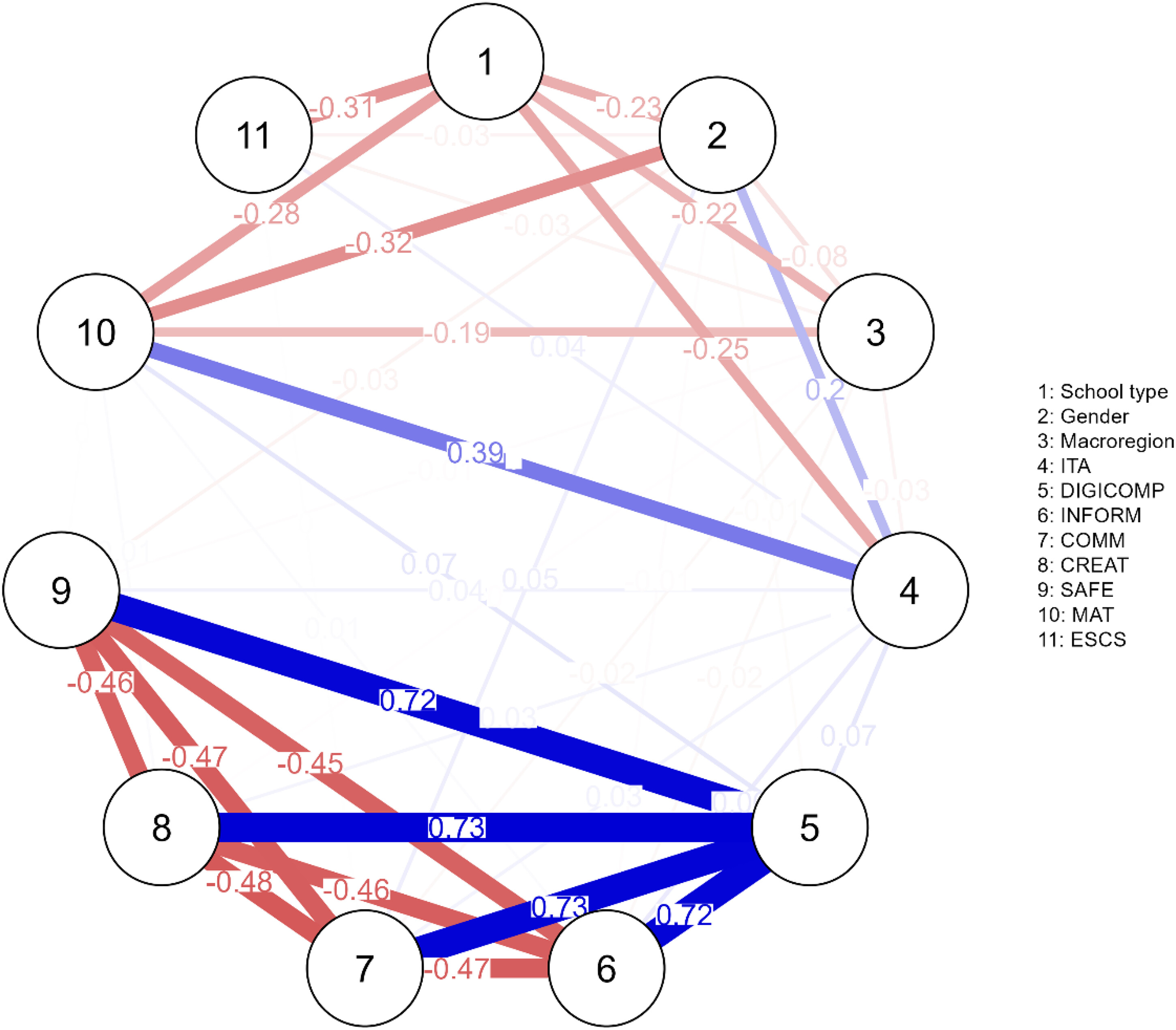
Network analysis was used to examine the structural relationships among all variables. The resulting network (
Figure 1) was relatively dense, with 44 of 55 possible connections present. To identify influential variables and potential clusters, we computed centrality and clustering measures (
Tables 3 and
4). The results reveal a clear structure: digital competence (DigComp competencies) was the most central variable in the network, exhibiting the highest strength and betweenness. This indicates it acts as a key hub connecting other factors. In contrast, the four DigComp subskills (Information and data literacy, Communication and collaboration, Digital content creation, Digital safety) formed a tightly interconnected cluster (high positive clustering coefficients across all measures), confirming they represent a cohesive construct.
Mathematics performance showed moderate centrality but negative strength, consistent with its role as a central outcome variable that is influenced by the network rather than a driver of it. Italian proficiency showed a positive expected influence, underscoring its supportive role. Demographic and contextual variables (ESCS, gender, macroregion, school type) generally occupied peripheral positions with low or negative centrality.
The partial correlation matrix (weights matrix,
Table 5) clarified these relationships. The strongest edge was a positive link between Mathematics performance and Italian proficiency (.387), highlighting their unique association. Mathematics performance also had direct negative connections with School typology (−.278) and School macroregion (−.195), pointing to structural inequalities. Meanwhile, the DigComp subskills showed very strong mutual positive connections (>.72) but only weak direct links to mathematics performance, suggesting their influence may be indirect.
Overall, the network analysis reveals: (1) language proficiency is the primary direct correlate of math scores; (2) digital competence is a central, cohesive cluster of skills that may support achievement indirectly; and (3) demographic and school-context factors maintain direct negative associations with outcomes, indicating persistent structural effects.
Therefore, mathematics performance had moderate betweenness and closeness but negative strength, confirming its structural role as a central outcome variable that is influenced by the network rather than a driver of it (RQ2). Mathematics performance is, hence, a central, dependent node in the network. Additionally, DigComp subskills formed a tightly interconnected cluster, as evidenced by consistently high positive clustering coefficients across all measures. The overall DigComp competencies variable acted as a central hub for this cluster, exhibiting the highest strength and betweenness in the entire network. It answers RQ3 by demonstrating that digital competencies form a highly cohesive, distinct cluster, with the overall score serving as its central hub.
Furthermore, mathematics performance retained a strong direct positive link with Italian proficiency and weak direct links to digital skills. Crucially, it also maintained direct negative connections with School typology and School macroregion. The centrality measures showed that these demographic and contextual variables (ESCS, gender, macroregion, school type) occupied peripheral positions with low or negative centrality, indicating their influence is not mediated through the central competency variables. This answers RQ4 by showing that even after accounting for academic competencies (language and digital skills), school-level factors (type, region) and student gender maintain significant direct negative associations with mathematics performance, highlighting persistent structural inequalities.
5. Discussion
The present research aimed at unveiling some skills and demographic factors that are related to students’ mathematics achievements on the Italian national assessment INVALSI. In particular, we aimed at investigating the relationship between these newly assessed digital competencies and students’ mathematical competencies. While the study is situated in the Italian context, the patterns observed also connect to broader debates on how transversal competencies (e.g., language and digital skills) shape mathematics learning in large-scale assessments.
This study contributes novel insights to the international literature on student achievement by combining predictive modeling with network analysis to investigate the interrelations among cognitive, digital, and demographic variables in a large-scale standardized mathematics assessment. While prior research has widely recognized the importance of language proficiency (
Ajello et al., 2018;
Arikan et al., 2017;
Prediger et al., 2018;
Wang et al., 2023) and ESCS (
Acıslı-Celik & Yesilkanat, 2023;
Eriksson et al., 2021;
Lee & Stankov, 2018;
Wang et al., 2023) in shaping academic outcomes, few studies have examined digital competence within a DigComp-aligned framework in relation to mathematics achievement. This approach is particularly relevant given the growing international policy emphasis on digital skills (
European Commission, 2020), and offers a transferable analytical model for other education systems adopting similar frameworks.
Descriptive analyses showed moderate to strong correlations among key variables. Mathematics performance was positively correlated with Italian proficiency and DigComp competencies, indicating a substantial association between these competencies and standardized mathematics test scores. Italian proficiency was also moderately correlated with DigComp competencies, suggesting a relationship between students’ language and digital skill levels. Among the DigComp subcomponents, all showed positive but weaker correlations with mathematics performance. This result partly supports previous findings, which highlighted that students’ digital competencies are correlated with students’ learning performance (
Chaw & Tang, 2024). These correlations reinforce international evidence that mathematics achievement is embedded within a broader constellation of literacy and digital skills, rather than being an isolated cognitive domain.
ESCS was also positively correlated with mathematics achievement, though the correlation was smaller than that observed with Italian and digital proficiency variables. This result is consistent with previous findings (
Acıslı-Celik & Yesilkanat, 2023;
Eriksson et al., 2021;
Lee & Stankov, 2018;
Wang et al., 2023), which found that students with lower ESCS tend to have lower performance on standardized mathematics tests (cf.
Agasisti & Longobardi, 2014;
Cornoldi et al., 2013;
Giofrè et al., 2020;
INVALSI, 2022;
OECD, 2019). The observed ESCS gradient aligns with global patterns documented in international assessments such as PISA, underscoring the cross-national relevance of socioeconomic disparities in mathematics education.
5.1 Language proficiency and mathematics performance
In the multiple linear regression models, Italian proficiency emerged as the most consistent and strongest predictor of mathematics achievement across all model specifications. This result supports previous findings (
Ding & Homer, 2020;
Thien et al., 2015;
Wang et al., 2023). In particular, language skills and proficiency are key elements to understand mathematics problems and effectively solve them (cf.
Mercer & Sams, 2006;
Ufer & Bochnik, 2020). This finding was further confirmed by the machine learning analyses. Both Boosting and Random Forest regression models identified Italian proficiency as the dominant predictor. This consistency across modeling techniques underscores the critical role of language proficiency in mathematics achievement. These results reinforce the international consensus that mathematics performance in large-scale assessments is inherently language-mediated, regardless of national curriculum differences.
5.2 Digital competencies and mathematics performance
DigComp competencies were also statistically significant predictors in the first two models, whereas the specific DigComp subcomponents did not retain statistical significance in the fully adjusted model. Therefore, these results are partly consistent with findings on general performance (
Chaw & Tang, 2024). Since digital competencies are related to several skills that are central to mathematical literacy, such as algorithmic thinking, problem-solving, critical thinking, and reasoning (cf.
Csernoch & Biró, 2015;
Moylan & Code, 2024), and students’ learning (
Chaw & Tang, 2024), it is plausible that reinforcing these cognitive skills may also support mathematics proficiency. In particular, strengthening algorithmic thinking may have a beneficial effect on mathematics proficiency, especially with regard to procedural knowledge. Similarly, digital problem-solving skills may contribute to more effective mathematics problem-solving strategies, thereby potentially enhancing students’ mathematics performance (cf.
Jonsson et al., 2014).
As reported by
Chaw and Tang (2024), students’ safety competencies are not associated with learning performance, a finding consistent with our results. This may be because protecting data and navigating the web safely does not require higher-order mathematical competencies or reasoning. However, a notable divergence from
Chaw and Tang's (2024) findings emerges when considering the other variables, that is, information and data literacy, communication and collaboration, and digital content creation, which did not have statistically significant predictive power for students’ mathematics achievement in our models. One plausible explanation is that the overall DigComp index subsumes these competencies, reducing their individual statistical contribution when modeled simultaneously.
It may also be that information and data literacy competencies are more closely linked to how digital information is obtained and how data are presented, skills that align more with statistical literacy than with mathematical literacy per se. Communication and collaboration skills, while important in a socially connected world, might exert limited influence on mathematics performance due to the relatively marginal role of collaboration in mathematics instruction (although communication is recognized as an important element of mathematics education;
Morgan et al., 2014). Furthermore, digital content creation may involve creativity and digital skills that, despite their importance in mathematics (particularly creativity;
Leikin & Pitta-Pantazi, 2013), manifest in forms that differ from domain-general creativity (although the two are positively correlated;
Schoevers et al., 2020). These findings contribute to the international debate on digital competence by showing that digital skills matter for mathematics performance, but their influence may be indirect, mediated by broader cognitive and linguistic abilities. This nuance is relevant for countries adopting DigComp-aligned frameworks or similar digital literacy standards.
Complementing these findings, network analysis revealed that DigComp competencies hold the highest betweenness and strength centrality within the network, indicating that digital competence acts as a critical structural bridge connecting other variables, including mathematics performance and Italian proficiency. The strong clustering of digital subskills further highlights that these competencies form a cohesive cluster, suggesting that improvements in one digital skill are likely to positively influence others.
Interestingly, the network also shows relatively weak direct partial correlations between DigComp subskills and mathematics performance, suggesting their influence may be indirect or mediated via other variables such as language proficiency. This nuance may explain why individual DigComp subcomponents did not independently predict math scores in fully adjusted regression models, even though the overall digital competence score was important. This structural insight is valuable beyond the Italian context, as it suggests that digital competence may function as a transversal mediator in educational systems where digital assessments and digital learning environments are increasingly prevalent.
5.3 Demographic variables and mathematics performance
Among the demographic variables, school typology was significantly associated with mathematics performance, indicating differences in achievement across school types. These results align with previous research (
Argentin & Triventi, 2015), which found that students from lyceums tend to achieve higher scores than those from technical and vocational schools. This finding should also be interpreted from a curricular perspective. Since these three school typologies have different focuses: lyceums providing a broad general education across all subjects, while technical and vocational schools emphasize professional development and practical knowledge, the mathematics curriculum reflects these distinctions. Lyceum students receive more general, theoretical mathematical instruction, whereas students in technical and vocational schools experience a more specialized, practice-oriented curriculum. Additionally, students’ motivation to learn mathematics may differ across these school types, which could partly explain lower INVALSI test scores among technical and vocational school students due to reduced motivation and effort.
Gender showed a statistically significant negative coefficient, suggesting that, on average, females had lower predicted scores in the sample. This result aligns with a substantial body of national (
Contini et al., 2017;
Giofrè et al., 2020;
INVALSI, 2022,
2025) and international research (
Else-Quest et al., 2010;
Lu et al., 2023) on gender differences in mathematics. One theoretical explanation for these differences is the gender stereotype model (
Cvencek et al., 2011), which posits that mathematics (and science) are perceived as “male domains,” whereas reading (and the humanities) are viewed as “female domains.” This stereotype has been repeatedly documented in Italian schools, where evidence suggests that the gender gap in mathematics tends to widen in higher grades (
Muzzatti & Agnoli, 2007;
Passolunghi et al., 2014).
ESCS was also a statistically significant, though relatively small, positive predictor. On one hand, this result corroborates findings from national and international literature (cf.
Agasisti & Longobardi, 2014;
Cornoldi et al., 2013;
Giofrè et al., 2020;
INVALSI, 2022,
2025;
OECD, 2019); however, the effect size is smaller than expected. This may be because other factors, such as students’ macroregion, capture some of the variance that ESCS would otherwise explain. In particular, literature consistently shows that students from southern Italian regions generally have lower ESCS compared to those from northern regions (
Daniele, 2015;
Giofrè et al., 2020). Therefore, while international studies emphasize ESCS as a strong predictor of mathematics performance on standardized tests, in the Italian context, macroregion may serve as a proxy for ESCS to some extent. It is important to interpret this finding cautiously, as generalization is limited; hence, future research should aim to better understand the complex relationship between these two variables.
Machine learning results reinforced the importance of school typology. School macroregion, although less influential, emerged as a modest but consistent predictor, reflecting regional disparities highlighted in the literature. Gender and ESCS had relatively minor but statistically significant effects, with gender slightly more influential than ESCS in the models. Network analysis further illustrated that demographic variables such as ESCS, gender, and macroregion generally occupy peripheral positions with low or negative centrality measures, indicating they are less central in the network of predictors compared to cognitive and digital competencies. The negative partial correlations between these demographic factors and mathematics performance highlight potential structural inequalities influencing achievement.
5.4 Recommendations
Based on the findings, some practical recommendations emerge for educators and policymakers. Firstly, given the robust association between Italian proficiency and mathematics performance, integrating language development into mathematics teaching could improve comprehension and problem-solving. Strategies may include explicit vocabulary instruction and reading comprehension exercises contextualized in mathematical content. While this study draws on Italian data, the recommendation aligns with international research emphasizing the importance of mathematical language proficiency across diverse educational systems. Thus, rather than proposing system-specific reforms, we highlight the broader implication that mathematics instruction benefits from explicit attention to linguistic demands. We therefore suggest that educators develop specific laboratories or interdisciplinary classes to reinforce students’ language skills and interconnect them with mathematics problems.
Secondly, the central role of DigComp competencies highlights the importance of digital skills in supporting mathematical learning. Schools should prioritize fostering algorithmic thinking, digital problem-solving, and critical reasoning skills alongside traditional mathematics content. Although recent Italian initiatives (e.g., coding programs supported by PNRR) illustrate one possible approach, the broader implication is that educational systems worldwide may benefit from integrating digital competence development into mathematics curricula in ways that reflect their own policy contexts and technological infrastructures. This might help students to gain digital competencies, develop their critical thinking, algorithmic thinking, reasoning, and mathematical modeling, which would, in turn, result in better achievement in mathematics as well.
Thirdly, differences across lyceums, technical, and vocational schools reflect varied curricular emphases. Educational strategies should consider these differences, providing support that addresses both curriculum content and student engagement, particularly in technical and vocational settings. Tracked or stratified educational systems often produce differentiated mathematics outcomes, and targeted support for students in less academically oriented tracks may be necessary across many countries. Being mathematical literacy of great importance in today's society and labor market, specific interventions are needed to guarantee students from each school type comparable mathematical skills.
5.5 Limitations and future directions
Despite its contributions, this study has some limitations that should be considered when interpreting the findings. First, the study relies on observational data from the 2024/25 INVALSI national assessment, which limits the ability to establish causal relationships among language proficiency, digital competencies, demographic variables, and mathematics performance. Second, while the dataset is large and nationally representative, some variables, such as ESCS and macroregion, may share overlapping variance, potentially complicating the interpretation of their unique effects. The finding that ESCS had a relatively smaller effect size than expected may reflect this issue, as macroregion might act as a proxy for socioeconomic status in the Italian context. Third, the study focuses on broad measures of digital competence using the DigComp framework; however, some subdomains showed limited independent predictive power, suggesting that further refinement or alternative conceptualizations of digital skills might be needed. This raises questions that extend beyond Italy, particularly for countries adopting or adapting DigComp-aligned frameworks, where the granularity and operationalization of digital competence remain active areas of debate. Additionally, motivation, attitudes, and other affective factors influencing mathematics performance and digital competence were not included, representing an important gap. Finally, the cross-sectional nature of the data precludes analysis of developmental trajectories or changes over time, such as the evolution of the gender gap in mathematics achievement.
Future research should address these limitations to deepen understanding of the complex factors influencing mathematics achievement. Longitudinal studies could clarify causal pathways and examine how language proficiency, digital competencies, and demographic factors interact over time, particularly across critical educational transitions. Further investigation into the role of affective and motivational variables, including students’ attitudes toward mathematics and digital learning, may offer additional explanatory power. Given the limited predictive power of certain DigComp subcomponents, qualitative or mixed-methods studies might explore how specific digital skills relate to mathematical problem-solving in classroom contexts. Moreover, research should unpack the intertwined roles of ESCS and regional factors within Italy, investigating how socioeconomic and geographic inequalities shape learning opportunities and outcomes. Finally, targeted research is needed to explore mechanisms underlying gender disparities in mathematics, particularly interventions that might reduce stereotype effects and promote equitable engagement in STEM subjects.
6. Conclusions
The results of the Boosting and Random Forest regression models supported the findings from multiple regression. In all these models, Italian proficiency was the most influential predictor of mathematics achievement. DigComp competencies ranked second in influence, followed by school typology. Other variables, including ESCS, gender, and DigComp subskills, had lower variable importance scores.
These results suggest that language and digital competencies, along with certain demographic variables such as school type and gender, are associated with variation in student performance on the INVALSI mathematics test. However, the direction and magnitude of relationships were not uniform across all predictors. While language and digital skills were positively associated with outcomes, demographic variables had smaller or negative associations, and some subskills within DigComp did not show independent predictive power when controlling for higher-level constructs and other covariates.
Beyond the Italian context, these findings contribute to the broader international discourse on mathematics education by demonstrating that mathematics performance in large-scale assessments is strongly shaped by transversal competencies, particularly linguistic and digital skills. This reinforces global evidence that mathematical achievement cannot be understood solely as a domain-specific construct but must be interpreted within a wider ecosystem of literacy, digital competence, and structural factors.
The findings underscore the centrality of language and digital competencies in educational performance, suggesting that interventions targeting these skills may have widespread benefits. Additionally, the peripheral roles of demographic factors in the network highlight the importance of focusing on cognitive and skill-based variables, rather than solely relying on background characteristics, when designing educational support strategies. As education systems globally strive to integrate digital competence frameworks and address post-pandemic learning gaps, this study provides timely evidence for informing equitable and skill-oriented education policies.