



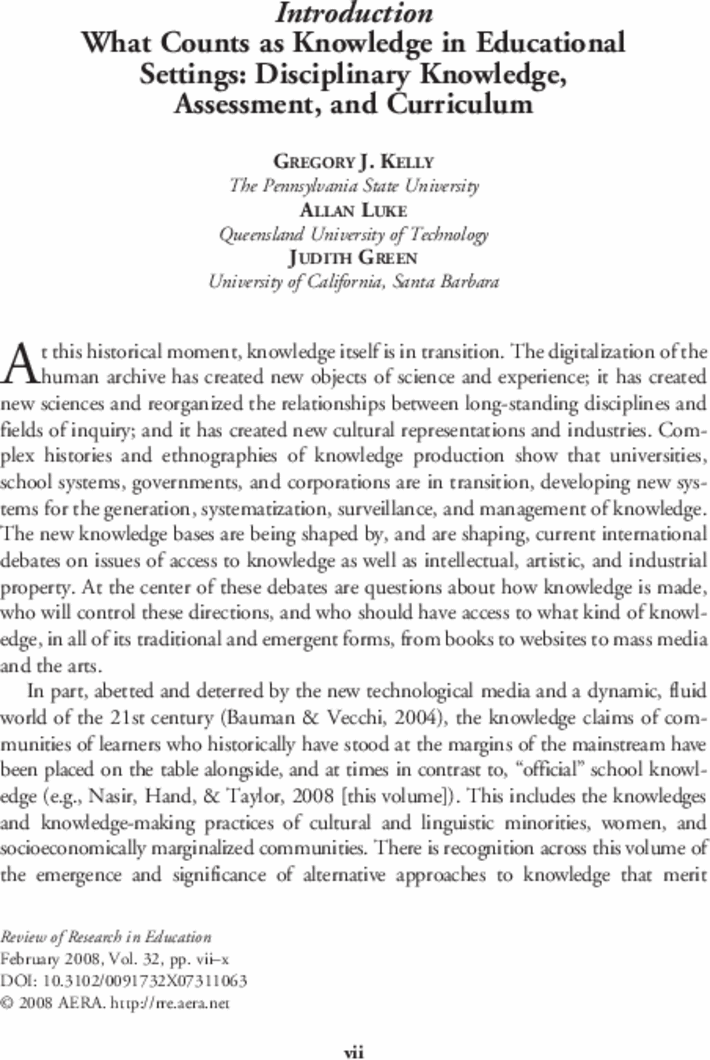
What Counts as Knowledge in Educational Settings: Disciplinary Knowledge, Assessment, and Curriculum
Get full access to this article
View all access and purchase options for this article.
REFERENCES
Cite
Cite
Cite
Download to reference manager
If you have citation software installed, you can download citation data to the citation manager of your choice
Information, rights and permissions
Information
Published In

Authors
Metrics and citations
Metrics
Journals metrics
This article was published in Review of Research in Education.
View All Journal MetricsPublication usage*
Total views and downloads: 3206
*Publication usage tracking started in December 2016
Altmetric
See the impact this article is making through the number of times it’s been read, and the Altmetric Score.
Learn more about the Altmetric Scores
Publications citing this one
Receive email alerts when this publication is cited
Web of Science: 35 view articles Opens in new tab
Crossref: 38
- Knowledge-rich curricula: revisiting questions of knowledge, power, diversity, and future learning
- Curriculum as policy deception: a critical analysis of Aboriginal and Torres Strait Islander knowledge inclusion in the Australian Curriculum
- 2024 ASEE Annual Conference & Exposition Proceedings
- Negotiating “what counts” in multimodal writing in the classroom: a high school English teacher’s perspective
- Interlocking models in classroom science
- Collaborative construction of artificial intelligence curriculum in primary schools
- Negotiation of Epistemological Understandings and Teaching Practices Between Primary Teachers and Scientists about Artificial Intelligence in Professional Development
- The OECD and epistemic (de)colonisation: Globalising visions for knowledge in the Learning Compass 2030
- Whose Knowledge Counts? Examining Paradigmatic Trends in Adapted Physical Activity Research
- Covid-19 as an opportunity to teach epistemic insight: findings from exploratory workshops on Covid-19 and science with students aged 15–17 in England
- View More
Figures and tables
Figures & Media
Tables
View Options
Access options
If you have access to journal content via a personal subscription, university, library, employer or society, select from the options below:
I am signed in as:
View my profileSign out

I can access personal subscriptions, purchases, paired institutional access and free tools such as favourite journals, email alerts and saved searches.
loading institutional access options
AERA members can access this journal content using society membership credentials.
AERA members can access this journal content using society membership credentials.
Alternatively, view purchase options below:
Purchase 24 hour online access to view and download content.
Access journal content via a DeepDyve subscription or find out more about this option.
