1. Background
For persons with intellectual disabilities the physical environment in the care sector is seen as relevant to their health, behaviour, and participation [
1]. The prevalence of challenging behaviour in people with intellectual disabilities has been reported to vary between 45 to 82 percent, depending on the type of behaviour and living situation [
2,
3]. The expression of challenging behaviour varies, but self-injurious as well as aggressive or destructive behaviour have been reported in people with intellectual disabilities and multiple disabilities [
2]. Challenging behaviour can be triggered and enheightened when the physical environment’s facilities are not in-line with the demand for care. When long-term patterns of inappropriate behaviour occur in people with intellectual disabilities, they are referred to as persons with problem behaviour or difficult-to-understand behaviour [
4]. People with difficult-to-understand behaviour express themselves differently because, for example, there may be delayed (sensory) information processing. Difficult-to-understand behaviour can manifest itself in several ways, such as poor language skills, excessive laughter, hyperactivity, a short attention span, and sleep problems [
5]. Aggression and self-injury are also manifestations of difficult-to-understand behaviour in people with intellectual disabilities.
The physical environment consists of the indoor environment and the layout of a room. The indoor environment comprises the indoor climate (thermal and air quality), (day)light and colours, acoustics, and sound. The hypothesis is that if the physical environment is appropriately designed to meet the wishes and needs of people with disabilities, and fit the demand for care, challenging behaviour will decrease. Unfortunately, no scientific literature exists that gives evidence of the possible benefits of the physical environment in care facilities where people that could display challenging behaviour reside, to the demand of care of these residents. It was still possible to examine the hypothesis as literature coming from other domains shows results that the physical environment does have a positive effect on people. Evidence is given by the Healing environment concept. A Healing environment is described as an environment that positively influences both patients and staff in a hospital environment [
6]. Ulrich, for example, showed that the length of stay in the hospital and the use of heavy medication could be reduced by providing a view of nature during the stay [
7]. In addition, the patient’s behaviour towards staff was friendlier.
In long-term care, comparable results were found. In this context, the concept is addressed as an enriched environment supporting the health and wellbeing of residents and staff [
8]. For people with intellectual disabilities in the care sector, both concepts may not apply, but elements of both concepts could be used to create a comforting and encouraging environment for those residing in a long-term care facility. However, for persons with intellectual disabilities in the care sector new practices may have evolved not yet supported by scientific evidence. Based on the expertise of care professionals, evidence from clinical practice could help identify knowledge gaps in need of further research [
9]. A scoping review was executed in search of evidence regarding comforting and encouraging environments and to develop an overview of studies and clinical knowledge in which the effect of the physical environment of people with intellectual disabilities (independent of specific intellectual disabilities) is addressed. This scoping review aims to unravel current evidence and clinical knowledge on the effect of building-related factors on expressions of challenging behaviour irrespective of the type of disability.
2. Method
The scoping review used scientific and grey literature following the methodological framework by Arksey and O’Malley [
10] and Rumrill et al. [
11]. A scoping review can be used to identify knowledge parameters and gaps in literature [
12]. Between January and March 2020, the databases HBO Kennisbank (a database of all publications of Dutch Universities of Applied Sciences), NARCIS, Science Direct, Scopus, Pubmed, PsycINFO, Google Scholar, Web of Science and Embase were searched to retrieve relevant studies. Table A1 in the appendix presents the keywords used in each of the databases. Keywords were categorised into three groups, Living situations, Target group and Behaviour was combined with the different keywords used per category. The final search string applied in PubMed can be found in Appendix 1. It provided guidance for all searches in the other databases. Articles published between January 2002 and March 2020 were eligible for inclusion. Studies published before 2002 were included if they provided information essential to the topic of this review not addressed in more recent studies. All levels of evidence were included and there was no restriction on the study design.
Furthermore, social media, care professionals, and experts in building physics were consulted. All search engines and digital media were searched in the English, Dutch, and German language. Case findings supplemented the theoretical approach to gain insights from experiences in daily practice on adjustments to the physical environment and its influence on behaviour. An iterative approach enabled reflection on the data collected allowing adjustments to each step of the scoping review.
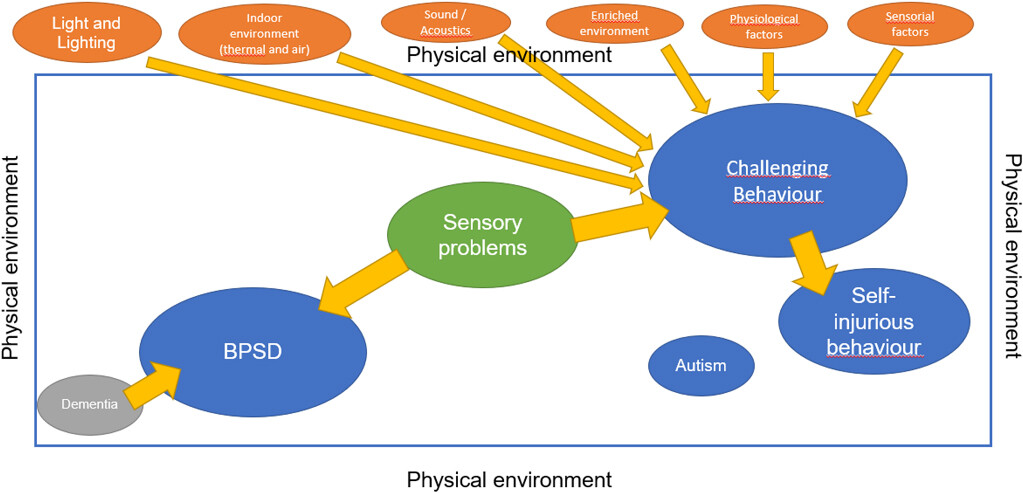
Literature from other domains was also included when no results were found. The focus, however, was kept on challenging behaviour for all types and expressions of behaviour for all types of disability that cannot easily be interpreted or is considered as incomprehensible behaviour, including Behaviour of Psychosocial Symptoms of Dementia (BPSD). Based on the available evidence, the data was ‘a posteriori’ structured and conceptualised taking indoor environmental factors and their potential influence on behaviour as a starting point (Fig.
1). The results are organised from the perspective of building physics. Therefore, findings are placed in sections aligned with indoor environmental factors. Size, design and lay-out are added as a separate section.
4. Reflection on the findings
The above findings address the building-related factors as a passive non-pharmacological intervention only. The relevance of our findings is supported by the consensus statement of the Summit on Intellectual Disability and Dementia that recognised adjustments in the physical environment as relevant non-pharmacological interventions and favoured these adjustments over therapy with pharmacological intervention in the case of people with an intellectual disability that display challenging behaviour or in the case of people with dementia displaying BPSD [
1]. The evidence on building-related factors and the influence on the behaviour of persons with intellectual disabilities are scarce. Several studies explored the impact of the size of the residential group and the impact on behaviour in persons with intellectual disabilities [
14,
15,
16,
18,
19,
20]. The smaller the setting the more positive the reported effect on the feeling of loneliness [
14,
15,
16] or the exhibition of aggressive behaviour was [
19]. Regarding the impact of sound environment, few studies describe a relevant impact on the behaviour of persons with intellectual disabilities [
21,
24]; the impact can be positive and cause relaxation and comforting behaviour but also negative if an overload of sounds is experienced. McGill therefore advocates providing strategies on how to deal with noises and sounds [
21]. However, no specific guidelines are provided. Specific information on optimal lighting conditions and the indoor climate is missing for this specific group. Studies in persons with dementia may provide a starting point for future research.
Studies reporting on care- or therapy-related interventions were also found; these comprise for instance the well-known ‘snoezelen’ rooms [
33], and a maybe less-known use of soundscaping. Soundscaping was used in the study by Van den Bosch in which five different sound sources (beach, silence, urban, forest, music) were used, aiming to create a safe and comforting environment for people displaying challenging behaviour. The silence mode increased boredom behaviour [
34]. However, the efficacy of ‘snoezelen’ rooms in dementia care is limited [
35], and evidence in persons with profound intellectual disabilities suggests it may only be significant in certain target behaviours [
26].
The focus of this scoping review was on the building-related factors. Understanding how building-related factors may influence people displaying challenging behaviour contributes to improving spaces as passive non-pharmacological interventions both in renovated and newly built residences.
The scoping review has been executed to retrieve the scope of the question/issue raised to set directions for future research. The findings are, therefore, not generalisable to all people displaying challenging behaviour and their residence. Future research could include a systematical approach of multiple case-controlled studies in which single or combined building-related factors are adjusted in the indoor environment to the demand of care and quality of life for people displaying challenging behaviour, while taking into account ethics and privacy considerations. Furthermore, this scoping review also showed the added value of combining clinical knowledge, building physics expertise and practice-based findings. Based on this experience, a collaboration of researchers and care facilities for persons with intellectual disabilities is recommended to systematically collect data on adjustments in the indoor environment and their effect on the behaviour of individual persons. An expert group encompassing researchers, care professionals, building facility management personnel, and experts in building physics would be beneficial to gain evidence-based knowledge in real-life situations.
5. Conclusion
Most of the studies report on sound, acoustics, light, colours and the influence on behaviour. No specific guidelines are given about how to adjust the indoor environment to an environment that is safe, comforting, and encouraging for people displaying challenging behaviour. Possible solutions are case-specific. This scoping review showed that studies are needed to gain a better understanding of how building-related factors, applied as non-pharmacological interventions may influence people displaying challenging behaviour and how displaying this behavior can be prevented or lessened. In future studies these cases could be studied aligned and categorised to the building-related factors and the expressions of challenging behaviour.
Author contributions
CONCEPTION: Helianthe Kort and Emelieke Huisman.
PERFORMANCE OF WORK: Emelieke Huisman, Chantal Huisman and Sigrid Mueller-Schotte.
INTERPRETATION OR ANALYSIS OF DATA: Eme-lieke Huisman, Chantal Huisman, Sigrid Mueller-Schotte and Helianthe Kort.
PREPARATION OF THE MANUSCRIPT: Chantal Huisman, Emelieke Huisman, Sigrid Mueller-Schotte and Helianthe Kort.
REVISION FOR IMPORTANT INTELLECTUAL CONTENT: Helianthe Kort, Chantal Huisman and Sigrid Mueller-Schotte.
SUPERVISION: Helianthe Kort.