
Intended for healthcare professionals
Palliative care continues to evolve and develop in the primary care setting to meet the outstanding challenge of being accessible and acceptable to every person with life-threatening illness. This special edition features a number of new studies highlighting the great potential to deliver palliative care in primary care. We define ‘Primary Palliative Care’ as palliative care carried out by primary care workers, including all professionals employed in community health and social care services, who provide integrated healthcare for people in local communities throughout their life.

Contents of this special edition

Peeler et al. present a scoping review to explore how palliative care is integrated in community settings in low and middle-income countries where it is most urgently needed. They very helpfully lay out five models of how people can access palliative care in primary care.1 Pereira et al.,2 in contrast, describe models of integrated palliative care in Canada and other higher-income countries. They also highlight the need for some new more nuanced indicators to monitor primary palliative care, such as how many months before death this approach was started.
Leng et al.3 conducted consecutive rapid participatory appraisals to develop and evaluate palliative care integration in a refugee setting in Uganda. They demonstrate the utility of this method to foster palliative care with community involvement under challenging circumstances. Mitchell et al.4 examined how the integration of primary and palliative care services can improve cultural competency and equity in the UK. Realist stakeholder workshops found that inequalities in access to palliative care can be addressed through integrated partnerships, emphasising, as Leng et al.3 also found, the importance of trust, communication and patient-centred care.
Education is an essential aspect in developing palliative care in primary care. The study by Seiça Cardoso et al.5 in Portugal explores a two-tiered complex intervention involving General Practitioner training combined with a new consultation model for patients with palliative care needs in primary care settings. They demonstrate the feasibility and effectiveness of empowering General Practitioners in this way. Ambulance services also daily face patients with life-threatening diseases. So Juhrmann et al.6 employed a Delphi study to develop a framework for national implementation in Australia to enhance palliative care delivery by paramedics. This framework will help improve the integration of palliative care in urgent and emergency care out-of-hours.
Cao et al.7 conduct a systematic review of electronic symptom monitoring in home-based palliative care. This shows promise in enhancing patient-provider communication and extend specialist and generalist palliative care into the community. Technological advances can be used for reaching those living in rural areas. A further qualitative study by Lion et al.8 investigated the experiences of family caregivers of people with brain cancer. Caregivers want timely access to coordinated support and information throughout the illness trajectory. This study finds that support needs could be provided by primary care providers such as general practitioners and community nurses, who typically have established relationships with patients and caregivers.
Finally, two studies explore that less may be more at the end of life. Davies et al.9 conduct a systematic review of hospital admissions at the end of life in people who are frail to explore the complex factors influencing clinical decision-making in primary care. They emphasise the need for a balanced approach and continuity of care. van der Waal et al.10 explore factors influencing deprescribing in the last phase of life in primary care settings. They identify barriers and facilitators to deprescribing, emphasising the importance of patient-centred care and systematic identification of patients with limited life expectancy.

What do we already know about palliative care in primary care?
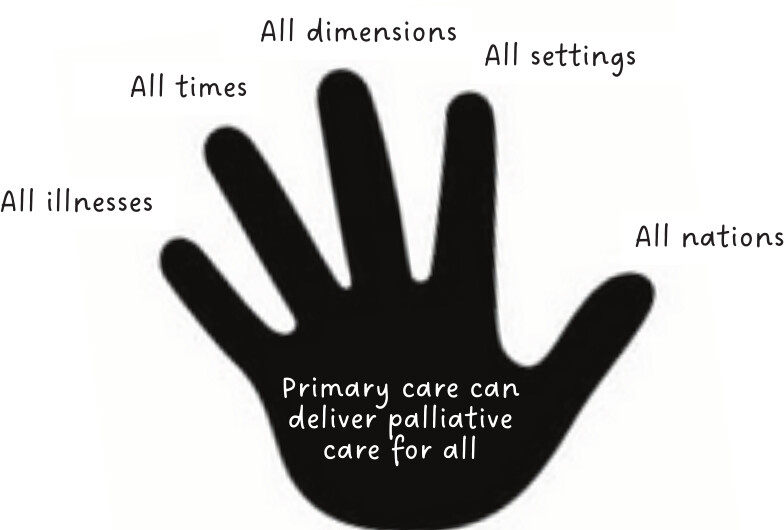
These above papers add to the body of evidence that primary care workers, supported by specialists and more experienced generalists can and actually do provide integrated palliative care for people with all diseases, at all times from diagnosis to death and can deal with all dimensions of need, in all settings and all countries (see Figure 1).
Figure 1. Primary palliative care for all.
Over twenty years of longitudinal qualitative and quantitative research on illness trajectories has helped us understand the multidimensional experiences and needs of patients as their health declines. This has brought a new vocabulary and an understanding of the concept of ‘illness trajectories of decline’ which clearly indicates that dying is a process that can take months or years rather than an isolated event.11 Understanding these dynamic patterns allows researchers and clinicians to pro-actively identify when patients might benefit from a palliative care approach. Subsequently tools were developed and validated across many patient groups and countries so that intervention studies could proceed (GSF12 and SPICT13). The development and testing of tools for assessment and care planning has also been proven useful to routinise in clinical practice and guide future care planning discussions in people with all illnesses including multimorbidity.14 Our EAPC toolkit to help advocate for and operationalise palliative care in primary care is now available in English, French, German, Spanish, Portuguese and Italian.15
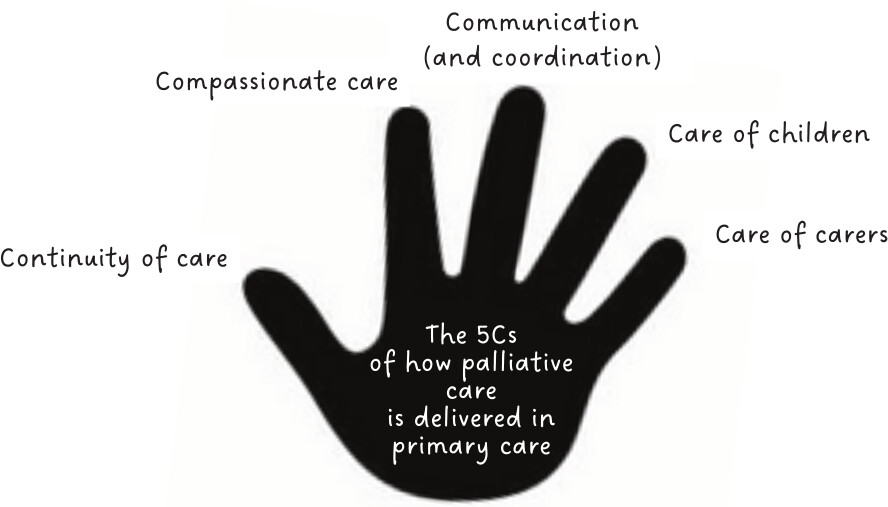
Primary care can also bring continuity of care and compassion, and communication and co-ordination skills to patients (adults and children) and their carers. See Figure 2.
Figure 2. The 5Cs of how palliative care is delivered in primary care.
We were disappointed that we did not receive any papers about the following topics which we had indicated as relevant: people with multimorbidity; people living in care homes; when to trigger palliative care in various illnesses to provide optimal benefit; cost-effectiveness outcomes of care provided in primary care; interventions to provide urgent care; or studies using a systems-based approach where palliative care is considered within a wider health and social and community context.

A research framework for primary palliative care

To promote universal access, we present a framework based on the ‘5 Alls’ listed above to overview the potential and scope of future primary palliative care research.
1.
All diseases: Clinicians in primary care need research to help them identify patients in routine consultations who might benefit from palliative care. Research to better treat people according to their capacity to benefit from palliative care rather than by their diagnosis or even prognosis is vital. Similarly, hospital specialists should test interventions to determine best practices for supportive and palliative care for their specific specialties such as heart failure or dementia. Research to improve care in care homes and for people with multimorbidity, frailty and dementia is especially warranted in primary care. Additionally, primary palliative leaders must develop evidence-based training programmes and evaluate them.
2.
All times: We need research to identify people earlier for a palliative care approach across all illness trajectories, possibly refining, validating and translating instruments such as various palliative care indicator tools. Routine outcome measures such as the number of months before death a person received a palliative care approach can be analysed by illness trajectory to assess this. Further prospective longitudinal intervention studies can then proceed around assessment, care planning and co-ordination.
Also, retrospective last-year-of life-studies using routinely collected big data and a systems approach across all care settings, including out-of-hours care are needed. They can identify interventions to reduce unnecessary emergency department attendances and hospital admissions for people in their last year of life.16,17
3.
All dimensions: We need multidisciplinary mixed-methods studies to dynamically assess people across social, psychological, spiritual and physical needs as the illness progresses Then we can test interventions to address the issues which patients find most troublesome. A longitudinal qualitative approach can assess the importance of continuity of care, co-ordination and perceived compassion of the providers (5Cs), while routine data about service usage and holistic assessment tools may be tested for feasibility and validity over time as outcome measures.
4.
All Settings: We need studies to take a public health systems approach to describe how patients follow continuous care pathways especially out-of-hours when routine services are closed. Interventions to improve the patient experience and provide low-cost high-value care in the community can then be tested. The evaluation of various palliative care service models, and their integration/coordination in primary care especially in care homes is imperative. More studies about the integration of technologies to expand palliative care access in remote or underserved areas are essential to address inequalities. Collaborative primary palliative care research networks are necessary to share knowledge and resources. We also need community development and volunteer innovations to help widen patients’ understanding and support. Lower income countries lead the way in this.18 These approaches can also leverage local resources, foster community engagement and empower individuals to support patients with palliative care needs in higher income countries.19
5.
All nations: We need cost-effectiveness research to help governments justify national integration into health services. National changes in policy and practice can be carefully evaluated as ‘natural experiments’ using large routine datasets if appropriate process and outcome indicators are recorded.20 Culturally sensitive approaches must be adopted since patients’ needs may depend on their income, availability of pain relief, religion and cultural beliefs. Models of primary palliative care should build on existing primary care systems. Testing models of palliative care to reduce high-cost low-impact treatments, hospital admissions and catastrophic costs for patients, may lead to significant cost savings for health systems and families.21

Towards redefining ‘primary palliative care’

‘Primary palliative care’ was initially defined in the UK as palliative care delivered by the primary care team. However, it is now interpreted in different ways in different countries. As many policymakers, clinicians, educators and planers find this confusing and studies hard to interpret, we have included a further editorial in this issue to redefine this term to allow this field to progress clearly.22 We believe that palliative care by primary care workers is vital, so that ‘Health for all’ includes ‘Palliative care for all’.

Declaration of conflicting interests

The author(s) declared no potential conflicts of interest with respect to the research, authorship, and/or publication of this article.

Funding

The author(s) received no financial support for the research, authorship, and/or publication of this article.

ORCID iDs

References

1. Peeler A, Afolabi O, Adcock M, et al. Primary palliative care in low- and middle-income countries: A systematic review and thematic synthesis of the evidence for models and outcomes. Palliat Med. 2024; 38: 762–765.
2. Pereira J, Herx L, Simoni J, et al. Mapping primary and generalist palliative care: taking a closer look at the base of the pyramid. Palliat Med. 2024; 38: 770–775.
3. Leng M, Namukwaya L, Downing J, et al. Evaluation of the integration of palliative care in a fragile setting amongst host and refugee communities: using consecutive Rapid Participatory Appraisals. Palliat Med 2024.
4. Mitchell S, Turner N, Fryer K, et al. Integration of primary care and palliative care services to improve equality and equity at the end-of-life: findings from realist stakeholder workshops. Palliat Med. 2024; 38: 830–841.
5. Seiça Cardoso C, Prazeres F, Oliveiros B, et al. Feasibility and effectiveness of a two-tiered intervention involving training and a new consultation model for patients with palliative care needs in primary care: a before-after study. Palliat Med. 2024; 38: 842–852.
6. Juhrmann ML, Butow PN, Simpson P, et al. Development of a palliative paramedicine framework to standardise best practice: A Delphi study. Palliat Med. 2024; 38: 853–873.
7. Cao Y, Mao S, Liu L, et al. Electronic symptom monitoring for home-based palliative care: a systematic review. Palliat Med. 2024; 38: 790–805.
8. Lion K, Jamieson A, Billin A, et al. “It was never about me”: a qualitative inquiry into the experiences of psychological support and perceived support needs of family caregivers of people with high-grade glioma. Palliat Med. 2024; 38: 874–883.
9. Davies R, Booker M, Ives J, et al. Hospital admissions at the end of life and in severe frailty: a systematic review and narrative synthesis of clinical decision making. Palliat Med. 2024;14: A28-A29.
10. van der Waal M, Teunissen S, Uyttewaal A, et al. Factors influencing deprescribing in primary care for those towards the end of life: a qualitative interview study with patients and healthcare practitioners. Palliat Med. 2024; 38: 884–892.
11. Murray SA, Kendall M, Boyd K, et al. Illness trajectories and palliative care. BMJ 2005; 330: 1007–1011.
12. Gold Standards Framework (GSF) and Prognostic Indicator Guide (PIG). https://www.goldstandardsframework.org.uk/ (accessed 28 May 2024).
13. SPICT - Supportive and Palliative Care Indicators Tool. https://www.spict.org.uk/ (2024, accessed 28th May 2024).
14. Murray SA, Boyd K, Moine S, et al. Using illness trajectories to inform person centred, advance care planning. BMJ 2024; 384: e067896.
15. European Association for Primary Palliative Care. Referenz Group on Primary Palliative Care, https://eapcnet.eu/eapc-groups/primary-care/ (2024, accessed 4 June 2024).
16. Mason B, Kerssens JJ, Stoddart A, et al. Unscheduled and out-of-hours care for people in their last year of life: a retrospective cohort analysis of national datasets. BMJ Open 2020; 10: e041888.
17. Mason B, Carduff E, Laidlaw S, et al. Integrating lived experiences of out-of-hours health services for people with palliative and end-of-life care needs with national datasets for people dying in Scotland in 2016: a mixed methods, multi-stage design. Palliat Med 2022; 36: 478–488.
18. Sallnow L, Smith R, Ahmedzai SH, et al. Report of the lancet commission on the value of death: bringing death back into life. Lancet 2022; 399: 837–884.
19. Abel J, Kellehear A, Mills J, et al. Access to palliative care reimagined. Future Healthc J 2021; 8: e699.
20. Finucane AM, Davydaitis D, Horseman Z, et al. Electronic care coordination systems for people with advanced progressive illness: a mixed-methods evaluation in Scottish primary care. Br J Gen Pract 2020; 70: e20–e28.
21. Pastrana T, Murray SA. The value and economic benefits of palliative care in primary care: an international perspective. Ann Palliat Med 2024; 13: 445–451.
22. Munday D, Pastrana T, Murray SA. Defining and developing primary palliative care as an essential element of primary health care. Palliat Med 2024.

Supplementary Material

Please find the following supplemental material available below.

For Open Access articles published under a Creative Commons License, all supplemental material carries the same license as the article it is associated with.

For non-Open Access articles published, all supplemental material carries a non-exclusive license, and permission requests for re-use of supplemental material or any part of supplemental material shall be sent directly to the copyright owner as specified in the copyright notice associated with the article.

Podcast