Skip to main content
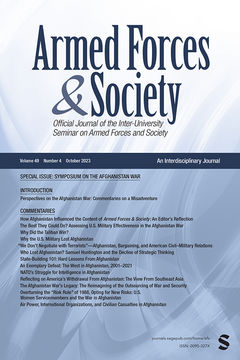





Volume 49 Issue 4, October 2023
Special Issue: Symposium on the Afghanistan War
Introduction
Abstract
This article introduces the Symposium on the Afghanistan War. During and after the American withdrawal from Afghanistan, emotions ran high. This special issue responds to public calls for further in-depth study of the Afghanistan War. We assembled an ...Restricted accessIntroductionFirst published March 10, 2023pp. 883–892
Commentaries
Abstract
This commentary examines the influence of the Afghanistan war on the content of Armed Forces & Society. My 20-year tenure as editor of Armed Forces & Society overlaps completely with the war. Using the lenses of the postmodern or post-Cold War military, I ...Free accessArticle commentaryFirst published May 16, 2022pp. 893–912
Abstract
This article explores shortcomings in military effectiveness in the war in Afghanistan. It focuses on three sets of problems: the failure to resolve internal contradictions in the training effort, the failure to integrate political considerations with ...Restricted accessArticle commentaryFirst published August 10, 2022pp. 913–922
Abstract
On October 7, 2001, 3 weeks after 9/11, U.S. forces attacked Afghanistan; bombers struck Taliban headquarters and Al Qaeda training sites. By early December, the Taliban and Al Qaeda have been defeated and had fled. However, a war that began so ...Restricted accessArticle commentaryFirst published June 20, 2022pp. 923–938
Abstract
Why did Afghanistan falter as a U.S. partner? America’s war in Afghanistan was lost for many reasons, but the U.S. military contributed to its downfall in two ways. First, U.S. combat units, trained to fight conventional battles, conducted ...Restricted accessArticle commentaryFirst published July 7, 2022pp. 939–952
Abstract
The United States government’s inability to view the conflict with the Taliban through the lens of the bargaining model of war was a fundamental element of its failure in Afghanistan. This problem was reinforced by a dysfunctional civil–military relations ...Restricted accessArticle commentaryFirst published April 13, 2022pp. 953–964
Abstract
Numerous reflections exist regarding who should be held accountable and what lessons should be learned from the military withdrawal and political collapse of Afghanistan. This essay argues that the failures in Afghanistan are second- and third-order ...Restricted accessArticle commentaryFirst published August 10, 2022pp. 965–981
Abstract
The American war in Afghanistan was originally an act of retaliation and retribution. Over time it assumed the moral burden of state-building. The state-building effort however was undermined by inadequate planning, inadequate knowledge, and inadequate ...Restricted accessArticle commentaryFirst published May 23, 2022pp. 982–988
Abstract
The Western defeat in Afghanistan was due to an inadequate process of strategic reflection informed, first, by an overestimation of the attractiveness of the Western political agenda to Afghans and, second, by overconfidence in the effectiveness of its ...Open AccessArticle commentaryFirst published July 7, 2022pp. 989–1000
Abstract
What role did North Atlantic Treaty Organization (NATO) and the coalition (International Security Assistance Force—ISAF) it led play in the failure of the West in Afghanistan? This essay argues that the ISAF intelligence community’s inability to come to ...Restricted accessArticle commentaryFirst published August 10, 2022pp. 1001–1012
Abstract
This essay reflects on the broad contours of the war in Afghanistan from Southeast Asia’s perspective. While the United States’ withdrawal from Kabul was calamitous, the pessimism about America’s role in Southeast Asia has been overstated. The United ...Restricted accessArticle commentaryFirst published July 7, 2022pp. 1013–1026
Abstract
The two decades of war in Afghanistan left a mark on the American armed forces and redefined the American ways of war-making. One of this war’s legacies is the reimagining of the role of private military and security contractors in contemporary warfare. ...Restricted accessArticle commentaryFirst published July 7, 2022pp. 1027–1034
Abstract
The evolution of the status of American women as warriors between Operation Desert Shield/Desert Storm in 1990-1991 and the War in Afghanistan, beginning in 2001 [and simultaneously the Iraq War in 2003] is explored. This era of American civil-military ...Restricted accessArticle commentaryFirst published July 10, 2022pp. 1035–1047
Abstract
Can the presence of international organizations reduce civilian deaths caused by aerial bombing? This commentary examines this question in the specific context of the U.S.-led war in Afghanistan. We evaluate this based on interviews conducted with members ...Restricted accessArticle commentaryFirst published July 13, 2022pp. 1048–1060
Book Reviews
Restricted accessBook reviewFirst published December 12, 2022pp. 1061–1064
Restricted accessBook reviewFirst published January 11, 2023pp. 1065–1068
Export citation
 Facebook
 X
X LinkedIn
 YouTube
 RSS feed
 Email alerts
Also from Sage
- CQ Library Elevating debateopens in new tab
- Sage Data Uncovering insightopens in new tab
- Sage Business Cases Shaping futuresopens in new tab
- Sage Campus Unleashing potentialopens in new tab
- Sage Knowledge Multimedia learning resourcesopens in new tab
- Sage Research Methods Supercharging researchopens in new tab
- Sage Video Streaming knowledgeopens in new tab
- Technology from Sage Library digital servicesopens in new tab