Skip to main content
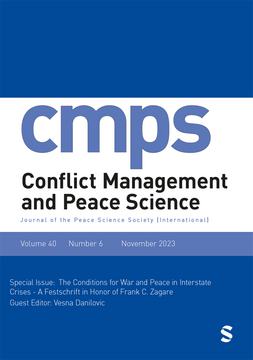





Volume 40 Issue 6, November 2023
Special Issue: The Conditions for War and Peace in Interstate Crises - A Festschrift in Honor of Frank C. Zagare
- Guest Editor: Vesna Danilovic
Special Issue Articles
Restricted accessResearch articleFirst published February 2, 2023pp. 580–583
Abstract
The empirical results on the influence of inexperience and experience in decision making are inconclusive. This paper offers a resolution to the puzzle of how empirical studies that advance contradictory risk-related claims can all command empirical ...Restricted accessResearch articleFirst published January 26, 2023pp. 584–598
Abstract
I propose an audience costs game with considerations added from selectorate theory. We see that winning coalition and selectorate size have competing effects on conflict choices in an audience costs setting. Large coalition regimes face lower audience ...Restricted accessResearch articleFirst published February 23, 2023pp. 599–618
Abstract
Why don't democracies fight each other? Since discovering this empirical regularity, scholars have assumed that the answer must lie with regime type (i.e. democracy). Our paper provides and tests an alternative explanation: the territorial explanation of ...Restricted accessResearch articleFirst published February 14, 2023pp. 619–633
Abstract
We examine whether bargaining behavior alters the initially expected effects of exogenous factors, such as power balance, issues, and domestic regimes, influencing crisis outcomes. Our argument is that, instead of weakening threat credibility as assumed ...Restricted accessResearch articleFirst published February 7, 2023pp. 634–654
Abstract
This paper identifies profound contradictions within and across nuclear deterrence strategies that evolved in response to the proliferation and modernization of nuclear weapons. To reconcile theory with practice, we summarize the theoretical assumptions ...Restricted accessResearch articleFirst published February 10, 2023pp. 655–674
Abstract
Many theories of international conflict are based on the premise that war can occur by accident. The basic idea of accidental war is that crisis situations can spiral out of control, leading to the outbreak of a war despite no one having decided to go to ...Restricted accessResearch articleFirst published February 2, 2023pp. 675–691
Export citation
 Facebook
 X
X LinkedIn
 YouTube
 RSS feed
 Email alerts
Also from Sage
- CQ Library Elevating debateopens in new tab
- Sage Data Uncovering insightopens in new tab
- Sage Business Cases Shaping futuresopens in new tab
- Sage Campus Unleashing potentialopens in new tab
- Sage Knowledge Multimedia learning resourcesopens in new tab
- Sage Research Methods Supercharging researchopens in new tab
- Sage Video Streaming knowledgeopens in new tab
- Technology from Sage Library digital servicesopens in new tab