Skip to main content
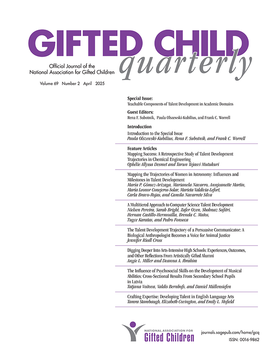





Volume 69 Issue 2, April 2025
Special Issue: Teachable Components of Talent Development in Academic Domains
- Guest Editor: Rena F. Subotnik
- Guest Editor: Paula Olszewski-Kubilius
- Guest Editor: Frank C. Worrell
Introduction
Restricted accessIntroductionFirst published January 23, 2025pp. 87–90
Feature Articles
Abstract
This study explores talent-development trajectories of early-career chemical engineers to identify key components for success in the field using the talent development megamodel as a theoretical framework. Interviews with 12 recent PhD graduates reveal a ...Restricted accessResearch articleFirst published January 13, 2025pp. 91–108

Abstract
Astronomy is critical for human development, driving technology and innovation, and creating knowledge that allows humanity to understand the universe more fully. Women, however, remain underrepresented in this field. Many women leave the field before ...Restricted accessResearch articleFirst published January 16, 2025pp. 109–129
Abstract
Technology is an increasingly omnipresent and rapidly changing component of today’s world. As a result, there is an urgency to develop talent in the field of computer science (CS). The purpose of this article is to examine ways that educational systems ...Restricted accessResearch articleFirst published January 16, 2025pp. 130–146
Abstract
Through the lens of the talent development megamodel and the higher mastery framework, this instrumental case study examines the career trajectory of a biological anthropologist, Barbara J. King, who became a persuasive science communicator in the ...Restricted accessResearch articleFirst published January 16, 2025pp. 147–164
Abstract
Arts-intensive high schools offer a unique learning environment for artistically gifted students, but relatively little is known about the long-term impacts of attending these schools. Using data from the Strategic National Arts Alumni Project (SNAAP), ...Restricted accessResearch articleFirst published January 28, 2025pp. 165–183
Abstract
Psychosocial skills are variables related to human behavior, beliefs, and attitudes and shape social interactions, learning processes, academic achievements, and general goal-directed behavior. Psychosocial skills seem particularly important during the ...Open AccessResearch articleFirst published January 8, 2025pp. 184–201
Abstract
The focus of this article is on the development of expertise in interpreting literature within English Language Arts (ELA). Experts and novices differ significantly in how they approach problems and acquire information, with experts demonstrating more ...Restricted accessResearch articleFirst published January 16, 2025pp. 202–215
Export citation
 Facebook
 X
X LinkedIn
 YouTube
 RSS feed
 Email alerts
Also from Sage
- CQ Library Elevating debateopens in new tab
- Sage Data Uncovering insightopens in new tab
- Sage Business Cases Shaping futuresopens in new tab
- Sage Campus Unleashing potentialopens in new tab
- Sage Knowledge Multimedia learning resourcesopens in new tab
- Sage Research Methods Supercharging researchopens in new tab
- Sage Video Streaming knowledgeopens in new tab
- Technology from Sage Library digital servicesopens in new tab