Marketplace globalization has created new competition for global and local products, which has attracted substantial interest among international business researchers (
Chabowski, Samiee, and Hult 2013;
Liu et al. 2020). Early investigations of this phenomenon revealed a favorable position for global products that, beyond supply-side advantages, enjoyed strong consumer preference and ability to charge higher prices through their association with quality, prestige, and the allure of a global consumer culture (
Batra et al. 2000;
Holt, Quelch, and Taylor 2004;
Steenkamp, Batra, and Alden 2003). However, an increasing number of studies have since reported a resurgence in the preference for local products (
Ӧzsomer 2012;
Steenkamp and De Jong 2010;
Xie, Batra, and Peng 2015). Recently, the decrease in global trade figures, the rejection of global integration initiatives (e.g., Trans-Pacific Partnership Agreement), rising antiglobal sentiment, shifts in the global sociopolitical landscape (e.g., Brexit, Eurozone crisis, U.S.–China trade war), appearance of reshoring activities, and the COVID-19 pandemic—all regarded as signs of globalization's fragility—question the inevitability of globalization, advance debates around the phenomenon of “deglobalization,” and initiate discussions about the future of competition between global and local products (
Cleveland and McCutcheon 2022;
Delios, Perchthold, and Capri 2021;
Witt 2019).
These ongoing discussions are far from reaching consensus. On the one hand, some globalization scholars argue that stalling globalization is not an existential threat to global brands, predictions about the end of globalization are premature, and global products will continue to dominate international markets and legitimize their price premiums through strategic adaptations (
Samiee 2019;
Steenkamp 2019a,
b). On the other hand, evidence from emerging markets—a key battleground for global brands—suggests that localization tendencies and the emergence of strong local players reduce the perceptual and high-end price advantages global products once enjoyed (
Santos and Williamson 2015;
Sichtmann, Davvetas, and Diamantopoulos 2019). Recent research suggests that brand globalness continues to build brand credibility in globalizing developed markets, while localness represents a stronger credibility signal for consumers in already globalized developed markets (
Mandler, Bartsch, and Han 2020). In addition, there is palpable growth in the number of consumers who are indifferent to a product's global or local character and who appear uninterested in both globally and locally induced consumption (
Steenkamp and De Jong 2010) and are thus less willing to tolerate the price premiums that global brands used to command. In summary, looking at the extant literature, one cannot reach definitive conclusions regarding whether, to what extent, for whom, at what cost, and under which conditions a product's globalness/localness still matters for consumers.
Against this background, this article investigates the following research questions: (1) Is a global/local product attribute still relevant for consumers, or has it been trivialized to the benefit of other attributes? (2) If it remains relevant, what price trade-offs are consumers willing to make to acquire global or local products? (3) How do the corresponding price premiums that global and local products charge vary across countries, consumers, and market segments?
To answer these questions, the role a product's global or local nature plays must be approached in a more complex way than previously assumed. Prior research has mostly conceptualized a product's globalness and localness as cues that operate through a halo effect (
Dimofte, Johansson, and Ronkainen 2008); that is, by favorably biasing other product attributes such as quality or prestige (
Özsomer 2012;
Steenkamp, Batra, and Alden 2003). According to this perspective, consumers carry positive and negative beliefs about globalness and localness that determine whether their product choices will lean toward the global or the local side (
Dimofte, Johansson, and Ronkainen 2008). Despite its conceptual appeal, this approach makes two questionable assumptions. The first is that all consumers ascribe equal weight (i.e., importance) to the globalness/localness of a product when making purchase decisions; this is a contentious assumption in light of evidence suggesting that many consumers simply do not care about the globalness or localness of the products they purchase, or they perceive global and local products as equally attractive and directly substitutable alternatives (
Steenkamp and De Jong 2010). The second is that preferences for either global or local products are uniform across market segments and price points, implying that such preferences will always translate into actual purchases for both low-priced and premium-priced product segments. These assumptions have hindered the study of a product's globalness/localness in conjunction with—and, more importantly, in direct juxtaposition to—other product attributes, and especially to price. Consequently, knowledge about the attributes that consumers are willing to trade off when they purchase global or local products remains limited. This is despite the fact that, in actual purchase decision making, consumers assess multiple attributes, engage in complex multiattribute trade-offs, and sacrifice some attributes to acquire others (
Bettman, Capon, and Lutz 1975).
To address these issues, we (1) employ the neglected conceptualization of globalness/localness as a distinct product attribute (
Dimofte, Johansson, and Ronkainen 2008), (2) use a conjoint approach to decompose the attribute's utility into a weight/importance component (i.e., how much does the global/local attribute matter to the consumer relative to other product attributes?) and a preference component (i.e., does a consumer prefer a product more when it is designated as local or global?), and (3) draw from equity theory (
Adams 1965) to develop theoretical predictions regarding how consumers react to perceived inequity between global and local products in their country markets through cognitive and behavioral inequity adjustments. To this end, we conduct two conjoint studies: one in a mature market (Austria) and one in an emerging market (India) using a total sample of 668 consumers. The results of a random-parameters ordered probit model demonstrate (1) evidence of trivialization of the global/local attribute in developed but not in emerging markets, (2) preference for local products in developed markets that is nonetheless weaker than the preference for global products in emerging markets, and (3) significant moderation of consumers’ inequity regulation strategies by country market (emerging vs. developed), consumer identity (global vs. local), and price segment (upper vs. lower).
Our findings contribute to the ongoing theoretical debate on the relevance/trivialization of product globalness/localness in an era of deglobalization by employing a neglected theoretical lens to explain how consumers across markets adjust their attribute weights and willingness to pay (WTP) to restore equity between global and local products. Furthermore, our findings assist global brand managers in quantifying consumers’ reliance on a product's global/local nature in contrast to other attributes by calculating the WTP estimates for global/local products across categories and countries. Our findings also offer insights regarding whether, when, and how to incorporate the global/local attribute in decisions regarding international segmentation, targeting, positioning pricing, and competitive strategy.
Conceptual Development and Research Hypotheses
Global and Local Products
Global products refer to products that are tailored for international markets and are branded for and distributed across multiple countries around the world. Local products refer to products that are marketed specifically toward the consumers’ home market (
Strizhakova, Coulter, and Price 2008). Following
Steenkamp and De Jong (2010), we use the term “product” to describe every entity subject to consumption, including tangible products, services, and brands. Although branded products represent only a subset of what the generic terms global and local products capture, our definitions parallel those that branding literature has proposed for global/local brands. Global products include brands “that have global awareness, availability, acceptance and desirability, and are often found under the same name with consistent positioning, image, personality, look, and feel in major markets enabled by standardized and centrally coordinated marketing strategies and programs” (
Özsomer et al. 2012, p. 2). Similarly, local products account for brands “only available in a specific geographical region” (
Dimofte, Johansson, and Ronkainen 2008, p. 118) or as products “associated with the local culture and symbolic of the local country” (
Xie, Batra, and Peng 2015, p. 53). There are examples of hybrid “glocal” brands that combine global and local elements in terms of both their supply-side strategies (e.g., local sourcing or manufacturing) and their intended demand-side positioning (e.g., country-specific product editions) (
Schmidt-Devlin, Özsomer, and Newmeyer 2022). However, consumers (1) generally “recognize [a global brand] when they see it” (
Steenkamp 2019a, p. 553), (2) classify individual products under the global or the local category (
Davvetas and Halkias 2019), and (3) respond to them on the basis of their categorization to the respective product collective (
Kolbl et al. 2020). Given that our research centers on globalness/localness as a general attribute factored into consumer decision making rather than as a perception tied to a particular brand (i.e., perceived brand globalness;
Steenkamp, Batra, and Alden 2003), we focus on global or local products as generic product classes. We intentionally distance our definitions from the country-of-origin tradition because of its inability to account for products whose origins cannot be accurately recognized by consumers due to the proliferation of outsourced operations, multicountry sourcing/manufacturing, and blurred or intentionally concealed origins (
Samiee 2011).
Product Globalness/Localness: Halo or Attribute?
Dimofte, Johansson, and Ronkainen (2008) propose two alternative theoretical approaches regarding how consumers respond to global/local products. Drawing on psychological theories of impression formation (
Nisbett and Wilson 1977), the first approach suggests that a product's global designation operates as a halo that leads to positive biasing of product attributes. Most relevant research has embraced this approach and revealed the effects of a product's globalness by investigating its associations with attributes such as quality and prestige (
Davvetas, Diamantopoulos, and Liu 2020;
Özsomer 2012;
Steenkamp, Batra, and Alden 2003), value perceptions (
Swoboda, Pennemann, and Taube 2012), and identity expression (
Strizhakova and Coulter 2015;
Xie, Batra, and Peng 2015). The second approach draws from multiattribute attitude models (
Bettman, Capon, and Lutz 1975) and conceptualizes globalness/localness as a distinct product attribute to which consumers assign discrete weight. Under this approach, consumers exhibit preferences for specific products because of the globalness/localness of these products; that is, beyond associations of increased quality or prestige (
Steenkamp 2014). Preference for globalness reflects a willingness to participate in the myth associated with global consumption, whereas preference for localness reflects support for a local cause, expression of one's antiglobalization attitude, or belonging to a particular identity group (
Holt, Quelch and Taylor 2004;
Steenkamp and De Jong 2010).
These alternative conceptualizations represent complementary theoretical accounts of how consumers process information about a product's globalness or localness. While the halo conceptualization answers why consumers prefer global/local products, the distinct attribute conceptualization aims to discover the extent of this preference and the trade-offs consumers are willing to make to acquire their preferred product options. Although much is known about why consumers prefer global/local products, little is known about whether these reasons still matter when other attributes (e.g., price) force consumers to contrast globalness/localness against other desirable attribute levels (e.g., low cost).
Globalness/Localness as a Product Attribute: Decomposing Weight and Preference
The term “attribute” refers to any feature consumers find relevant when forming attitudes about products; for instance, in the category of soft drinks, typical attributes include “sweetness,” “calories,” “carbonation,” and “price” (
Srinivasan 1979). Product attributes typically have several levels; that is, different values that create differentiation among the options offered in the marketplace. Demand for different attribute levels is heterogenous (e.g., some consumers prefer sweeter soft drinks); thus, brand managers must differentiate their products based on the attribute level that matters most, so that their consumers will maximize product demand. Research on multiattribute attitude models (
Bettman, Capon, and Lutz 1975) suggests that when consumers make purchase decisions, they assess the desirability of the attribute levels of the offered alternatives and engage in attribute trade-offs. For instance, consumers may forgo a product with a desirable level in one attribute (e.g., low price) to buy a product with a more desirable level in another (e.g., high horsepower).
If conceptualized as a distinct product attribute with discrete levels (global/local), a product's globalness/localness carries utility that can be decomposed into two components: weight/importance and preference. The latter describes how desirable the consumer perceives each attribute level to be (i.e., whether the consumer prefers global or local products) while the former refers to how high the consumer evaluates the level of a specific attribute. The greater the difference in preference between attribute levels, the higher the weight the consumer puts on an attribute and, thus, the higher the trade-off to acquire a product with the preferred attribute level.
Theorizing about these two components based on extant literature leads to inconclusive predictions. Regarding attribute preference, both global and local products are associated with positive and negative consumer beliefs. Globally branded products are associated with higher perceptions of quality, status, and prestige (
Özsomer 2012;
Steenkamp, Batra, and Alden 2003); increased brand credibility and decreased purchase risk (
Davvetas and Diamantopoulos 2018;
Mandler, Bartsch, and Han 2020); higher functional and psychological values (
Swoboda, Pennemann, and Taube 2012); and enhanced ability to express consumers’ identity (
Xie, Batra, and Peng 2015). However, they are also viewed as hated symbols of globalization and are accused of promoting cultural uniformity, harming local economies, and lacking authenticity (
Heinberg, Ozkaya, and Taube 2016;
Steenkamp and De Jong 2010). In contrast, local products are usually perceived as tailored to local tastes and needs (
Ӧzsomer 2012), cultural representatives of local communities, nostalgic tokens of past consumption experiences (
Heinberg, Ozkaya, and Taube 2016), and protectors of local economies from globalization pressures (
Steenkamp and De Jong 2010). However, they are also regarded as low-quality products that lack modernity and aspiration (
Dimofte, Johansson, and Ronkainen 2008) and lag behind in technological edge, innovation, and symbolism (
Balabanis and Diamantopoulos 2016).
No universal predictions can be made for attribute weight, either. Attribute weight depends on the purchase context, the product category, and the consumer (
Batra, Homer, and Kahle 2001). For example, when consumers make purchase decisions in visible contexts, they weigh more heavily the attributes that allow for identity construction and signaling (
Bearden and Etzel 1982). Regarding the product category, consumers rely more on functional product attributes when they evaluate products from utilitarian categories and more on sensory attributes when they evaluate products from hedonic categories (
Batra and Ahtola 1991), explaining why consumers pay differential attention to product globalness in hedonic versus functional categories (
Davvetas and Diamantopoulos 2016). Similar conditioning of attribute weight happens across consumer traits such as consumer expertise, which increases reliance on intrinsic versus extrinsic product cues such as globalness (
Rao and Monroe 1988). Finally, research has revealed the existence of alienated consumer segments who exhibit simultaneous negative attitudes toward both global and local products (
Steenkamp and De Jong 2010). Considering such contingencies, one cannot predict a fixed weight that all consumers assign to a product's globalness/localness.
Equity Theory: Explaining Variability in Global/Local Attribute Weight and Preference
Equity theory explains how individuals form equity judgments and respond to perceived inequity in social exchange situations (
Adams 1965). According to the theory, when engaged in some sort of exchange (e.g., product purchase), individuals (e.g., A and B) assess the fairness of the exchange by comparing the output-input ratios (
) of the parties involved in the transaction (where O
A, O
B represent the outputs for the two parties and I
A, I
B represent their corresponding inputs). Individuals perceive inequity in the exchange when either of the two parties enjoys a bigger output-input ratio (
or
). Otherwise, the deal is perceived to be equitable (
). According to the principle of distributive justice (
Homans 1961), inequity is an undesirable state, so individuals are motivated to adjust their behavior in ways that restore the balance between the two parties to an equity equilibrium. This can be achieved by altering one's inputs to the exchange, altering one's outputs, changing the level of comparison, or leaving the exchange without committing to a deal (
Huppertz, Arenson, and Evans 1978).
Although original applications of equity theory involved comparisons between two parties, the same principles apply when individuals compare two or more referents with which they are in a potential exchange relationship. Applying this principle, we argue that consumers evaluate global and local products as alternative referent groups with different ability to offer outputs in response to consumer inputs. The outputs (i.e., utility) can be expressed as a difference between the benefits received from purchasing a global or local product (e.g., perceived quality) and the downsides associated with the product's ownership (e.g., unfavorable identity), while the inputs represent the financial resources the consumer must sacrifice to acquire these products (i.e., price). Essentially, when comparing global and local products, consumers engage in mental calculations and comparisons of the following ratios:
If consumers assess the two ratios as being equal, they are expected to be indifferent between global and local products and subsequently minimize the importance (i.e., weight) of the global/local attribute in their choice, thus turning to other attributes. However, if the ratios are unequal, consumers aim to restore the inequity. Equity theory identifies two ways through which people restore inequity: (1) by altering one side's perceived outputs (referred to as cognitive inequity regulation) or (2) by altering the level of inputs a consumer is willing to make to acquire the corresponding output (referred to as behavioral inequity regulation). In the first case, given the psychological nature of many benefits and costs associated with the purchase of global/local products, alterations are subject to perceptual mechanisms and achieved through cognitive distortions (
Huppertz, Arenson, and Evans 1978). In the second case, consumers restore inequity by adjusting their WTP for global/local products and by developing price tolerance zones within which the two ratios are rendered equal. In summary, equity theory predicts that consumers should adjust the weight they place on the global/local attribute or the WTP for global/local products, or they can do both as a means to restore perceived inequity between global and local product offerings.
Market Development as a Determinant of Global Versus Local Product Inequity
Prior research has established that consumers in emerging markets respond differently to global and local products than consumers in developed markets (
Guo 2013;
Sharma 2011). This differentiation is grounded on three arguments. The first argument suggests that as a country's economic development rises, domestic firms develop products that match the quality of global brands (
Guo 2013;
Moon et al. 2016). As a national economy develops, local firms internationalize by developing products that compete effectively in the global marketplace through matching the offerings of their global counterparts. This leads developed-market consumers to eschew global products and turn to local products that—apart from similar performance—are also better tailored to local tastes (
Özsomer 2012). In contrast, emerging-market consumers opt for global products to fill the void of local-market alternatives and access quality offerings that domestic firms cannot offer (
Batra et al. 2000). Xenocentric tendencies in certain emerging markets further exacerbate the situation for local products, which are then unable to break through the inferiority beliefs of local consumers (
Balabanis and Diamantopoulos 2016).
The second argument revolves around consumer attitudes toward globalization. Consumers are displaying increasingly negative attitudes toward globalization (
Hu and Spence 2017;
Organization for Economic Co-operation and Development [OECD] 2017). National identities have reemerged as the primary triggers of consumers’ purchase decisions. As globally branded products represent symbols of a flat world, they often constitute targets of nationalistic consumer tendencies. Such tendencies are not uniformly distributed across emerging and developed countries, because of the imbalance of the globalization-driven benefits and costs that emerging and developed markets experience (
Stiglitz 2003). Global attitude surveys find that while 55% of consumers in developed countries view globalization as a force for good, this figure is around 75% for emerging countries (
YouGov 2016). Developed markets have traditionally been more engaged in the global, economic, and cultural arenas and thus are beyond the positive influences of globalization. Developed markets have also been exposed to the downsides of cultural and consumption homogenization through the proliferation of global products (
Steenkamp and De Jong 2010). Recent political developments (e.g., Brexit, European Union anti-immigration forces) reflect a rise in Western populism that is strongly linked with antiglobal attitudes. Populist publics see globalization in general—and by extension global products—as a more negative influence on national economies than do nonpopulist cohorts (
YouGov 2019). In contrast, emerging markets such as China and India have started to reap the benefits of globalization as a result of opening their economies and dominating important industries (e.g., China's efforts to overtake the mobile technology industry).
Finally, due to the scarcity of specific well-known global products in emerging markets in the past and/or the increased cost of acquiring them, emerging-market consumers still associate global products with increased status in collective memory and exhibit preference for them for identity-signaling reasons (
Laforet and Chen 2012;
Wong and Ahuvia 1998). The opposite trend is observed in developed markets. Global products no longer have the allure they once did. Phenomena like “buy local” campaigns, global brand boycotts, anticorporatist attitudes, and emphasis on sustainable development that favors local supply chains (
Thompson and Arsel 2004) have also limited the potential of global products to assume the role of consumers’ identity tokens. Corroborating studies show that consumers push many developed-market firms to return operations to their home countries (
Grappi, Romani, and Bagozzi 2015,
2018).
Thus, in terms of equity ratios, the benefit–cost output (i.e., the numerator of the equity ratios) should favor global (local) products in emerging (developed) markets.
H1: Emerging-market consumers exhibit preference for the global attribute level, whereas developed-market consumers exhibit preference for the local attribute level.
Cognitive Inequity Regulation: Global/Local Attribute Weight Inflation
Whether emerging- or developed-market consumers prefer global or local products, however, says little about the second component of global/local attribute utility: the attribute weight. Approached as the difference between the strength of preference between the two attribute levels, the global/local attribute weight captures how much the global or local designation of a product matters to a consumer and thus how easily it can be substituted by favorable levels of other attributes (e.g., low price). In this sense, a consumer with a high global or local attribute weight exhibits significant preference for one attribute level (be it global or local). Meanwhile, a consumer with a low attribute weight exhibits a small difference in preference; in extreme cases, a consumer may be indifferent to both attributes. We expect that developed-market consumers exhibit both lower global and local attribute weights than emerging-market consumers; that is, the former care less about products being global or local.
Preference for global or local products is predominantly formed through two functions: the quality-signaling function and the identity-signaling function (
Strizhakova, Coulter, and Price 2011;
Zhou, Yang, and Hui 2010). The stronger these functions are, the more important the global/local distinction is in consumer decisions. However, substantial differences exist in the strength of these two functions in emerging and developed markets. According to signaling theory, product attributes provide economic information signals to consumers and help them form product quality judgments (
Erdem and Swait 1998). Product globalness acts as one of those signals, but not with the same intensity across markets. In markets undergoing deep, globalization-induced changes (e.g., emerging markets), brand globalness has been found to operate as a stronger brand credibility signal than in already heavily globalized countries (
Mandler, Bartsch, and Han 2020). In addition, a country's economic development minimizes the importance of the global/local quality function both for consumers oriented to local consumption and for those exhibiting strong global connectedness (
Strizhakova and Coulter 2015).
We expect a similar pattern regarding the identity-signaling function. Postmaterialism theory (
Inglehart 1971) suggests that consumers in Western postindustrial societies that became affluent after World War II have progressively displayed a significant value shift away from material values (e.g., security, food, shelter) and material goals (e.g., status consumption) toward nonmaterial values (e.g., environmentalism, protection of human rights) and needs (e.g., self-actualization). In contrast, emerging-market societies that have not experienced the affluence of the postmaterialist West tend to be more appreciative of material values and more motivated by material goals (
Belk 1999;
Sharma 2011). In emerging markets, material possessions are more likely to be treated as “identity currency” and effective communicators of consumers’ identities (
Strizhakova, Coulter, and Price 2011). The presence of stronger materialistic goals in emerging markets inflates the importance that consumers place on product attributes, allowing for the projection of a materialistic identity to their peers.
Both quality and identity functions are stronger in emerging than developed markets; thus, emerging-market consumers perceive higher differences in utility between global and local products. In equity theory terms, this implies that the global/local output comparisons are more unjust in emerging than developed markets, triggering the need for inequity regulation. One mechanism through which consumers restore inequity is by adjusting their attribute weights to inflate the importance of the attribute for which the output comparison is unjust (i.e., cognitive inequity regulation). We hypothesize:
H2: Consumers from emerging markets place more importance on the global/local product attribute than consumers from developed markets.
Consumer Identity as a Moderator of Cognitive Inequity Regulation
Equity theory suggests that strategies to regulate inequity must be identity-consistent; that is, when consumers adjust their behavior to reinstate equity, they are more resistant to cognitive alternations (e.g., attribute weight adjustments) that threaten their identity (
Adams 1965). In the context of global/local product comparisons, a consumer's global or local identity should thus be highly relevant in the process of cognitive equity adjustments.
A global identity refers to a consumer's identification with people around the world, while a local identity refers to a consumer's identification with their local community (
Zhang and Khare 2009). Consumers with strong global identities typically exhibit feelings of belongingness to the global community, perceive more similarities than differences in people around the world, follow a more international lifestyle, and prefer global products. In contrast, consumers with a pronounced local identity are strongly attached to their local community, respect local traditions and customs, follow a local way of life, and appreciate local products (
Diamantopoulos et al. 2019;
Zhang and Khare 2009).
As previously discussed in the context of H1, consumers in emerging markets prefer global (as compared with local) products, whereas consumers in developed markets prefer local (compared with global) products, ceteris paribus. Thus, in an emerging market, a consumer with a pronounced global identity exhibits a product preference that aligns with the general preference of their social (national) group, while a consumer with a pronounced local identity will deviate from it. Similarly, in a developed market where local product preference is normatively desirable, locally identified consumers exhibit norm-consistent product preferences, while globally identified consumers exhibit norm-deviating purchase behavior.
Conflicts between social identity and self-identity trigger categorization threats (e.g., fears of not legitimately belonging to the social group) or prototypical threats (e.g., fears of marginalization due to divergence from group norms) (
Branscombe et al. 1999). Identity threats represent negative states that individuals try to minimize, so cognitive inequity regulation must also be self-protecting from an identity perspective. Thus, consumers should regulate global/local product inequity by increasing the importance of the global/local attribute only when doing so does not threaten self-identity (e.g., when social and individual identities are congruent). Conversely, consumers are likely to avoid inflating the global/local attribute when their attribute-level preference conflicts with the preference dictated by their social identity. Thus,
H3a: In emerging markets, consumers with a strong (vs. weak) global identity place more weight on the global/local attribute.
H3b: In developed markets, consumers with a strong (vs. weak) local identity place more weight on the global/local attribute.
Behavioral Inequity Regulation: Price Premium Tolerance Adjustment
Another way to restore global/local product inequity is by adjusting the behavior of the input of the equity ratios (e.g., reservation prices for global/local products). These adjustments are reflected in the trade-offs that consumers make between the global/local attribute and price, ultimately determining consumers’ WTP for global/local products.
1Unlike adjustments for cognitive inequity, which focus on the importance of the attribute, regulations for behavioral inequity—through acceptable price premium adjustments—consist of two elements: the direction of the premium and the size of the premium. Direction relates to whether consumers are willing to pay more for global or local products. Size relates to how large the premium can be, regardless of whether the consumer would pay more for global or local products. The direction of the premium is a function of the relative preference for global or local products. As H
1 predicts, consumers in emerging markets should be willing to pay a premium for global products, whereas consumers in developed markets should be willing to pay a premium for local ones. However, for an attribute level, the size of the premium is not a function of nominal preference but of the discrepancy between the perceived output of global and local products. According to equity theory, severe output inequity should trigger larger behavioral regulation; that is, the higher the perceived difference in benefits and costs between global and local products, the higher the price adjustment needed to make the two equity ratios similar. As output differences are more pronounced in emerging markets, the respective premiums that consumers accept for global products should be larger than the corresponding premiums of developed-market consumers.
2 Thus,
H4: The price premiums that emerging-market consumers are willing to pay for global products are larger than the price premiums developed-market consumers are willing to pay for local products.
Price Segment as a Moderator of Behavioral Inequity Regulation
Regulations to balance out inequities are subject to constraints. Unlike cognitive adjustments of attribute weights, which are less affected by objective restrictions, behavioral adjustments related to price acceptability are constrained by consumers’ disposable income. Competition within product categories is usually structured around consumers’ price elasticities, leading to low, medium, or high prices (
Gupta and Chintagunta 1994). Cost leaders typically dominate lower-market segments and often position their offerings around lower prices, while differentiators dominate upper-market segments and position themselves around superior quality matched with premium pricing. Although higher-price premiums are generally observed in upper-market segments, products positioned in lower-market segments can also differ in terms of the prices they charge within their (micro)segment.
Emerging-market consumers generally face greater resource constraints than consumers in developed markets. This translates to a comparatively limited ability to afford the price premiums commanded by either global or local players in upper-market segments. As a result, such consumers will more likely turn to lower-market segments and try to access desirable global products that are still affordable. These products, often referred to as “value brands” (e.g., affordable fast-fashion retailers, low-cost flanker brands, global discount retailers), are global products whose competitive advantage relies on attractive price–quality combinations achieved through economies of scale by international production and global value chain synergies (
Steenkamp 2014). Such products represent attractive options for emerging-market consumers because they combine affordability with the ability to signal participation in the global consumer culture (
Strizhakova, Coulter, and Price 2008) and are thus better poised to command price premiums. In contrast, consumers in developed markets have, on average, higher purchasing power and, thus, products in the high-price segments (e.g., products with expensively sourced local ingredients) fall within their price tolerance. Given developed-market consumers’ increased preference for local offerings, local products positioned as premium in these upper-market segments can charge higher prices. Consumers can use their WTP as a means to restore inequity ratios. Consumer differences in ability to pay are more observable in the lower-price markets in emerging countries and in the higher-price markets in developed countries. Thus,
H5a: Emerging-market consumers are more willing to pay price premiums to acquire global brands in low-price (compared with high-price) market segments.
H5b: Developed-market consumers are more willing to pay price premiums to acquire local brands in high-price (compared with low-price) market segments.
Methodology
To test our hypotheses, we used full-profile conjoint analysis, which is close to a real purchase situation in which a buyer has to decide between levels of product attributes (
Green and Srinivasan 1978). More specifically, respondents had to rank several product profiles representing multiple combinations of product attributes.
Selection of Research Settings
Emerging markets are economies that typically experience rapid economic development and growth in their annual gross domestic product while their economic institutions concurrently undergo adaptation to free-market ideologies. In contrast, developed markets are typically highly industrialized economies with high per capita incomes, built-out infrastructures, and large service sectors (
Arnold and Quelch 1998;
Hoskisson et al. 2000). Following previous studies that draw conclusions about emerging and developed markets based on samples from two prototypical countries (e.g.,
Chacar and Vissa 2005;
Heinberg et al. 2020), we collected data from a developed economy (Austria) and an emerging economy (India) that fall on opposite extremes in terms of the development of the countries’ institutional environment.
India and Austria are significantly heterogeneous in terms of institutional-type characteristics, such as political institutions, legal institutions, and product- and factor-market institutions. At the same time, the two countries are homogeneous when respectively compared with established emerging (e.g., Brazil, South Africa, Philippines) and developed (e.g., United States, United Kingdom, Japan) economies, as evidenced by relevant group means. Our choice of countries can be reasonably used as representative of emerging and developed economies: they capture the levels of market development, while their institutional characteristics do not deviate from realized group norms. Further details on country selection are provided in the Web Appendix (
Figure W1).
India has been widely used as a prototypical emerging-market country in prior research conducted in the areas of international marketing (e.g.,
Guo 2013), strategic management (e.g.,
Chacar and Vissa 2005;
Khanna and Rivkin 2001), international business (e.g.,
Elango and Pattnaik 2007;
Sharma 2011), and finance (e.g.,
Khanna and Palepu 2000), among others. Similarly, Austria has been used in prior empirical research as a prototypical developed country in the areas of international marketing (e.g.,
Davvetas and Halkias 2019;
Halkias, Davvetas, and Diamantopoulos 2016;
Makri, Papadas, and Schlegelmilch 2019), business and management (e.g.,
Kolbl, Arslanagic-Kalajdzic, and Diamantopoulos 2019), and finance (e.g.,
Paramati, Alam, and Apergis 2017). Moreover, we chose Austria because it (1) has been widely used in global branding research (e.g.,
Davvetas and Diamantopoulos 2016;
Sichtmann and Diamantopoulos 2013) and shares a similar demographic composition with other countries that are typically used in this research stream (e.g., Denmark, the Netherlands), (2) has a good balance between imported and domestic goods, (3) offers a variety of local and global brands in most product categories, and (4) holds seventh place on the 2021 KOF Index of Globalization (
ETH, 2021).
Pretests
Pretest study 1
The goal of our first pretest was to identify the appropriate product categories and relevant product attributes and attribute levels needed for the successful implementation of a conjoint design (
Orme 2014). We aimed for product categories that vary in terms of product involvement and hedonism/utilitarianism to enhance generalizability. We also aimed for categories in which the choice between global and local products is seen as realistic. Regarding attributes and their levels, conjoint analysis requires that stimuli include attributes that are substantial/important for consumers’ purchase decisions, actionable (i.e., able to be put into practice), and independent (
Orme 2014).
Drawing on prior studies (e.g.,
Ӧzsomer 2012;
Steenkamp, Batra, and Alden 2003), we tested nine product categories: tea, coffee, beer, yogurt, toothpaste, laundry detergents, refrigerators, washing machines, and TVs. First, we asked respondents (N = 41; mean age 26.3 years; 51.2% female, 48.8% male; 51.2% employed) to indicate their involvement with the product category (“I have a strong interest in [product category]”; seven-point agreement Likert scale) based on
Mittal (1989). Second, we asked respondents for their perception of the hedonic/utilitarian character of the product category (“Please evaluate whether you perceive [product category] as rather utilitarian or hedonic”; seven-point semantic differential scale with “utilitarian” and “hedonic” as anchors); the terms utilitarian and hedonic were explicitly defined in the questionnaire using the definitions of
Dhar and Wertenbroch (2000). Finally, for each product category, we asked whether respondents perceived the relevant brands as local or global (“If I think about brands in the [product category], then these brands are rather local/global”; seven-point scale semantic differential with “local” and “global” as anchors).
To identify attributes that were relevant for respondents, we asked an open question: “Imagine you want to buy [product category], what are important purchase decision criteria for you?” Then we presented a list of criteria for each product category (e.g., for coffee, the list included flavor, form, fair trade, and package size) that we had identified as relevant based on advertisements, product descriptions, online reviews, and our own experiences. Respondents selected their three most relevant criteria from the list.
Based on the pretest results, we selected six product categories for the main study: tea, washing machines, refrigerators, laundry detergents, coffee, and either beer (for Austria) or TVs (for India).
3 We selected four attributes for each product category, two of which were the same for all product categories: nature of the product (global or local) and price (with three attribute levels). Beyond price and nature of product, we chose two additional product attributes according to respondents’ most important purchase criteria (see
Web Appendix Figure W2 for attributes/attribute levels used per category).
Pretest study 2
Our second pretest involved an extensive offline and online search, for example for a range of local supermarkets and electrical good stores. We did an internet search for price ranges of products in Austria to set realistic price levels in the conjoint design. We took the minimum and maximum price levels revealed by this search and selected a price in between to cover the price range in each product category.
Pretest study 3
With this study, we aimed to identify relevant price levels in India because these were expected to differ from prices in Austria.
4 More specifically, we did an extensive online search of shopping platforms and conducted an online survey (N = 136) via Amazon Mechanical Turk (MTurk) to identify minimum and maximum prices of brands in the selected product categories. We excluded 42 respondents from the data set because they filled out the questionnaire in less than four minutes and excluded one additional respondent who indicated a postal code that did not match to India (i.e., we could not ensure that this person lives in India). We used the remaining 93 questionnaires (mean age: 30.3 years; 48.4% female, 51.6% male; average monthly income 20,901.4 rupees [SD = 33,092.3]) to merge the results of the online survey with the price levels that we found based on our online search and set the price levels in the Indian conjoint design.
Main Study: Research Design, Samples, Procedures, and Measures
To reduce the number of comparisons for respondents, we used a balanced orthogonal design (
Steckel, DeSarbo, and Mahajan 1991) to create the stimuli, resulting in nine product profiles per product category (see
Web Appendix, Figure W3). More specifically, each attribute level was matched exactly once with every other level of the other attributes.
The final questionnaire had two parts. In the first part, respondents were randomly assigned to one of the six product categories and asked to rank the nine stimuli (i.e., product profiles) according to their preference. After completing the conjoint task, as holdout stimuli, respondents saw three additional product profiles that did not match any of the nine profiles used in the conjoint task. They were asked to select the one they preferred most. We asked this question to evaluate the goodness-of-fit of the conjoint analysis (
Green and Srinivasan 1990). The second part of the questionnaire contained questions relating to their global/local identity (
Zhang and Khare 2009) and demographic data.
We used MTurk to collect data from Indian consumers because MTurk respondents have been identified as paying close attention to instructions (
Hauser and Schwarz 2016); this was particularly important for our research design because conjoint analysis requires that respondents clearly distinguish between stimuli according to their preferences. We tried to address the disadvantages associated with the use of MTurk following the recommendations of
Goodman and Paolacci (2017). All participants were paid a fair fee; had to formally enroll in the study, thus they could not see the survey beforehand; and had to have a rating above 95%. We expect that nonnaivete plays a minor role in our study due to the indirect conjoint measurement approach whereby respondents could not make assumptions about “appropriate” answering behavior.
A total of 439 respondents from India took the online survey, with 77 excluded from the data set for the same reasons mentioned in Pretest Study 3, leaving a final sample of 362 respondents (32.3% female; M
age = 30.1 years [SD
age = 8.0]). Of these respondents, 74.6% lived in an urban area, 82.0% were currently employed, 9.1% were students, 1.5% were retired, 2.8% had an elementary education, 1.4% completed apprenticeship/technical school; 4.1% graduated high school, and 89.8% completed university education. Our sample is a bit older,
5 more male, and more urban than the overall Indian population but comparable to other consumer research studies conducted in India (e.g.,
Javalgi and Grossman 2016). As expected, the Indian sample faced much higher resource constraints than their Austrian counterparts. In terms of monthly net income, 41.2% of Indian respondents reported income of less than 15,000 rupees (180 euros), 42% reported between 15,000 and 30,000 rupees, and 16.9% reported more than 30,000 rupees. Considering the scope of our study, our sample demographics reflect the new middle class in India, which is the main target group in product categories where global and local products compete.
In Austria, data were collected through a professional market research agency via an online survey; 306 adult respondents took part in the survey (49.6% female; M
age = 41.2 years, SD
age = 12.9 years), and the sample was broadly representative of the national population (50.9% of the Austrian population are women and mean age is 42.4 years;
Austrian Office for National Statistics 2018). In terms of monthly net income, 25.8% of Austrian respondents reported income of less than 1,000 euros, 57.8% reported between 1,000 and 2,500 euros, and 16.3% reported more than 2,500 euros per month. In other demographics, 8.1% had an elementary education, 64.8% completed apprenticeship/technical school, 15.5% graduated high school, 10.6% completed university education, 65.1% were currently employed, 7.4% were students, and 14.8% were retired.
Model Development
Our dependent variable is discrete and represents a preference ordering of alternative (nine in all) product profiles. The conventional ordinary least squares (OLS) estimator treats the dependent variable as continuous, which fails to restrict any predictions within a predetermined interval (
Judge et al. 1985). Although this type of discrete data could be handled by an unordered multinomial model (
Cameron and Trivedi 2005), such a model would fail to account for the ordinal nature of the variable. Ordered probit analysis is thus the econometrically preferred way to capture the ordinal ranking of our dependent variable (
McKelvey and Zavoina 1975). We thus estimated the part-worth utilities of our conjoint experiment through ordered probit models in an NLOGIT6 environment.
The basic idea of the ordered model is that a latent continuous variable
affects the outcome of the observable variable y
i. Although the latent
is not observed, the ordinal outcome y
i is observed and reflects the magnitude of the latent response. Next, we explain the procedure we followed to estimate the continuous (latent) dependent variable
, which, in our case, reflects the unobserved preferences for the alternative product profile descriptions. First, we estimate the following model:
where the vector
xi contains the values of the explanatory variables for observation i (i.e., dummy variables representing attribute levels) and ɛ
i is a normally distributed error term. The sign of the parameters β can be interpreted as determining whether the latent variable
increases with the regressor. The model also estimates the cutoff points m
j, which define the range of values of
corresponding to a specific category of the observed ordinal variable, y
i. These cutoffs subdivide the latent continuous variable
into m ordered and mutually exclusive intervals, corresponding to the m ordered and mutually exclusive categories of y
i.
where y
i represents the observed (ordinal) dependent variable.
6 For instance, the probability of a product profile to be ranked third in order of preference, was defined as
where Φ is the cumulative density function of ɛ
i. The parameters β and the m
j cutoff points were obtained using a modified maximum likelihood procedure (
Cameron and Trivedi 2005).
Each respondent evaluated nine profile descriptions and ranked them in order of preference. Our two data sets were treated as balanced panels, in which we observe several panelists (N
India = 362; N
Austria = 306) responding to the same number of stimuli (T = 9) of the fractional factorial design. Since our data set includes multiple observations for the same respondent (i.e., there are distinct groups of nonindependent observations), we used an estimation procedure that accounts for this within-group dependence and individual heterogeneity. Specifically, individual attribute coefficients were estimated by the application of a random parameters (RP) model, which allows for variation in parameters across respondents and permits heterogeneity of individual preferences (
Beck and Katz 2007;
Western 1998). The RP can be considered outcomes of a common mean plus an error term representing a mean deviation for each individual n (
Hsiao 1995). We estimated the following model:
where
is the continuous (latent) dependent variable reflecting the unobserved preference for product profile t by individual n, α is a common mean intercept, β is a common mean attribute-level coefficient, and δ
(n) and γ
(n) are individual deviations from the mean intercept α and mean preference parameter β, respectively. Both δ
(n) and γ
(n) are random variables. Thus, the RP model estimates a unique set of parameters (slope and intercept) for each individual n. Finally,
is the group-wise heteroskedastic error term, allowing a different variance for each individual,
.
Results
Estimated Part-Worth Utilities
We estimate our model separately for the Austrian and Indian samples at both the aggregate (pooled) and product category levels. Results are presented in
Tables 1 and
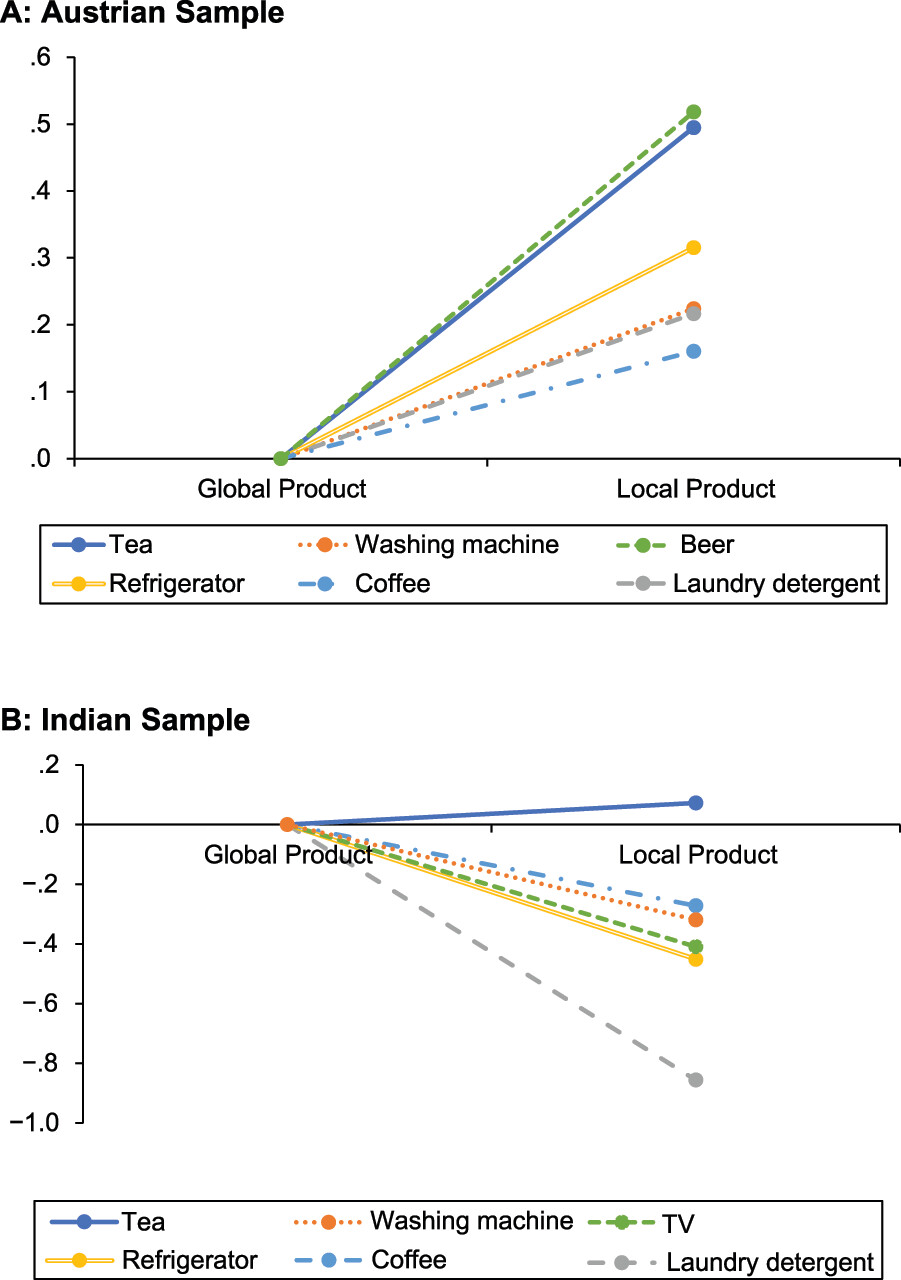
2 and suggest that the parameters of interest are highly significant and intuitively signed (i.e., in the expected direction). Part-worth values are shown graphically in
Figure 1.
The coefficient for product type (local vs. global) is positive and statistically significant (β = .29,
p = .00) for the pooled Austrian sample, while its sign is negative and significant (β = −.33,
p = .00) for the Indian pooled sample (see Models 1 and 8 in
Tables 1 and
2, respectively). We observe a similar pattern across most product categories in both markets, with the exception of laundry detergent and coffee (Austrian sample) and tea (Indian sample), for which the estimated coefficients were again intuitively signed but nonsignificant. Marginal effects for all our ordered probit models were also estimated to infer the effect size of each variable on the probability of y
i taking each of the m = 9 ordered and mutually exclusive discrete values. The estimated effects were intuitively sized and signed and are available upon request. Overall, our results provide strong evidence in support of H
1, that emerging-market consumers generally exhibit stronger preference for global (over local) products, while developed-market consumers exhibit stronger preference for local (over global) products.
To assess the validity of the estimated individual part-worth values, we used holdout stimuli that were rated by the subjects but not used to estimate part-worth values or build the preference model. Instead, they served as a check on the validity of the model (
Green and Srinivasan 1990). Accordingly, we used the estimated coefficients to calculate individual-level overall utilities per holdout stimulus and, in turn, relevant choice predictions and choice shares. Finally, we compared predicted choice shares with actual choice shares based on the individual-level choice data collected via holdout profiles. Overall, predicted and actual choice shares were highly consistent, with minor discrepancies in size (ranging from 1.25% to 3.60%). In addition, the validation analysis produced qualitatively similar conclusions across all holdout stimuli and within all product categories, suggesting that our model has strong satisfactory predictive ability (
Srinivasan and Park 1997).
Estimated Attribute Importance
We measured the relative importance of each attribute by the proportionate range between maximum- and minimum-level utilities within each attribute (
Wind 1976) and computed this in percentage terms to reflect weighted importance. Specifically, we used the following formula to estimate attribute importance (
Gustafsson, Herrmann, and Huber 2003):
where w
r is the relative importance of attribute r, max(β
rj) is the maximum estimated part-worth utility of level j in attribute r, and min(β
rk) is the minimum estimated part-worth utility of level k in attribute r.
Attribute importance (weights) are presented in
Table 3 and illustrated in
Figure 2. Except for the tea category, for which relevant attribute-level part-worth utilities were found statistically insignificant, the global/local product attribute is a significantly more important choice determinant for the Indian sample than for the Austrian one. For Austrian consumers, the global/local attribute is consistently the least important choice determinant across all product categories (fourth out of four attributes) while, for Indian consumers, the global/local attribute is the first or second most important attribute in most categories. Similarly, the relative importance of the global/local attribute is significantly higher for Indians than for Austrians for the pooled samples (t(666) = −20.84,
p = .00) as well as for the product categories of washing machines (t(103) = −5.91,
p = .00), laundry detergents (t(109) = −13.28,
p = .00), refrigerators (t(111) = −20.05,
p = .00), and coffee (t(105) = −9.19,
p = .00). The only observed difference that was not statistically significant was for tea (t(110) = .47,
p = .64). We also estimated effect sizes using the Cohen's d index. Following Cohen's (1988) definition of effect sizes as small (d = .20), medium (d = .50), and large (d = .80), all our effect sizes are large (d index is much higher than .80), except for the tea category. Thus, our results strongly support H
2 by showing that emerging-market consumers place more importance on the global/local product attribute than consumers in developed markets.
Global and Local Identity
To test H
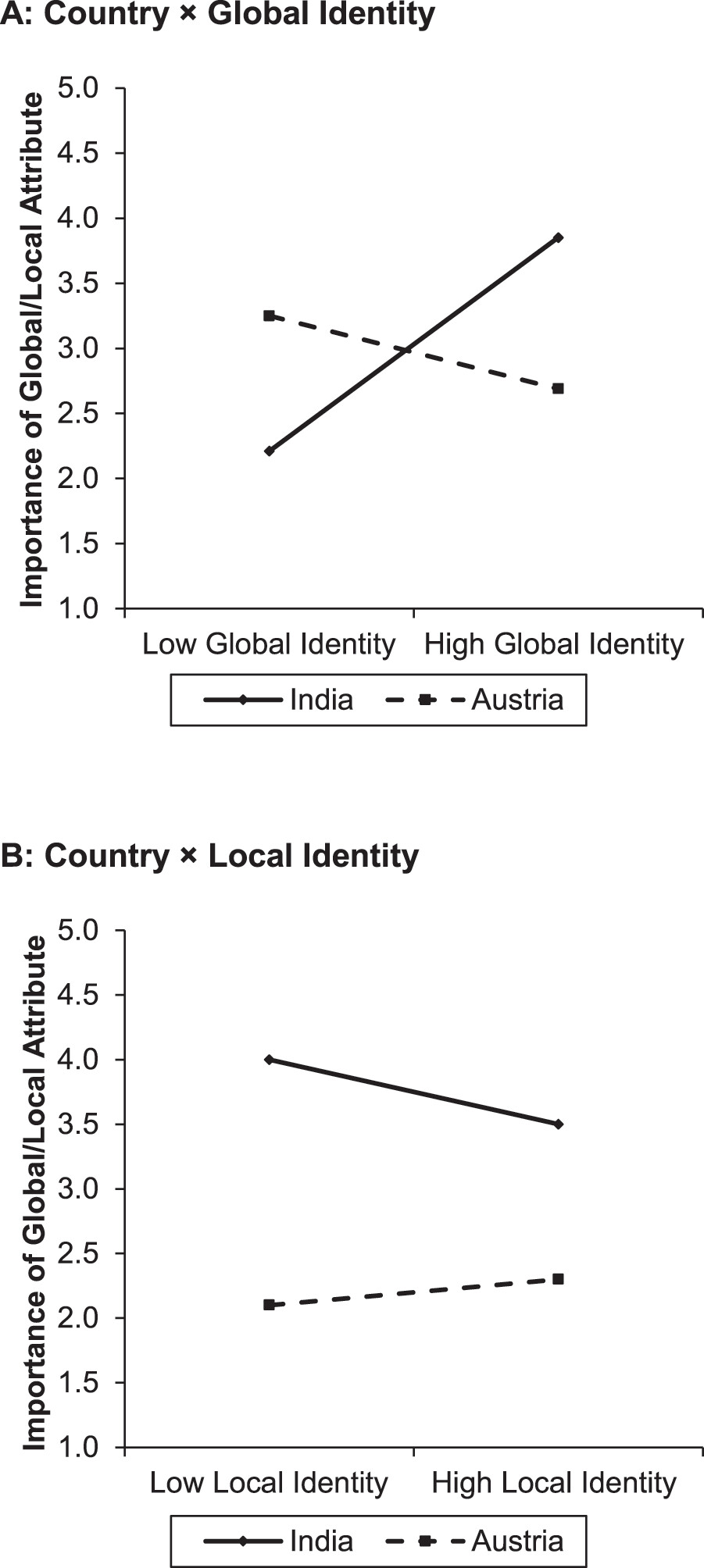
3, we estimated two regression models incorporating relevant interaction terms between country and global or local identity, respectively (see
Web Appendix, Table W4). We find a significant negative interaction (β =
−.03,
p = .00) between country and global identity (reference category: India); the interaction between country and local identity was positive, as expected, but noninsignificant (β = .00,
p = .41). As
Figure 3 shows, the positive effect of global brand identity on the importance of the global/local product attribute found in India is reversed in Austria. Although a strong local identity in Austria slightly increases the importance of the global/local attribute, the relevant effect is not statistically significant. Thus, our results support H
3a but not H
3b.
Willingness to Pay for Global and Local Brands
WTP expresses the value a consumer puts on a good or service (
Wertenbroch and Skiera 2002). The results of conjoint analyses have been widely used in the literature to estimate WTP, and researchers typically assess consumers’ WTP for certain product configurations and/or attribute levels (
Kohli and Mahajan 1991;
Miller et al. 2011). WTP for a certain attribute level over another is defined as the maximum monetary amount the customer would pay for an improved change in attribute level. We used the following formula to estimate Indian consumers’ WTP for the change from a local to a global product and Austrian consumers’ WTP for the change from a global to a local product:
where WTP
jr over kr is the maximum amount of money the consumer is willing to pay for an improvement from attribute level k to attribute level j of attribute r, β
jr is the estimated part-worth utility of level j in attribute r, β
kr is the estimated part-worth utility of level k in attribute r, max
p is the maximum level in the price attribute p, min
p is the minimum level in the price attribute p, max(β
p) is the maximum estimated part-worth utility in the price attribute p, and min(β
p) is the minimum estimated part-worth utility in the price attribute p. We estimated WTP within product categories of each country separately because it is measured in monetary terms. Results are presented in
Table 4.
Except for tea, the estimated price premiums
7 for global over local products in the Indian sample are significantly higher than the estimated price premiums for local over global products in the Austrian sample. More specifically, Indian consumers are willing to pay two or three times as much for a global product over a local one with similar characteristics, while Austrian consumers are willing to pay from 9% to 87% more (depending on the product category) for a local product over a global one with similar characteristics. A t-test shows that the observed price premium differences between the two countries are statistically significant for the product categories of washing machines (t(103) = −3.45,
p = .00), laundry detergents (t(109) = −6.06,
p = .00), refrigerators (t(111) = −8.46,
p = .00), and coffee (t(105) = −3.96,
p = .00). The only observed difference in the opposite direction than expected and statistically significant was for tea (t(110) = 4.11,
p = .00). This unexpected finding suggests that, within the tea product category, Indian consumers are willing to pay a price premium for a local over a global product that is lower than the price premium Austrian consumers are willing to pay. Effect sizes were again estimated using Cohen's d index, and all were very large (d = .74 or higher). Overall, our results offer strong support to H
4.
Interaction Effects Between Price and Product Preference
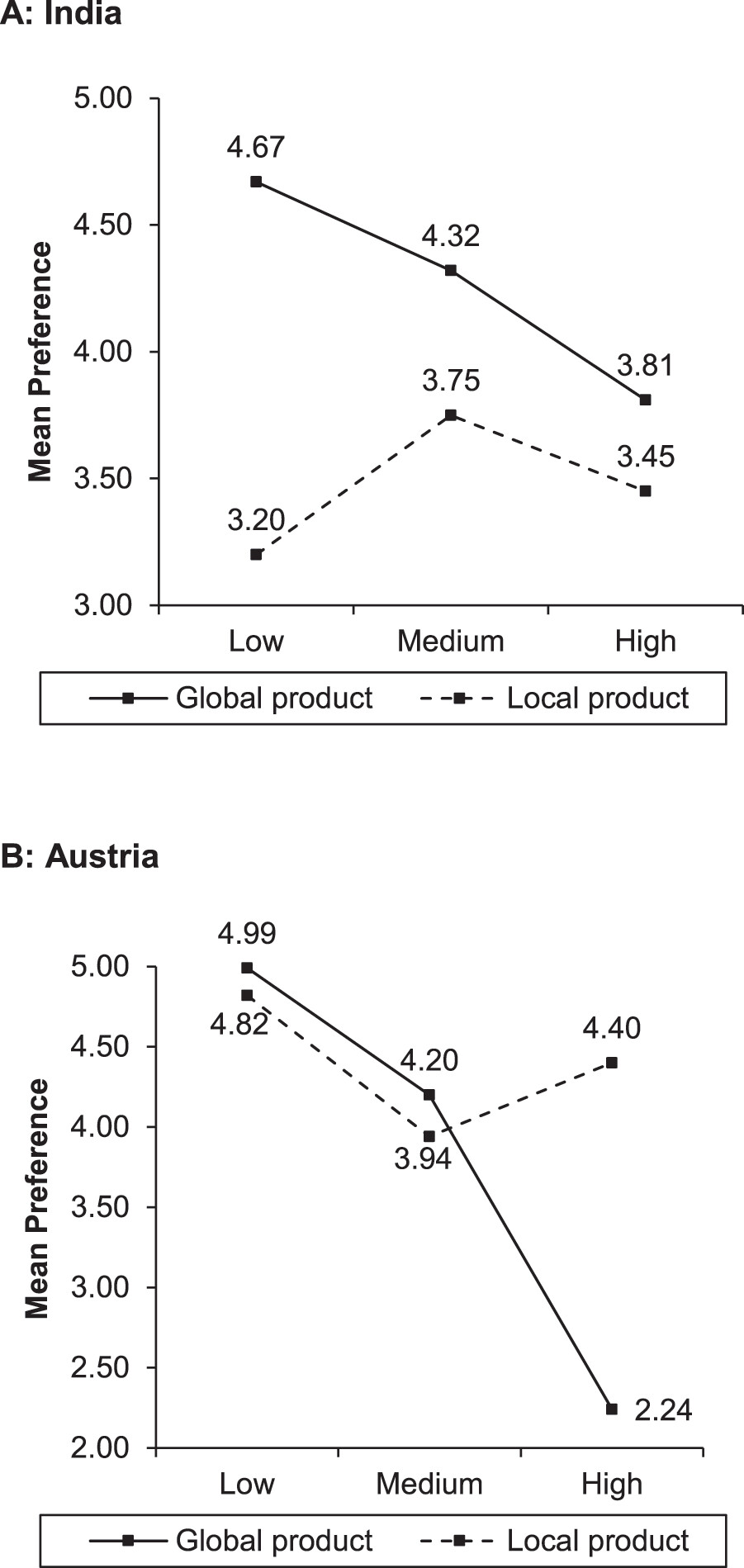
We conducted a two-way factorial analysis of variance to investigate how price levels interact with global/local product preferences and to identify the specific price segments in which consumers are willing to pay price premiums for one type of product over another. We find a significant interaction (
p = .00) in both countries between price levels (1: low, 2: medium, 3: high) and global/local product preference (
Web Appendix, Table W5).
Consistent with H
5a, Indian consumers have a stronger preference for global over local products and are more willing to pay higher price premiums in low-price market segments. In contrast, and in support of H
5b, Austrian consumers have a stronger preference for local over global products and are more willing to pay higher price premiums in high-price market segments (
Figure 4). Taken together and drawing on
Steenkamp's (2014) global brand typology, the findings suggest that developed-market consumers prefer premium local brands and emerging-market consumers are more attracted to value global brands.
Discussion and Implications
The recent debate on the consequences of deglobalization has put many assumptions of international business research in question (
Witt 2019). In the international marketing domain, one commonly held assumption has been the importance consumers ascribe to a product's global or local character when making purchase decisions (
Kashif and Udunuwara 2020;
Liu et al. 2020). However, recent developments (e.g., stalling economic integration, reshoring practices, local brand revival) cast doubt on whether a product's globalness or localness still matters or whether it has gradually become a trivial attribute with minimal impact for consumers and disregarded by global/local managers (
Carpenter, Glazer, and Nakamoto 1994). Against this background, our research answers some pressing questions and offers guidance to global/local brand managers.
Is Product Globalness/Localness Still Relevant for Consumers?
Our study is among the first to provide empirical and quantifiable evidence of the relevance/trivialization of the globalness/localness attribute. Our findings reveal a contrasting image with both attribute relevance and trivialization co-occuring in different markets. In the investigated emerging market (India), whether a product was global or local was among the top two attributes considered by consumers, accounting for roughly 27% of their decision-making weight to purchase a product; in the developed market (Austria), consumers largely ignored this attribute in the presence of price and other attributes and ascribed only half the importance, or 13%, as emerging-market consumers. Along with caring more about the global/local attribute, emerging-market consumers generally preferred global products, while developed market consumers showed a stronger preference for local alternatives. Thus, despite being consistent with prior research showing that emerging markets are more promising competitive spaces for global brands (
Guo 2013;
Sharma 2011) and that localization trends are stronger in developed markets (
Sichtmann, Davvetas, and Diamantopoulos 2019), our findings show that the global/local attribute is at risk of losing relevance and that global brands face threats from their local rivals in developed markets.
What Explains the Relevance or Trivialization Contrast in Emerging Developed Markets?
We offer a theoretical explanation of this contrast based on equity theory (
Adams 1965). We posit that preferences for global and local products are shaped by consumers’ responses to (in)equity ratios formed by the perceived benefits/costs associated with global/local product purchases and the corresponding inputs; that is, the monetary resources required for product acquisition. Consumers compare these ratios and respond to inequity either by cognitively adjusting the importance they place on the global/local attribute or by behaviorally altering their reservation prices for global/local products. Differences between the relative utility of global versus local products persist, making inequity between global and local products high. This motivates consumers to decrease inequity by increasing the importance of the attribute and/or increasing their price tolerance for the product type (global or local), thus experiencing higher “relative deprivation” (
Adams 1965, p. 268). If differences between the relative utility of global versus local products are minor, equity exists. Consumers decrease the importance of the global/local attribute and become less willing to pay substantial price premiums for either product type. These cognitive adjustments are more noticeable for consumers with location-based identities (global or local) that are congruent with generalized preferences in the country to minimize consumers’ self-identity versus social identity conflicts.
This process effectively accounts for the differences between emerging and developed markets in terms of both attribute weight and price premium variance. Interestingly, it is also in line with how preferences for global and local products have developed over time. In the early years of marketplace globalization, global brands represented distinctive products offering premium quality, symbolism, and participation in an enticing consumer culture (
Batra et al. 2000;
Holt, Quelch, and Taylor 2004), making the global/local attribute highly relevant and allowing global brands to charge premiums that local brands could not (
Davvetas, Sichtmann, and Diamantopoulos 2015). Local brands are now building on nostalgia, symbolism, and premium local sourcing to upgrade their standing relative to their global rivals (
Sichtmann, Davvetas, and Diamantopoulos 2019), thus minimizing the importance of the global/local attribute and suppressing the price premium discrepancies between global and local brands in the market. Essentially, global/local attribute weights and reservation prices act as equity restoration levers between global and local products in (what we speculate to be) an ever-changing global/local cycle of consumer preference that varies across markets (see
Web Appendix, Figure W6 for an illustration of how these cycles could plausibly look). Although we did not empirically test global/local preference trajectories over time, our study offers a snapshot of how these restoration levers currently stand in two prototypical markets—one developed and one emerging—and offers a direction that research in this area could follow.
Should Brand Managers Keep Using the Global/Local Attribute in International Segmentation, Targeting, and Positioning Strategies?
While practitioners can still segment international markets using the global/local attribute (
Steenkamp and Ter Hofstede 2002), they should do so cautiously because the attribute's importance varies by market type (emerging vs. developed) and by consumers’ location-based identities. Economic development indicators must be combined with metrics of target consumers’ local/global identity to maximize predictions of how important acquiring a global or a local product is in a particular country market. Consumers limit the importance they put on acquiring an identity-consistent product (global vs. local) when their identity conflicts with normative purchase behavior in their country. This implies a need for microsegmentation within developed and emerging markets and identification of consumer niches deviating from country purchase norms that require special strategic adaptations.
Global brand managers in emerging markets should promote their brand's globalness using global consumer culture positioning strategies (
Alden, Steenkamp, and Batra 1999) and should charge price premiums over their local competitors when operating in lower-price segments. In developed markets, the strategy should flip by downplaying brand globalness, localizing the brand through country adaptations, and avoiding overcharging unless it can be explicitly justified based on other competitive advantages (e.g., superior quality). Local brands competing in emerging markets are viewed less favorably by consumers relative to their global counterparts; thus, reliance on localness might backfire unless the products belong to an ethnic industry and can capitalize on their domestic origin (
Usunier and Cestre 2007). Such brands should consider internationalizing and communicating their internationalization as a means of boosting their image domestically (
Sichtmann, Davvetas, and Diamantopoulos 2019).
How Does the Global/Local Trivialization Attribute Affect International Pricing Strategies?
Developed-market consumers willingly pay price premiums to acquire local products, while emerging-market consumers do so to acquire global products. These premiums are substantially different in size. In a developed market, consumers appear willing to pay an (average) premium that is roughly 30% above the average category price, while the equivalent premium for emerging market consumers is, on average, more than 200%. That is, consumers in emerging markets are willing to pay two or even three times the average category price to acquire a global product, even after weighing other relevant attributes. This implies that global/local attribute elasticities are too high to be ignored in emerging markets. Although these point estimates should be viewed with caution, especially by well-known brands with established reservation prices, they are relevant for new brands for which consumers lack prior reference prices but are likely to develop them based on brand categorization to the global/local product class (
Davvetas and Halkias 2019).
Importantly, it would be misleading to conclude that all global and local products have equal potential to charge price premiums, because consumers’ reservation prices are not uniformly distributed across price segments. Global products can charge the highest premiums in low-priced segments in emerging markets, while local products can charge more in high-priced, premium segments in developed markets. Market price structure governs the ability of global and local products to charge premiums, but price increases might be ineffective if not targeted at the right market segment.
What Does Trivialization of the Global/Local Attribute Mean for Competitive Strategy?
Our findings have implications for the ability of global and local products to pursue competitive strategies of cost leadership versus differentiation. The favorable match between global products and low-priced emerging-market segments and between local products and premium developed-market segments suggests that strategic reconfigurations might be required for global multinationals and local small and medium-sized enterprises. The long-standing advantages of big global brands as premium differentiators in many industries are increasingly threatened by local players (e.g., Lurkin Coffee in China) that reclaim their position and trim global brand price premiums and market shares (
Santos and Williamson 2015). In parallel, many of the most successful global players now comprise “global value brands” (
Steenkamp 2014), such as low-cost fast-fashion brands (e.g., H&M, Zara), fast-moving consumer goods cost leaders (e.g., Nescafé), supermarket chains (e.g., Costco, Lidl) and experience retailers (e.g., IKEA), that do not compete in premium market segments and instead target value-sensitive consumers. Ceteris paribus, global value brands seem to be in a better position to charge more than their local counterparts in emerging markets, whereas local premium brands are better positioned to charge higher premiums than their global rivals in developed markets. Local differentiators appear to take over from their global competitors in developed markets while global cost leaders solidify the cost benefits brought about global supply chain synergies by continuing to dominate local value brands in emerging markets.
An overview of key guidelines to managers based on our findings is shown in
Figure 5.
Limitations and Future Research
Our conjoint design was not tailored to break attribute utilities down to specific components (e.g., functional value, symbolic benefits, ease of global product access due to digital presence) and calculate their corresponding utility contributions. Although such effects have been established in prior research using the halo conceptualization (
Kashif and Udunuwara 2020;
Liu et al. 2020), identifying benefit–cost configurations and calculating exact price trade-offs would be insightful. Our findings are subject to typical limitations of conjoint experiments, including the use of hypothetical product profiles that may not fully correspond to actual product configurations in the marketplace (
Danaher 1997). Although isolating the effect of the global/local product attribute would be impossible with the use of real brand profiles due to preexisting brand image confounds (
Dimofte, Johansson, and Ronkainen 2008), future research could employ longitudinal designs with secondary data of global/local brand performance over time. This would independently validate the proposed equity theory explanation of attribute weight and price premium changes over time and reveal factors that extend or shrink the corresponding global/local cycles.
Our research design allowed for interdependence between the global/local attribute and price, yet other potential interactions between attributes were not considered. We considered four product attributes using a full-profile design because this design works well with six or fewer attributes (
Green and Srinivasan 1990). However, it is restrictive for more complex purchase decisions that involve more than attributes and interattribute interactions (e.g., car purchases). Future research could thus use incentive-aligned, choice-based conjoint analysis (
Ding, Grewal, and Liechty 2005), or adaptive conjoint analysis, which allows for inclusion of more product attributes (
Green, Krieger, and Agarwal 1991).
We took great care to make the data collection in Austria and India as comparable as possible, but common limitations of multicountry studies (such as the use of different languages and data collection methods) may apply in our study. It is also reasonable to expect some degree of heterogeneity within our chosen two countries not only from cultural factors but also from sample representation biases. Although the novel analytical strategy employed in this study controls for this type of within-group heterogeneity by allowing individual-level preference estimation, there is always the risk of conclusion generalization. Future studies could provide a fuller picture of the proposed effects by observing whether a similar pattern of results occurs across a broader variety of product categories and/or a greater number of developed and emerging countries. Finally, while the emerging/developed divide offers conceptual parsimony and practical intuitiveness, it does not capture nuances pertaining to countries in the middle of the economic development continuum (e.g., Romania) and disregards how cultural dimensions interact with economic development in determining attribute utility. Replications in other countries are thus needed to reveal culture's role on the trivialization of the global/local product attribute.
Declaration of Conflicting Interests
The author(s) declared no potential conflicts of interest with respect to the research, authorship, and/or publication of this article.
Funding
The author(s) received no financial support for the research, authorship, and/or publication of this article.