Intended for healthcare professionals
Open access
Research article
First published online March 20, 2026

Exploring How Young Consumers Construct Identities in Socially Restrictive Societies: Managing Impressions Through Fashion Clothing

Abstract

In many societies, fashion serves as a medium of self-expression and a site of social regulation, where sartorial decisions can expose consumers to social censure and physical risk. Consequently, consumers must navigate the tension between adhering to local norms and participating in global fashion cultures. This study draws on impression management theory to examine how young consumers in a socially restrictive society use fashion as a means of identity expression while mitigating potential social risks. It uses data from in-depth interviews (n = 40) and open-ended surveys (n = 150) with consumers aged 18 to 35 years, analysed using an abductive thematic approach. We conceptualise consumer bricolage as the creative and strategic recombination of available cultural and material resources to manage impressions and negotiate identity. The analysis identifies five bricolage practices: ideational bricolage, accessorising, customisation, hybrid styling and assembling. The findings also highlight antecedents, such as cultural and religious identity, fashion innovativeness and identity distinctiveness, which help explain why young consumers engage in bricolage in restrictive settings. This study contributes to impression management theory by theorising fashion consumption as adaptive agency within constraining sociocultural environments and refines the concept of bricolage by specifying practice-level mechanisms of identity work.

Introduction

The tension between fitting in and standing out has made personal image central to social standing (Das & Jebarajakirthy, 2020). Individuals manage impressions through clothing as part of the ‘personal front’ in everyday performances (Goffman, 1978). As a symbolic cue, clothing signals identity and social belonging (O’Cass & Choy, 2008; O’Cass & Siahtiri, 2014) and operates as part of the extended self that communicates values and affiliations (Belk, 1988; O’Cass, 2004). Yet these identity signals can also provoke friction and constraint within social settings, intensifying the tensions consumers must navigate (Al-Mutawa et al., 2023).
These tensions are immediate in everyday life. Research shows that adolescents and young adults are especially drawn to clothing as a vehicle for identity expression and peer affiliation, with younger consumers in many countries reporting greater involvement in fashion (O’Cass, 2004). In Pakistan, for example, a large young adult cohort is coming of age amid persistent social and religious scrutiny, positioning young adults at the forefront of negotiating competing pressures to project modernity while upholding communal and family expectations for modesty (UNICEF, 2019; Yunus et al., 2023). Further, across South Asia and the Middle East, young consumers similarly navigate tensions between tradition and modernity, often selectively retaining local practices while privileging Western clothing, entertainment and lifestyles as markers of progress, prosperity and social status (Das & Jebarajakirthy, 2020; Gabol & Subhani, 2016; Gabriel & Lang, 2015; Little, 2017; Ramadan & Mrad, 2017).
The intersection of youth, dress and public-space risk is salient. Evidence suggests widespread harassment and low perceived safety specially among women in major South Asian cities, where dress is socially policed and often regulated by public preference. With high rates of gender-based violence globally, these realities underscore the urgency of understanding how consumers manage impressions and negotiate identity under constraint (Expert Market Research, 2025; UNICEF, 2019).
Depending on the cultural context, clothing can facilitate assimilation (O’Cass et al., 2013) or become a source of vulnerability when individual expression conflicts with norms (Al-Mutawa et al., 2023). In such settings, fashion choices may provoke social sanctions or safety threats (Gabol & Subhani, 2016; Sarkar & Sarkar, 2022). Consequently, impression management becomes a strategic response to risk, balancing adherence to local norms with global fashion participation.
These dynamics are pronounced in ‘restrictive societies’, defined by strict social norms and low tolerance for deviance (Harrington et al., 2015). Here, tradition and religious beliefs shape clothing consumption and clothing styles are regulated to reflect communal values. In this fraught environment, fashion becomes context-sensitive impression management (Sobh et al., 2014). Rather than simply adopting or rejecting Western styles, consumers mobilise bricolage and piece together locally acceptable and globally legible garments to manage impression and audience perceptions. Consumers employ conservative hybridisation for safety and selective accenting for self-expression. However, prior work has not specified these mechanisms or their sequencing under constraint, nor examined how bricolage can alternatively affirm or stretch social expectations over time.
Despite increased interest in consumer identity and impression management, several limitations persist. First, the process of constructing identity under salient personal risk remains underexplored (Bhattacharjee et al., 2014; Courtois et al., 2025; Dufault & Schouten, 2020; Lam et al., 2013; Maciel & Wallendorf, 2021). Second, prior work gives limited attention to active experimentation with appearance and style during identity formation in settings where experimentation can be penalised (Sobh et al., 2014). Third, the social and psychological forces that compel fashion-based identity strategies in high-risk environments remain underspecified, including motives such as affiliation, distinctiveness, self-efficacy and status recognition. Fourth, recent impression management research has favoured digital self-presentation over offline settings in potentially hostile public spaces (Blunden & Brodsky, 2024; Gupta & Sagadevan, 2024).
Applying impression management theory (Goffman, 1978), this study examines how young consumers in restrictive societies use fashion to navigate the tension between agency and social integration. It focusses on bricolage as a central mechanism blending front-stage conformity with back-stage resistance as individuals balance social norms with personal values. Specifically, the study examines the bricolage practices through which identity is constructed over time and develops a conceptual model that captures the stages, practices and social forces shaping identity construction through fashion in restrictive contexts.
This study makes three key contributions to the literature. First, it extends impression management theory to high-stakes environments where failed impression work may trigger reputational sanctions or physical harm. This lens shifts from vanity and self-promotion to identity negotiation under threat. Second, it conceptualises consumer bricolage in fashion as the creative and strategic recombination of available cultural and material resources to manage impressions and negotiate identity. This adds a protective function to the expressive role documented in prior work. Third, it identifies and organises internal and external social forces that influence bricolage and integrates them into a dynamic process model that explains how consumers iteratively test, recalibrate and manage identity through clothing as aspirations and pressures evolve. Together, these contributions expand impression management theory beyond its largely Western and low-risk contexts and advance understanding of identity construction in high-risk, socially conservative societies.
Finally, the practical stakes are high. The Pakistani apparel market was estimated to be worth USD 5.81 billion in 2024, with per capita consumption rising significantly (Statista, 2024). Mirroring trends in India and Saudi Arabia (Expert Market Research, 2025), growing commercial investment is increasing the everyday exposure of young consumers to global styles. The insights generated here, therefore, hold practical implications not only for Pakistan but also for firms operating in other socially conservative markets where clothing is closely tied to identity, respectability and the management of public impressions.

Literature review

Consumer identity is materially mediated. Consumers use goods to express, negotiate and revise the self over time, which aligns with postmodern views of fluid identity (Gabriel & Lang, 2015; Mishra et al., 2023; Sörum & Gianneschi, 2023). Building on this view, Gabriel and Lang (2015) describe consumers as ‘identity hunters’ who use goods to quench an unending thirst for self-definition. This idea resonates with Cushman’s (1990) notion of the ‘empty self’, portraying identity as a psychological vacuum filled through consumption but never fully satisfied. These conceptualisations highlight identity as fluid, performative and materially mediated. This perspective aligns with postmodern consumer theory.
In restrictive societies, consumption becomes a negotiation between agency and surveillance. Studies show adherence to modesty norms and identity signalling (Goto, 2023; Jaber, 2020), alongside moments of transformation during sociopolitical change (Sandikci & Ger, 2010). Clothing, therefore, serves as an instrument of conformity and a medium for change, contingent upon the audience and period. Researchers emphasise adaptive compliance, while others document more agentic forms of resistance in a religious community (Sandikci & Ger, 2010). They reveal how fashion operates as a dynamic tool for identity transformation amid sociopolitical change. These cases illustrate how clothing functions as both an instrument of conformity and a medium for subversion, depending on the sociocultural context.
A thread across the literature is the symbolic function of consumption in shaping social identities (Price & Arnould, 1999). However, the function of symbolism appears nuanced in restrictive societies. For instance, while Western fashion is adopted to project modernity and elite status (Das & Jebarajakirthy, 2020; Sobh et al., 2014), such adoption is fraught with social risk in some societies. The paradox here is striking. Even elites are subject to criticism when their fashion choices contravene moral boundaries, when bodily exposure is involved. This highlights the burden of class performance and norm conformity in socially restricted contexts. In contrast to Western liberal societies, where individual identity construction is celebrated for its divergence, in socially restrictive societies, identity work must be curated within the boundaries of social norms.
The concept of consumer bricolage offers a valuable lens for exploring how consumers manage the tension between agency and constraint. Lévi-Strauss (1966) argues that bricolage is a practice of improvising and reconfiguring available cultural and material resources to construct meaning and identity within limiting sociocultural environments. Bricolage has become influential in consumer research, entrepreneurship and marketing, shedding light on understanding how individuals find creative ways to piece together available resources under limitations. Dion and Mazzalovo (2016) describe bricolage as how people shape their identity and resist norms by creatively reusing materials, especially in times of economic constraint. Scaraboto and Fischer (2013) examine how plus-size consumers engage in marketplace bricolage to challenge exclusionary fashion norms, while Brown et al. (2003) highlight its performative role in vintage consumption. Together, these studies demonstrate that bricolage is not merely about resourcefulness but is embedded in cultural and social practices.
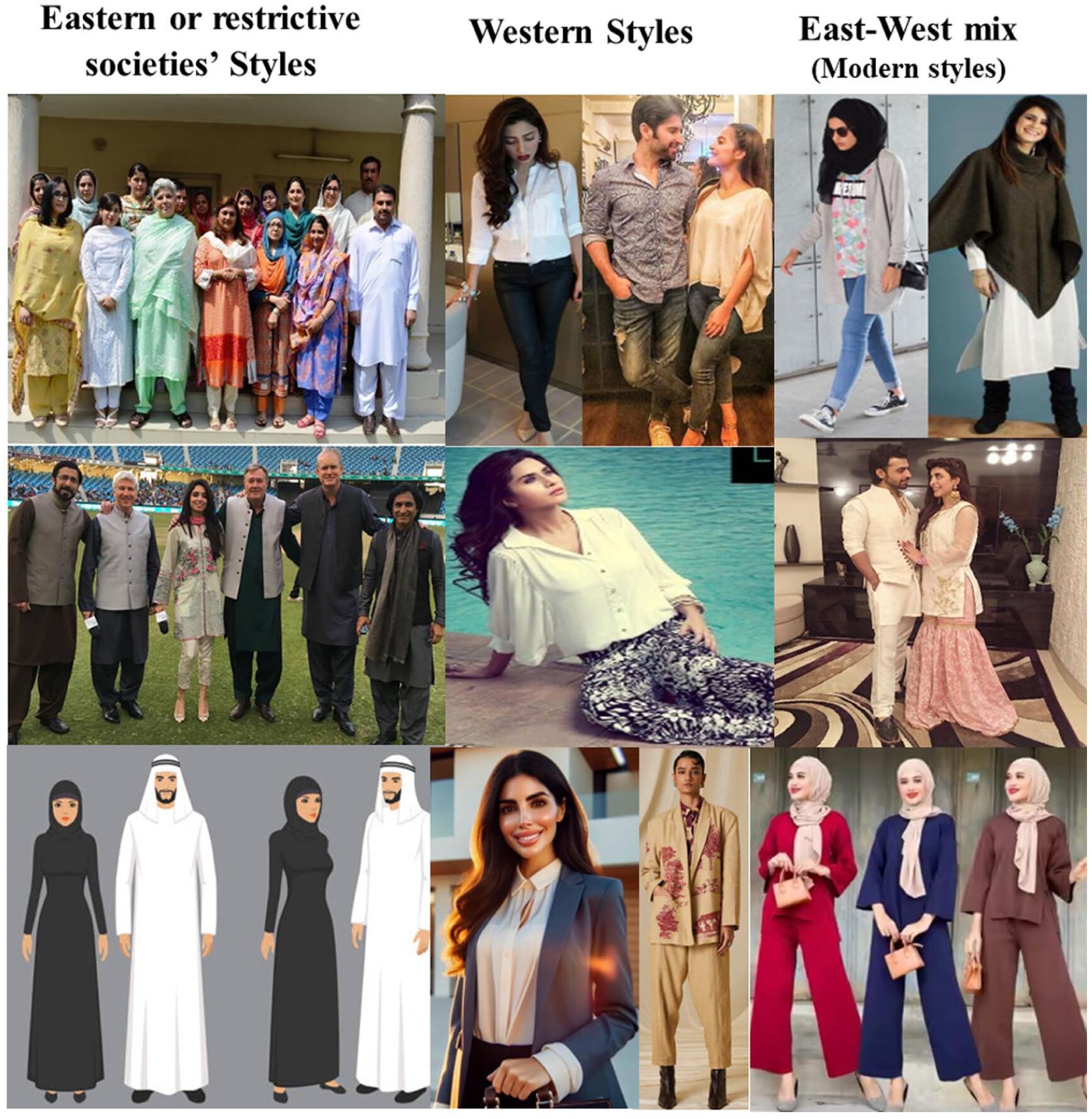
In restrictive settings, bricolage manifests through layering to control exposure, modular accents that can be concealed, time-of-day switching, audience-specific ensembles and reversible styling. These practices translate impression motives into dress tactics under risk. While studies have explored bricolage or equivalent concepts in the context of subcultures (Brown et al., 2003; Dion & Mazzalovo, 2016), its role as a tool for impression management and identity negotiation in high-risk environments remains under-theorised. Hybrid styles emerge when consumers combine local modesty templates with selective global cues. Such styles function as impression management strategies that signal status and belonging while avoiding sanctions (Das & Jebarajakirthy, 2020). While such practices enable identity signalling aligned with globalised ideals, they also reflect localised negotiations of status. These styles challenge conceptions of ‘authentic’ versus ‘Western’ identity and instead support a more bricolage-oriented understanding of identity construction, in which consumers draw on multiple cultural logics to craft acceptable styles (see Figure 1).
Figure 1. Western, Eastern (or South Asian) and modern styles.
Despite the theoretical richness of prior studies, gaps remain in understanding how consumers respond to social criticism when constructing their identity through clothing. Social criticism is a significant issue when adopting Western fashion, regardless of social class. Even the elite class face social pressure if they wear Western clothing that reveals the body. In restrictive societies, there is an expectation that people consider social impressions, not just one’s social class. This highlights another theoretical gap in identity and impression management research, where less attention is paid to the negotiation between identity goals and norms in offline contexts. Unlike its digital counterpart, offline impression management is more contextually bound and embedded in local norms yet remains underexplored in and consumer research (Gupta & Sagadevan, 2024). Moreover, while researchers have examined online impression management strategies, the embodied dimensions of offline impression formation in a socially restrictive society warrant further investigation (Blunden & Brodsky, 2024).

Impression management theory

Impression management has been recognised as a process through which individuals construct and project desired identities (Goffman, 1978; Leary, 2019). Building on this foundational work, scholarship has extended impression management theory across disciplines, including marketing and psychology. It highlights how individuals shape others’ perceptions to enhance their social standing, express identity and mitigate reputational risk (Bolino et al., 2008; Gardner & Martinko, 1988; Lim et al., 2025; Zhang et al., 2022).
Impression management and identity-based theories, such as interdependent self-construal and collective identity, are related but distinct. Impression management concerns strategic self-presentation, conscious or automatic efforts to shape others’ perceptions in pursuit of acceptance, status or goals (Leary & Kowalski, 1990). By contrast, interdependent self-construal is an identity schema in which the self is defined through relationships and obligations (Singelis, 1994). Individuals high in interdependence may use impression management, but typically to maintain harmony in line with their core identity rather than engage in mere image control (Leary & Kowalski, 1990). Collective identity, in turn, denotes a shared sense of ‘we-ness’ that binds members, sustains cohesion and enables coordinated action as an emergent group-level phenomenon, not an individual self-presentation tactic (Polletta & Jasper, 2001).
Impression management theory is well-suited to socially restrictive settings because failed impressions can trigger reputational, moral or physical risks (Little, 2017). On this point, the contextual sensitivity of impression management has been well documented with McFarland et al. (2023) showing that tactics and motivations vary with relational norms and audience expectations. Empirical evidence from such social contexts underscores that impression construction through consumption shapes relational and individual self-concepts (Wang et al., 2023).
Building on Leary and Kowalski’s (1990) model, which emphasises impression motivation and construction, we argue that Pakistani (and similar societies) youth’s application of bricolage in fashion is motivated by the aspiration to build a desired identity and defensive concerns. Bolino et al. (2008) show that impression management is socially functional in high-risk contexts, helping individuals preserve a sense of belonging. Finally, Mead et al. (2011) demonstrate that impression motives intensify under social threat, aligning closely with the risks of moral policing and criticism. These perspectives justify applying impression management theory as a lens to explain bricolage consumption in restricted societies such as South Asian and MENA countries.
Table 1 provides an overview of the literature on the application of impression management theory across psychology, marketing and other cultural studies. A common thread is the recognition that individuals tailor their behaviour, appearance and consumption choices to manage impressions (e.g. Philp & Nepomuceno, 2020; Segev et al., 2013). The literature illustrates that impression management is not merely about vanity or self-promotion; rather, it is a complex, context-sensitive strategy driven by aspirational and defensive motives (e.g. Ozansoy Çadırcı & Sağkaya Güngör, 2019; Rosenberg & Egbert, 2011; Wirtz et al., 2013). Individuals use impression management to navigate social hierarchies, assert belonging and avoid potential social harm, which becomes salient in cultures where identity expression is constrained by social and religious norms (e.g. Christiansen, 2011; Segev et al., 2013). The insight from these studies is that impression management is not merely individualistic but is shaped by cultural narratives and power dynamics.
Table 1. Relevant Literature on Impression Management.
AuthorDomainTermTheoretical positioningContextResearch settingMethodKey findings
PHILP AND Nepomuceno (2020)Consumer behaviourImpression managementImpression management motives are a psychological factor that can help reduce usage intentions of frugal consumersIM in frugal consumptionUnited States, developed countryExperimentWhen a product is negatively perceived, the usual connection between frugality and usage weakens, as owning it suggests poor choices.
JEONG and JIANG(2021)Consumer behaviourImpression management strategy, cutting off reflected failureConsumers regulate their impressions on social media through CSR advertisingIM used in stigmatised and cause-related consumptionUnited States, developed countryExperimentLower social value of CSR in stigmatised industries reduces consumer engagement. Yet, consumers with high self-disclosure still value CSR and engage with it.
Segev et al. (2013)Consumer behaviourImpression management theory tacticsImpression management is used in gift-giving behaviour among adolescents to manage their impressionsManaging impressions in a gift-giving contextIsrael, developed countrySurveyAdolescents use gift-giving to manage peer impressions, with different gifts serving to build connection, signal similarity or maintain social balance.
Ozansoy çadirci and Sağkaya güngör (2019)MarketingImpression management practicesImpression management strategies can be used for digital self-presentationPersonal branding in online networking sites ConceptualSelfies can support self-extension and personal branding by conveying context and managing impressions on social media.
Wirtz et al. (2013)Service marketingImpression management and metaperceptionUse of impression management in adjusting metaperception about the behaviour of recommending products to othersAdjusting impressions in incentivised recommendationsSingapore, developed countryInterviews and experimentsRRPs can impact recommendation behaviour positively, neutrally or negatively, depending on the balance between the negative effect of incentives and the positive effect of perceived incentive attractiveness.
ROSENBERG and EGBERT (2011)Social media (or marketing)Impression management and self-presentationImpression management and self-presentation tactics used by Facebook usersImpression management via Facebook profilesUnited States, developed countrySurvey 
POUNDERS ET AL. (2016)Social media (or marketing)Impression management and self-presentationManaging impressions used to create the desired impression through selfiesSelf-posting on social mediaUnited States, developed countryInterviewsThe selfie trend is reshaping social culture. This study shows female millennials use selfies to manage impressions and seek affirmation.
Proudfoot et al. (2018)Social media (or marketing)Impression management affordances, impression management disclosure propensityImpression management is used for social benefits and to counterbalance privacy concerns on social mediaManaging impressions through social networksUnited States, developed countrySurveyPerceived impression management affordances as a key factor driving both perceived social benefits and the tendency to disclose through IM.
JANG ET AL. (2021)Social media (or marketing)Self-presentationThe impact of self-presentation on generating happiness and improving self-esteemImpression development and presentation via FacebookUnited States, developed countryExperimentsSelf-presentation boosts happiness for high self-esteem users, while a strategic style benefits all. Expressing true self meets the high self-esteem users’ need for competence, increasing their happiness.
Stopfer et al. (2014)Personality studiesImpression management, metaperception, meta-accuracyImpression management is used to form an impression on online social networking sitesManaging impression on online social sitesGermany, developed countryOnline text miningExplores personality accuracy, impression management and meta-accuracy in online networks.
CHRISTIANSEN (2011)Cultural studiesImpression management as a conscious strategyImpression management tactics are used to communicate desired clothing stylesMuslim womenDenmark, developed countryInterviewsMuslim women’s presence in Danish media reflects conscious impression management, with Islamic fashion acting as subtle micro-politics.
Sezer (2022)PsychologyImpression management/mismanagement tactics or strategiesImpression management can backfire in unintended waysLiterature review Conceptual paperProvides a model/framework that outlines the psychology behind impression management or mismanagement and associated risks and rewards when people engage in different self-presentation strategies.
Zhang et al. (2022)MarketingImpression management as behavioursBehaviours employees may engage in to shape others’ perceptions of their actions and influence the impressions others form about them
Internal marketing and consumer eWOMChinaSurveyExplores the issue from employees’ perspectives and offers insights for marketing managers on motivating staff to voluntarily create positive eWOM on social media.
This studyConsumer behaviourImpression managementIdentity construction and managementFashion clothing consumption in socially restrictive settingPakistan, developing countryQualitative 
As Table 1 indicates, the literature examines impression management in online, low-risk environments that feature voluntary self-enhancement and limited penalties. These studies clarify tactics and motivations but reveal a coverage gap for offline, high-stakes settings where missteps invite moral policing and harassment. For example, Rosenberg and Egbert (2011), Proudfoot et al. (2018) and Pounders et al. (2016) focus on how individuals use impression management on social media platforms like Facebook or through selfies to manage self-presentation and social impressions. These contexts reflect voluntary, self-enhancing behaviours in environments where the risks of misrepresentation are minimal. Similarly, Philp and Nepomuceno (2020) explore impression management among frugal consumers in the U.S., demonstrating that impression management motives influence product use when reputational concerns are involved, but within low-stakes consumption environments. Even research examining CSR in stigmatised industries (Jeong & Jiang, 2021) or adolescent gift-giving (Segev et al., 2013) addresses socially sensitive topics, but within developed, democratic societies.
While the Table 1 studies offer valuable insights into the mechanisms and motivations of impression management, there are contrasts in the focus across the literature. Some research centres on identity affirmation and status projection (e.g. Philp & Nepomuceno, 2020; Segev et al., 2013), while others emphasise risk mitigation and stigma avoidance (e.g. Christiansen, 2011; Jeong & Jiang, 2021; Ozansoy Çadırcı & Sağkaya Güngör, 2019; Rosenberg & Egbert, 2011; Wirtz et al., 2013). The contrast lies not in the tactics used, but in the underlying motivations, whether to elevate the self or to protect it. Furthermore, most of the literature focusses on low- to moderate-risk social environments, where the consequences of failed impression management may include embarrassment, exclusion or reputational damage. What remains underexplored is how consumers in socially restrictive environments manage impressions when the risks include moral policing, harassment or physical danger. This gap is particularly significant in contexts where fashion serves as a politically and morally charged symbol. While research in digital and Western contexts highlights individual autonomy in self-presentation, consumers in restrictive societies operate under tighter constraints, where identity performance must balance personal expression with social norms. Yet, little research has examined how impression management unfolds under high-stakes conditions, especially through the lens of fashion and apparel.

Research context

Focussing on a socially restrictive society, we examined cultural norms and practices that impose significant social constraints in both South Asian countries and the Middle East. We chose Pakistan as a suitable context for three reasons. First, more recently, the younger generation has moved towards Western fashion trends (Das & Jebarajakirthy, 2020; Gabol & Subhani, 2016). The rise of the young working class in Pakistan has led to increased disposable income, enabling young people to purchase fashion clothing (Alam et al., 2018). The revenue generated by Pakistan’s apparel market was estimated to be US$5.81 billion in 2024. The market is expected to reach 1.9 billion units by 2028, averaging 7.7 garments per person (Statista, 2024). Available statistics indicate that the average consumption of Western fashion clothing increased by 81% between 2002 and 2011, and the per capita volume of clothes purchased in Pakistan increased by approximately 11% (Imtiaz, 2015).
Second, the emergence of hybrid fashion styles in Pakistan, as evidenced by the incorporation of Western elements into traditional attire (Rasool, 2024). Consumers living in metropolitan cities in Pakistan are exposed to global fashion trends through social media, but they must also comply with their cultural values. This tension creates fertile ground for exploring how individuals’ consumption behaviour navigates risk while constructing and managing identity in Pakistan. Pakistan’s Islamic culture tightly regulates fashion, making it a restrictive society ideal for studying identity negotiation through consumption. Third, the researchers’ extensive familiarity and established ties with Pakistan enhance their depth of contextual understanding. Their direct exposure to local norms and restrictions offers valuable insight into the complexities of consumers’ clothing choices in restrictive settings. These experiences help researchers understand the local context, allowing a clearer view of how people balance social expectations with personal identity.

Research method

Data collection and sampling

We employed semi-structured interviews and open-ended surveys, using an inductive approach (Yin, 2009). This approach revealed how young consumers in restrictive societies use fashion to shape their identity and manage the consequences.

Semi-structured interviews

Interviews were used to gather inductive insights by probing the participants’ inner voice and gathering detailed information about our focal phenomenon (Corbin & Strauss, 1990). We conducted forty semi-structured interviews with male and female participants through purposeful sampling (Patton, 2014) to reach saturation in terms of themes and content. We recruited participants using referral methods. The participants ranged in age from 18 to 36 years (M = 27.65; SD = 5.62; see Supplemental Web Appendix 1). A pre-screening question was used to recruit participants: Are you fashion-conscious? They ‘qualified’ to participate if they answered yes. The questions in the interview guide related to how participants construct(ed) their identities and the role of fashion clothing from their childhood to adulthood.
A rigorous process was followed to design the interview guide. We reviewed relevant literature on fashion consumption, identity construction, bricolage, fashion experimentation and impression management to inform the development of potential questions. To ensure content validity, we adopted a deductive-inductive approach. We initially derived questions from the literature and then discussed with some potential participants to assess clarity, cultural appropriateness and their ability to elicit detailed narratives about fashion (Abid et al., 2023). Based on their feedback, some questions were revised or removed. We then conducted a peer review with two qualitative consumer behaviour researchers and one academic from Pakistan, and refined the interview guide based on their feedback.
Participants provided a history of how their clothing choices developed from their younger years to the present. We sought specific examples from their experiences and asked additional questions pertinent to our research (Vuori & Huy, 2022). Participants were classified into three sub-categories: fashion-conscious individuals, professionals and students and fashion designers. Young individuals, including university students, actively participate in self-expression and identity construction through fashion (e.g. O’Cass & Siahtiri, 2013; Yadav, 2024). Their perspectives are especially valuable for understanding how young consumers negotiate global fashion clothing trends and local sociocultural constraints. Interviews were held at participants’ preferred locations (e.g. home, work, cafes or university campuses) and lasted 80 to 120 min. Consistency was ensured by having one researcher conduct all interviews.

Open-ended survey

The purpose of the open-ended surveys is to triangulate the interviews’ findings following procedures similar to those of Felix et al. (2017). We designed the open-ended survey by drawing on ten questions from the interview guide, including four demographic questions and six open-ended questions.
The sample characteristics were the same as those of semi-structured interviews. The participants in the open-ended survey were distinct from those who participated in the interviews. Using referrals, we contacted 300 individuals via social networking sites and email. The referral-based sampling method was employed via social media due to the research context’s restrictive nature, which made direct access to the target population challenging. The phenomenon under study is predominantly observed among urban, middle-class and upwardly mobile segments in Pakistan, who are also the most active users of social media platforms (Yunus et al., 2023).
Nonetheless, we deliberately sought to enhance sample diversity by recruiting participants from various cities, socioeconomic backgrounds and educational levels. Reminders were sent to encourage participation. Finally, 150 responses were obtained, and 12 cases were discarded due to incomplete responses. Participants included males and females aged 18 to 35 years from various metropolitan cities in Pakistan. The sample comprised fashion-conscious individuals, including students, working professionals and fashion designers. Of the 138 participants, the average age was 24.67 years (SD = 3.65); 60% were male, 59% were non-students and 94% held at least a bachelor’s degree.

Data analysis

A qualitative concept development tool was created. It required understanding that codes and concepts can overlap, as the same code or meaning may legitimately apply across multiple cases (Goulding, 2005). The interviews were transcribed, coded and analysed. The coding and analysis used a three-step process (see Figure 2; Vuori & Huy, 2022). First, data comprising phrases, terms and descriptions were entered into NVivo 12, and first-order codes were generated. The coded file was swapped, and the data reread to find more codes. We then engaged in first-order coding and progressively compared and analysed these codes for possible conceptual patterns. Second, the codes were analysed across the data to group them into higher-order nodes. These nodes were refined through data triangulation to generate a set of first-order categories. We examined the first-order categories and grouped them into theoretically distinct second-order themes based on their associations (see Figure 2). We compared categories, moving iteratively between the first-order categories and the second-order themes until appropriate conceptual themes emerged. In the third stage, we used axial coding to link second-order themes, grouping them into broader constructs that supported our theorising.
Figure 2. Coding process for aggregate themes.
We followed the same data analysis procedure for the open-ended survey as for the interview data. During the first-order coding stage, we found that most of the open-ended survey codes were similar to those generated from the interviews. We then formed first-order categories. However, the open-ended survey did not yield any such first-order codes that could contribute to the development of new first-order categories or second-order themes. All the first-order codes generated from the open-ended survey primarily served to confirm and triangulate the interview results. The analysis did not produce new categories, themes or theoretical dimensions.
The analysis of interview data yielded three models: the consumer identity construction process, bricolage practices and motivations for engaging in bricolage (see Figure 2). Supplemental Web Appendix 3 (see also Figure 3) presents the final data structure, including categories and themes. Representative first-order data supporting the second-order themes are detailed in Supplemental Web Appendix 4, linked to Supplemental Web Appendix 3 (excluding motivations for bricolage). Supplemental Web Appendix 2 shows the frequencies of each theme.
Figure 3. Final data structure in tree form.
In addition to the three steps outlined above, we used two techniques to ensure the data’s trustworthiness and reliability, following the approach suggested by Abid et al. (2023). First, our coding scheme was examined by the research team with the assistance of consumer behaviour researchers. As multiple authors, we independently assessed each other’s coding schemes and then assigned the codes to first-order categories. We discussed the codes and their categorisation until we reached a strong agreement, adjusting where disagreements occurred. This iterative process helped refine the codes and categories and ensured data consistency. Afterwards, two consumer behaviour researchers reviewed our coding scheme and suggested minor changes, after which we finalised the analysis.
Second, a member check procedure was conducted with some participants to examine whether the researchers’ interpretive scheme made sense (Nag et al., 2007). We shared the themes and key interpretations with some participants to verify that our findings accurately reflected their experiences and the narratives they had shared. We found that participants resonated with the interpretive scheme and confirmed its accuracy.

Findings

Consumer identity construction process findings

Building on our qualitative analysis, we developed a seven-stage model of consumer identity construction that captures how young consumers in restrictive societies form, negotiate and stabilise their identities through fashion consumption (see Figure 4). Our data show that individuals move from one identity stage to the next based on their internal motivations, social sanctions or peer pressure and feedback from impression management efforts as represented by the outer boxes in Figure 4. At the model’s core is the individual’s ability to challenge norms and engage in clothing experiments, which we labelled consumer bricolage practices. The findings show that identity stages in restrictive societies are complementary, with each stage building on the previous one. Identity construction emerges as a fluid, iterative process that varies in intensity, sequence and completeness depending on individuals’ social context, agency and exposure.
Figure 4. Seven-stage consumer identity construction process.
Note. In this figure, solid arrows represent the most common progression between stages. Dashed arrows denote alternative or recursive pathways where individuals may skip, regress or re-enter earlier stages in response to changing social feedback or personal circumstances. Circular feedback loops indicate ongoing impression-management and identity-work mechanisms (e.g. self-verification, face-work and narrative coherence) that govern movement between stages.
Although the model is visually represented as sequential, our data show that identity construction is plural, recursive and context dependent. Individuals do not necessarily traverse all stages or follow the same order. Some regress or remain ‘stuck’ in earlier phases due to enduring social sanctions, while others, especially those with greater cultural exposure, skip directly to later stages. These non-linear patterns reflect situated agency, consistent with identity-work theory, which views identity construction as a negotiated, iterative process shaped by feedback and constraint (Giddens, 1991; Sveningsson & Alvesson, 2003). Movement across stages depends on three interrelated forces: (1) impression-feedback loops from audiences that validate or challenge the self-presentation (Goffman, 1978; Leary & Kowalski, 1990), (2) identity-work motives such as self-verification, coherence seeking and emotion regulation (Ibarra & Barbulescu, 2010) and (3) contextual contingencies such as perceived social risk, gender norms and access to cultural capital suggested by Sandikci and Ger (2010) and Al-Mutawa et al. (2023). For instance, the shift from random identity experimentation to identity confirmation often follows cycles of social feedback that stabilise a provisional self-image. Transitions from confirmation to planned experimentation arise when individuals acquire sufficient autonomy and self-efficacy to refine their style. These mechanisms underscore that stage progression represents adaptive impression management and identity-work processes rather than a passive or purely developmental sequence.
Note: In this figure, solid arrows represent the most common progression between stages. Dashed arrows denote alternative or recursive pathways where individuals may skip, regress or re-enter earlier stages in response to changing social feedback or personal circumstances. Circular feedback loops indicate ongoing impression-management and identity-work mechanisms (e.g. self-verification, face-work and narrative coherence) that govern movement between stages.
Almost all the participants progressed through the first three identity stages. Most participants followed an iterative pattern, shifting between stages (see Figure 4). In some cases, participants did not explicitly mention identity confirmation, but their narratives implied that they had reached this stage before progressing further or revisiting earlier ones.

Pre-identity construction

When discussing this stage, all participants commented that they were not aware of their identity since they were in their pre-teen period. Further, they described being unaware of their preferences/choices and were totally dependent on their family’s buying decisions and did not have any liberty to make their own choices during this period. One interviewee explained, ‘I was the youngest child in my family . . . I was treated like a puppet of my sister . . . I had to wear whatever she bought(Interview 8; Sex female; Age 22; Profession student). Almost all the participants discussed this stage of identity and expressed their feelings about it. The findings indicate that participants’ clothing consumption was influenced by their family members’ fashion ideologies. They have not formed a sense of self but begin internalising role cues and social expectations, laying the groundwork for identity performance.

Identity awareness

Participants said that in this stage, they had limited permission to express preferences, but these had to align with cultural and religious norms, reflecting impression management’s behavioural matching strategy (Goffman, 1978). Participants had limited freedom in fashion choices, often debating with parents over clothing that didn’t align with their desired style. One participant shared: ‘When I was in school, I had started adding my choices in my dressing . . . I had been strongly advised by my parents that my clothing styles must be aligned with our family and social values . . . But I was always very keen to adopt all Western styles(Interview 14; Sex female; Age 22; Profession student).
During this stage, participants, particularly males, felt less pressure from family if their styles were a little Western (such as full-length trousers and full/half sleeve shirts) since people in their social environment considered them too young to follow cultural and religious ethos, unlike females who face pressure to follow their social norms irrespective of their age group. This stage marks the emergence of identity consciousness, primarily triggered by social comparison during adolescence. These findings are advances of the psychological development theory, which views adolescence as the stage where individuals begin to negotiate their identity versus role confusion (Maree, 2022). This also aligns with Goffman’s (1978) concept of ‘impression triggers’, where early social interactions spark self-awareness of how one is being perceived (see Table 2 for identity stages transitions with theoretical mapping).
Table 2. Theoretical Basis for Identity Transition Stages.
Stage transitionTransitional mechanismRelevant theory/key sources
Pre-identity→identity awarenessEmergence of self-awareness through social comparison and impression triggers as adolescents begin recognising others’ evaluations.Erikson (1968) psychosocial development; Goffman (1978) impression triggers and behavioural matching
Awareness→random identity experimentDesire for peer validation, differentiation and self-verification motivates initial fashion experiments that test social boundaries.Symbolic interactionism (Blumer, 1969); self-presentation and self-verification (Goffman 1978)
Random experiment→identity confirmationCycles of social feedback stabilise a provisional self-image; individuals adjust to avoid face-threats or sanctions.Goffman (1978) face-work; Leary & Kowalski (1990) impression motivation/construction model
Confirmation→planned identity experimentGrowing autonomy and narrative coherence prompt deliberate, planned self-presentation and re-experimentation.Identity work and narrative identity (Ibarra & Barbulescu 2010)
Planned experiment→identity refinementReflexive mastery and internalised feedback lead to aesthetic self-control and refinement of identity performance.Exemplification (Bolino et al. 2008); reflexive self (Giddens 1991)
Refinement→fashion opinion leadershipAccumulation of symbolic and social capital transforms impression management into social influence and status signalling.Symbolic capital (Bourdieu 1989); exemplification (Bolino et al. 2008).

Random identity experiment

During this stage, participants focussed on self-presentational and self-verification strategies, experimenting with various fashion styles in different social contexts (Goffman, 1978). They navigate awareness of styles and social values while uncertain about their future identity. Most gained financial freedom, broader friendships and shopping independence, but faced growing social pressures despite fewer family restrictions. They followed the media and celebrities’ fashion trends and conducted random experiments with a variety of Western and Eastern clothing styles. One interviewee said, ‘When I was in college, I experimented with different fashion styles, such as spraying and painting my t-shirts and jeans. . . similar to what street fashion is going in Western countries. My parents often criticised me . . . people stared at me on my styles in a way I felt like sexually harassed(Interview 35; Sex female; Age 30; Profession professional).
All participants spoke extensively about this identity stage and tended to remain here longer than in other stages. For example, several participants explained that they continued engaging in random experimentation even after reaching the opinion-leadership stage, as they constantly tried new fashions to see how they would appear. Male participants often adopted rebellious looks (e.g. torn jeans and spiked hair) despite parental disapproval, while females, facing harsher criticism, adjusted their experiments to balance individuality with social acceptance. These trial-and-error efforts were driven by rebellion against norms, desire for peer approval and media influences. These findings explain the symbolic interactionism perspective (Blumer, 1986) – identity formation occurs through social interactions and the meanings attached to symbols and fashion choices (see Table 2).

Identity confirmation

Consistent with opinion conformity strategy (Bolino et al., 2016), identity confirmation occurred when participants relied on audience-focussed strategies (e.g. ingratiation or strategic ambiguity) and sought social acceptance of fashion styles they created in the previous identity stage. Female participants reported serious consequences, like sexual harassment, for violating cultural norms. As a result, they reverted to earlier stages and experimented with more socially acceptable styles. Here, they engage in an impression management feedback loop, adjusting their behaviour based on feedback from family, peers and society (Goffman, 1978). This social feedback loop helps them navigate social risks and assess whether their identity performance is accepted or rejected. From the participants’ discussion, this feedback loop and their iteration between identity stages continued until their fashion style conformed to social norms. For instance, a recent university graduate said, ‘I performed multiple clothing experiments to create the desired styles . . . If my society does not accept a specific style, I have to reverse back for another clothing experiment; otherwise, I need to prepare myself for social boycott and face some serious issues . . . I kept the accepted style to create a signature look and continued to do more experiments(Interview 26; Sex female; Age 25; Profession professional).
Our findings also reveal that some rebellious consumers, and those from metropolitan, elite-class backgrounds and university, appeared to bypass this stage entirely. Their lifestyles or individualistic family culture already mirror Western norms, encouraging self-expression and reducing the need to negotiate or confirm their identities. Similarly, participants with higher cultural capital adopt and sustain hybrid fashion identities more fluidly, constructing their identities without the same iterative processes observed among other groups. As outlined in Figure 4, during the last three identity stages, participants become mature, more conscious of contemporary fashion trends and fully aware of cultural and religious values. Not all participants experienced these last three stages. These stages were mainly discussed by professionals, fashion designers and some students. Participants often moved back and forth between stages, which shows the reflexive, fluid and dynamic nature of identity (see Figure 4). Many university-going participants skipped some stages, moving directly from random experimentation to opinion leadership, often influenced by sociocultural and personal circumstances such as individualistic family environments and international schooling, where hybrid fashion was normalised. In some cases, participants valued innovation and distinction over conformity, further legitimising a rapid transition into fashion leadership without the need for broader social validation, particularly among males. These conditions reduced the need for identity negotiation, allowing them to fast-track their identity construction. These findings are also supported by Supplemental Web Appendix 2.

Planned identity experiment

During this stage, participants narrowed their style choices from broad teenage experimentation to mature, focussed looks during identity confirmation. For example, one interviewee working in advertising shared: ‘Now, in my professional life, I am mixing and matching them in a careful way. I performed some experiments . . . in the light of my cultural and religious values . . . I want to be perceived as a decent person. At public places, wearing purely Western clothes has caused issues for me, including one unfortunate incident where I was publicly mocked for wearing a sleeveless, deep-neck top(Interview age 33; Sex male; Age 35; Profession professional).
During this stage, participants took calculated risks while experimenting with new styles, and refrained from experiments that could damage their impressions; otherwise, they were deemed indecent and ignorant. With growing autonomy and self-awareness (Ibarra & Barbulescu, 2010), individuals shift from random to intentional identity experimentation and begin refining their identity narratives through purposeful choices. They engage in reflexive identity crafting, customising fashion elements to express agency and control. At this stage, they construct aspirational identity narratives that integrate diverse experiences into a coherent self-concept, marking a transition from identity exploration to consolidation (Ibarra & Barbulescu, 2010). Here, fashion becomes a curated narrative of the self (see Table 2). Individuals sought to create a flawless self-image and felt a need to refine their identity to distinguish themselves in their social environment.

Identity refinement

Many participants bypassed the identity refinement stage because they already felt self-assured and aesthetically confident, reinforced by social media feedback and peer validation. They saw little need to reassess their style critically and instead relied on external reinforcement to affirm their fashion choices. Participants described purchasing high-quality East-West fusion outfits from reputable brands and combining distinctive accessories to craft a unique personal style. A working professional said, ‘I start following the fashion styles of my role models, uniquely mix Western and Eastern fashion elements, and compare my fashion styles . . . this approach fulfils my deep internal desire to have a fashion image that reflects Westernisation(Interview 18; Sex male; Age 36; Profession professional).
At this stage, individuals engage in identity refinement and begin to master their identity performance by emulating their role models. Their fashion experimentation becomes more strategic and polished, and their strategic self-presentation becomes routine (see Table 2).

Fashion opinion leaders

Consistent with exemplification or self-enhancement strategies (Bolino et al., 2008), some participants stated that their fashion experimentation aim was to attain recognition and validation from others and convince them to follow their styles. Several participants reported reaching the opinion-leadership stage but deliberately avoided assuming that role, instead returning to identity experimentation. They prioritised personal exploration and self-expression over becoming trendsetters, continuously testing new styles and selectively adopting only those that aligned with their evolving identities. For instance, a participant said, ‘Clothing experimentation is not only helping me to create a matchless look but also stimulating others to follow my styles and ask me for fashion advice. In fact, by having a socially acceptable, unique fashion sense, I have earned a high status in my family(Interview 29; Sex female; Age 25; Profession fashion designer).
Our findings reveal that participants constructed one look for a given period and then returned to the planned identity experiment stage to create another look (see Figure 4). These findings support the fluid and dynamic nature of identity development and refinement and impression management (Giddens, 1991; Jensen Schau & Gilly, 2003). Interestingly, our findings explain Cushman’s (1990) empty-self phenomenon by showing how individuals continuously feed objects to their empty self, which never fills up. Likewise, consumers’ identities are constantly changing, like the notion of a black hole that Cushman (1990) identified, in which identity is continuously updated and evolving.

Consumer bricolage findings

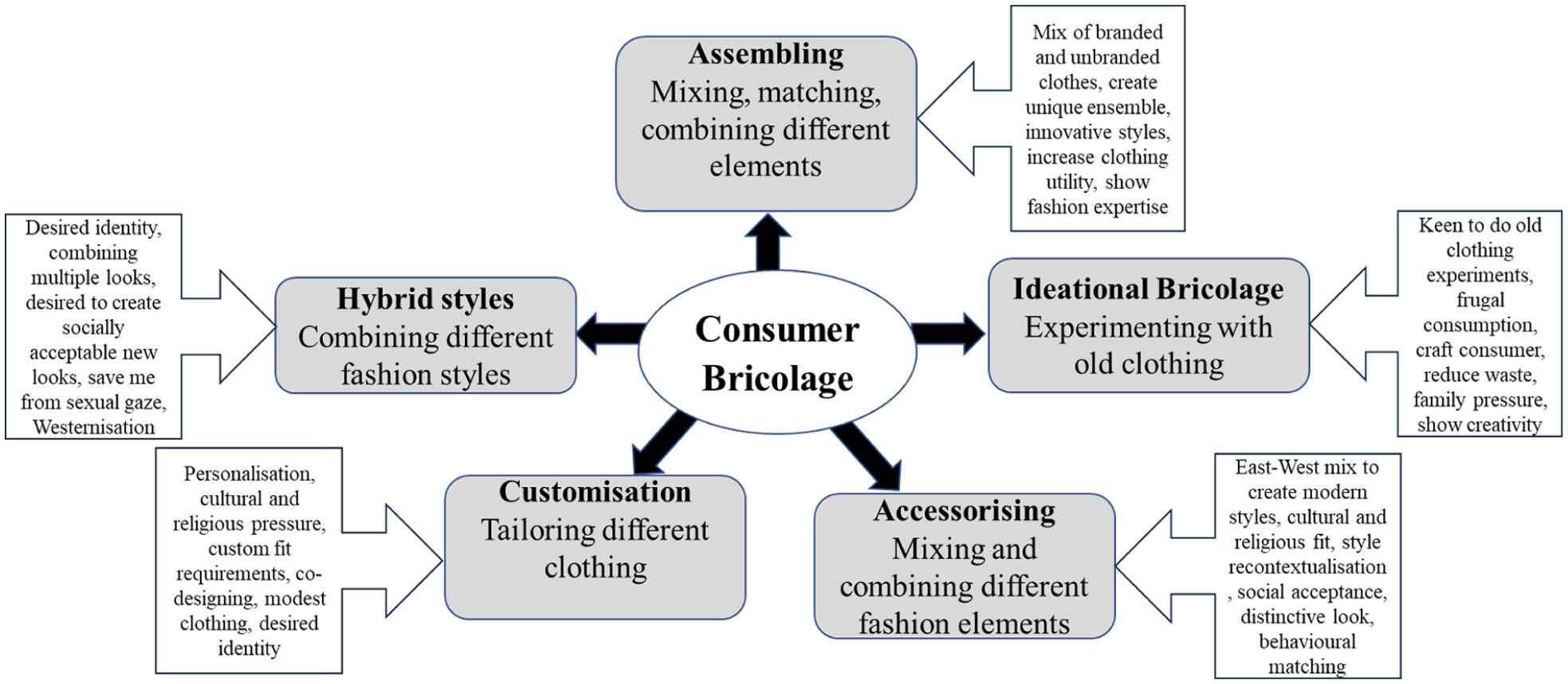
This study identified five fashion bricolage practices that participants use to construct their identities within the constraints of a socially restrictive society. Based on participants’ responses, we developed Figure 5, showing distinct aspects of consumer fashion bricolage. After consulting consumer behaviour experts, we labelled these practices ideational bricolage, accessorising, customisation, hybrid styles and assembling, each driven by specific social forces. The impact and role of each dimension and also discussed. Figure 5 shows social forces unique to each dimension, while Figure 6 highlights factors linked to overall consumer bricolage engagement.
Figure 5. Five-dimensional consumer bricolage model.
Figure 6. Motivations to engage in consumer bricolage.

Ideational bricolage

Participants described mixing old-fashioned elements (e.g. clothes and accessories) with new apparel to craft their desired styles. Ideational bricolage emerged from interviews with fashion designers and female participants. They engaged in redesigning and transforming their old clothing in unique ways. For instance, some cut pieces from their old clothes and use them with new clothes to create a new fashion style. Sometimes, they altered their old clothes to make them usable again. One interviewee said, ‘I usually repurpose my old clothes into short frocks and remove some motifs and embroidery pieces from my old shirts and creatively stitch or paste them into new shirts. This way, we can wear different versions of the same outfits a hundred times (laugh) without wasting lots of clothes and money(Interview 2; Sex female; Age 20; Profession student).
Our findings indicate that, because of clothing experimentation skills and sometimes family pressures, females were more engaged in old clothing experimentation than males. By experimenting with old clothes and styles, participants perform the role of bricoleur consumers, using self-enhancement and self-promotion strategies (Bolino et al., 2016) through frugality and creativity. They described themselves as individuals who could shape desired impressions by reusing old clothing rather than discarding it. Ideational bricolage often began with random identity experiments, progressed into planned identity experimentation and advanced to identity refinement as participants gained confidence (see Table 3).
Table 3. Mapping Consumer Bricolage Practices, Identity Construction Stages and Impression Management Strategies.
Bricolage practiceIdentity stagesImpression management strategies
Ideational bricolageRandom identity experiment, planned identity experiment, identity refinementSelf-enhancement, exemplification, self-promotion
AccessorisingIdentity awareness, random identity experiment, identity refinementSelf-promotion, opinion conformity
CustomisationIdentity confirmation, identity refinement, planned identity experimentSelf-enhancement, self-promotion, exemplification
Hybrid stylesRandom identity experiment, planned identity experiment, identity confirmationSelf-enhancement, exemplification, opinion conformity
AssemblingPlanned identity experiment, identity refinement, fashion opinion leaderSelf-enhancement, self-promotion, opinion conformity

Accessorising

Most participants mentioned they creatively engaged in mixing, matching and combining accessories (e.g. watch, handbag, purse, belt, glasses and jewellery) with clothes to construct their modern styles (i.e. an East-West mix), especially for specific occasions (e.g. Eid, Ashoor, a cultural event, marriage, spring festivals, etc.). Female participants adapted Western styles by adding Eastern accessories to align with cultural norms. In contrast, male participants combined accessories to create personalised styles, noting less cultural pressure. Two participants in the open-ended surveys shared similar views. One participant said, ‘I usually buy Western and Eastern-style accessories and clothes, then creatively mix them to form a unique but socially acceptable style. I heavily wear Western styles clothes with Eastern-style accessories and makeup to protect myself from the lecherous gaze(Open-ended survey; Sex female; Age 26; Profession professional). Another participant stated, ‘I properly match accessories with my outfits, such as matching either belt, purse, or footwear with my watch to create a unique ensemble(Open-ended survey; Sex male; Age 22; Profession student).
By combining Western-style clothing with traditional accessories (and vice versa), participants balance individual agency and social integration, supporting Sandikci and Ger’s (2010) argument about negotiating contrasting social images. Accessorising is both an ongoing and initial practice through which consumers carefully navigate and construct new identities without fully transforming their outfits, performing random experiments to refine their identity (see Table 3).

Customisation

We identified customisation as a critical component in consumer fashion bricolage. Most female participants customised their existing or new clothing by resizing or reshaping it to meet their fashion needs, custom-fit requirements or to manage cultural and religious expectations. One participant described her customisation practices, ‘I alter my dupatta (long headscarf) into a short shirt or belt and Eastern Kurta (long shirt) into a short shirt to create a Western but acceptable look. I recently wore a Western Trumpet Maxi and added Eastern embellishment . . . otherwise, my husband and his family and relatives criticised me(Interview 34; Sex female; Age 28; Profession professional).
Customisation typically emerges when participants feel the need to control how they present their identity (Bhattacharjee et al., 2014). They engage in planned experiments by customising outfits to refine their identity and solidify impressions within cultural and religious norms. While engaging in customisation, consumers use impression management strategies (Goffman, 1978) such as self-enhancement through tailored-fit experiments, exemplification by maintaining modesty and self-promotion by demonstrating proactive creativity (see Table 3).

Hybrid styles

Consumers combine assorted styles to create their desired identity. Most participants, especially university students, combined formal, casual, exotic, punk, cultural and religious styles to create hybrid fashions that conform to their social values. By doing so, they engage in exemplification and opinion conformity strategies (Bolino et al., 2016). Consumers often tried to negotiate the tension between what to wear and in which situations to integrate their styles into their social environment. One participant said: ‘I create the hybrid look by combining Western-style trousers with Eastern Kamiz (long shirt). I usually wear Eastern dresses at family functions . . . to avoid controversy, whereas Western outfits on fashion shows . . . to construct my image as purely a Western(Interview 7; Sex female; Age 21; Profession student).
By engaging in hybrid styling, consumers navigate cultural contradictions and form identities that are both expressive and socially acceptable by balancing personal preferences with social expectations.

Assembling

Describes how consumers engage in mixing, matching and combining different colours, prints and clothing fabrics. Participants described mixing colours, prints and branded items with unbranded clothes, creatively combining items like shirts, trousers, scarves, belts and shoes to craft unique looks. Some participants combined new and existing clothes to create fresh ones. Others folded sleeves, paired jeans with long tops and matched dresses with various headscarves for different occasions. They engage in self-promotion and self-enhancement strategies (Goffman, 1978) by strategically presenting their socially admired expertise in innovative ways. One female said, ‘Once I bought and wore a straight shirt and a gown for Eid (religious event), later I used the same dress in three following functions by mixing and swapping it with a fancy jacket, different colours of dupatta (headscarf), and an embellished gown(Interview 14; Sex female; Age 22; Profession student).
Assembling demonstrates mature bricoleur skills used to create innovative looks with limited resources. This practice is primarily associated with the refinement and fashion leader stages of identity and is tactfully employed to construct and manage impressions within restrictive social boundaries (see Table 3).
Our findings indicate that consumers who possess appropriate bricoleur skills believe they can better construct their desired identity. Drawing on our findings, we conceptualise consumer bricolage as ‘the creative and strategic recombination of available cultural and material resources to manage impressions and negotiate identity’.
Table 3 presents the links between bricolage practices, identity stages and impression management strategies, discussed under each specific bricolage practice. This mapping highlights identity construction as an evolving process, where bricolage enables consumers to express and refine their identities to form desired impressions within socially constrained environments.

Underlying motivations to engage in consumer bricolage

We analysed participant responses and, based on their input and expert consultation, identified 12 factors underlying consumer bricolage. Further analysis enabled the subdivision of these motivations and outcomes into two distinct subgroups (see Figure 6).
The findings demonstrate that the six motivations for consumer bricolage (grouped into awareness of social restrictions and consumer consciousness; see Figure 6) are analogous to the first four identity stages discussed in Figure 4. The first four identity stages facilitate consumers’ learning in constructing the first part of their identity, and the motivations for consumer bricolage enhance their learning in using bricolage within a restrictive social environment.

Awareness of social restrictions

Our findings reveal that consumers’ fashion choices are influenced by various environmental stimuli, including interpersonal, media and cultural and religious influences. Participants, particularly students, explained that their fashion interests were often influenced by peers, friends, colleagues, parents and other family members, mainly to conform to social norms, using the opinion conformity strategy (Bolino et al., 2016) to manage their desired impressions. Peer influence helped them understand acceptable styles, while social media exposure, fashion shows, celebrities and TV shaped their fashion choices. Social media helps them find economic ways to tweak their fashion styles in line with their prescribed social norms and restrictions.
Apart from interpersonal and media influences, the findings revealed that culture and religion played a significant role in forming consumers’ clothing tastes in restrictive social environments. We combine cultural and religious influences into one category since cultural values and belief systems in Pakistan are based on individuals’ religious ideology. The findings demonstrated that three factors of awareness of social restrictions enhanced consumers’ learning and consciousness about different fashion trends that they can safely adopt within their restrictive environment. One participant commented on her fashion choices: ‘Since childhood I was spending most of my time on social media to understand traditional and Western fashion trends. I usually adopt Western cutlines and make them Eastern to shut the mouth of advocates of social. Otherwise, perhaps no one marries me since males in my society are hypocrites, and they want Western-style girlfriend but Eastern-style wives(Interview 35; Sex female; Age 30; Profession professional).
The findings show that interpersonal influences play the second most important role in fostering awareness of social restrictions. For instance, one participant said, ‘I refrain from wearing short shirts and jeans since people consider me vulgar . . . traditional and cultural values compel me to wear Eastern attire, yet my affluent friends encourage me to embrace Western fashion(Interview 36; Sex female; Age 26; Profession professional). Based on the analysis, we found that consumer consciousness of fashion clothing is linked to the level of social restrictions a person is exposed to.

Consumer consciousness

Participants suggested that three factors of awareness of social restrictions lead to three factors of consumer consciousness: consumers’ public self-consciousness, fashion consciousness and fashion clothing involvement. Participants, mainly students and fashion designers, said they invested considerable time and money in managing their public appearance through clothing. The findings show that public self-conscious consumers had greater interest in fashion, thereby increasing their fashion consciousness. For these participants, fashion was viewed as a visible, meaningful and central aspect of their lives.
The findings revealed that factors within the category of consumer consciousness encourage individuals to engage in bricolage practices of assembling, accessorising and hybrid styling. Self-conscious and fashion-conscious participants were more involved in clothing experimentation because they wanted to align their fashion styles with their social environment to conform to social norms (Bolino et al., 2016) and gain social validation. One male participant stated: ‘Nowadays, people give respect and value based on our good sense of style, and here, good sense means the style which is Western but follows social values. So, I create a unique ensemble by experimenting with different clothing every day(Interview 15; Sex male; Age 25; Profession student).
The findings suggest that bricolage in clothing is effortful and time-consuming, yet all participants engage in it due to intense external pressures and internal desires. Furthermore, the outcomes of consumer bricolage are related to the social and psychological benefits consumers gain by experimenting with their clothing. The six outcomes of consumer bricolage (grouped into maintaining individual attitudes and conforming to social norms) in Figure 6 are similar to what we discussed in the last three identity stages in Figure 4. In both cases, participants sought to communicate unique, innovative and socially acceptable identities within their social environments.

Maintaining individual attitude

Interview findings show that innovativeness helped consumers establish their unique identity and gain respect and social recognition among other fashion-conscious people. All participants said that they created their distinctive looks not only for themselves, but also for others, to establish their image as fashion experts. These types of participant discussions are underpinned by self-promotion, exemplification and self-enhancement strategies (Bolino et al., 2016; Goffman, 1978).
Participants said that mixing and matching fashion elements boosted their creativity, self-expression and confidence (see Figure 6). For instance, one participant said: ‘Mixing and customising different clothing helps me to create many novel and trendy looks . . . I live in a paradoxical society where girls distrust men in pure Western clothes yet hesitate to engage with those in purely traditional attire. So, it is very challenging to follow Western patterns in your clothing within social boundaries(Interview 21; Sex male; Age 34; Profession professional). This quote demonstrates how consumers engage in bricolage practices, such as accessorising, customisation and hybrid styling, to showcase their fashion innovation and construct unique identities. In patriarchal societies, females face more severe restrictions than males in regulating appearance, behaviour and identity expression (Al-Mutawa et al., 2023; Sobh et al., 2014).

Conforming social norms

The findings identified three outcomes of bricolage: cultural and religious identity, social recognition and fashion opinion leadership (see Figure 6). Participants reported customising clothing styles to align with cultural and religious values, with some embracing these values willingly rather than feeling pressured to do so. One participant said, ‘As a Muslim, I adhere to certain religious practices on Fridays . . . I wear a hijab to cover my head and a dupatta over the shalwar qameez to cover my body. Yes, I do many experiments with my hijab and shalwar qameez to create trendy looks(Interview 2; Sex female; Age 20; Profession student). Participants, particularly females, engage in customisation and hybrid styling to form impressions that align with their cultural and religious values. Another participant said, ‘I wear modern but non-vulgar outfits, which give me social appreciation. Otherwise, my family banned my social gatherings because of serious social ramifications(Interview 11; Sex female; Age 22; Profession student). Participants said that by incorporating cultural and religious values into Western styles, they get social acceptance, respect and recognition from their social environment. Participants appeared to engage in exemplification and self-enhancement strategies (Goffman, 1978) and created modern styles that others followed and considered fashion leaders. One male participant said, ‘I try to become inimitable, inventive, and iconic in fashion by mixing local and global styles. In this way, I become easily successful(Interview 32; Sex male; Age 29; Profession professional).

Discussion

The literature on consumer identity construction and bricolage in socially restrictive societies remains limited. Most studies examine identity formation in more permissive or Western contexts and pay less attention to how cultural, social and religious constraints shape identity work in restrictive environments. This study addresses this gap by proposing a seven-stage model of consumer identity construction grounded in the Pakistani context. The model links impression-management and identity-work perspectives to explain why and when consumers move across identity states, framing transitions as driven by feedback, reflexivity and evolving social capital. It also reframes identity construction as dynamic and non-deterministic, with individuals continually calibrating impression-management tactics (e.g. exemplification, self-promotion and opinion conformity) and narrative identity repair in response to shifting expectations and sanction risk. In doing so, the study deepens impression-management theory by incorporating recursive feedback and extends identity-work research to high-risk settings where surveillance and sanctions shape everyday identity negotiation.
The study also identifies five bricolage practices (hybrid styling, customising and upcycling, accessorising, ideational reuse, assembling) and twelve underlying motivations that explain why particular tactics are adopted at different points in the identity trajectory. These practices are both expressive and protective, enabling experimentation while sustaining a veneer of conformity and distributing risk across settings, audiences and material artefacts. By tracing how motivations, tactics and perceived risks interact over time, we extend bricolage research from creative recombination to a relational, context-sensitive account of bricolage as a means of managing identity and vulnerability in socially restrictive contexts.
Evidence further indicates that bricolage capabilities can be a key resource for navigating identity construction under constraints. Participants with fewer opportunities, skills or resources for bricolage reported greater vulnerability to sanctions when their appearance deviated from expectations. However, bricolage is not the only pathway for managing these tensions; some individuals may withdraw from fashion, rely on discursive justification or shift identity work into less visible domains. Finally, the findings show that bricolage practices are shaped by societal structures, including gendered expectations, family surveillance and religious interpretations. This underscores the value of integrating consumer behaviour, identity research and sociocultural theory to explain identity construction in contexts defined by strong social and religious constraints.

Theoretical contributions

This study contributes to impression management theory, identity work research and the bricolage literature in four ways by expanding their scope, refining their application and introducing mechanisms specific to socially restrictive societies.
First, we extend bricolage beyond resource recombination to a repertoire of impression management tactics. Classic accounts emphasise improvisation and creative recombination under material or market constraints (Lévi-Strauss, 1966), and recent organisational research shows how bricolage helps actors cope with institutional voids and resource scarcity (Abid et al., 2023; Wijekoon et al., 2024). We build on this work by showing that bricolage in fashion consumption operates as a structured set of micro-practices that consumers deploy to reconcile expectations of modesty, tradition and modernity. These practices allow consumers to calibrate visibility, recognisability and deniability in ways that reduce sanction risk while sustaining a sense of self. By demonstrating how psychological and sociocultural motives, including public self-consciousness, cultural and religious identity, fashion innovativeness and status aspirations, shape bricolage choices, we extend bricolage theory from resourcefulness to identity regulation embedded in power, risk and surveillance.
Second, we refine dynamic accounts of impression management by theorising feedback loops and tactic selection in high-risk offline settings. Reviews highlight the need for more processual work that situates self-presentation in specific institutional and technological environments (Bolino et al., 2016; Blunden & Brodsky, 2024; Gupta & Sagadevan, 2024). While classic formulations describe impression management as situational, responsive and unfolding over time (Goffman, 1978; Leary & Kowalski, 1990), empirical research has largely focussed on low-risk or digitally mediated contexts where sanctions are limited. Our process model specifies how self-presentation unfolds across repeated episodes in environments where missteps can trigger moral policing, harassment or physical danger. We identify feedback loops in which consumers monitor audience reactions, update threat appraisals and adjust bricolage tactics, producing patterned shifts between more accommodative and more assertive presentations. We also identify boundary conditions shaping tactic selection and pacing, including perceived sanction risk, gendered norms and access to cultural capital. Together, these insights explain why identity work in such contexts is cyclical rather than linear and clarify when consumers switch from conforming bricolage to more assertive, norm-stretching presentations.
Third, we contribute to identity work research by theorising a seven-stage, non-deterministic process of consumer identity construction under constraint. Identity work theories emphasise how consumption objects extend and express the self (Belk, 1988) and how marketplace resources help people negotiate who they are and who they are not (Bhattacharjee et al., 2014; Sobh et al., 2014). Our model shows how young consumers move from pre-identity, through experimentation and provisional confirmation, to more deliberate experimentation, refinement and occasional opinion leadership in a tightly policed context. Rather than treating these as age-graded phases, we conceptualise them as states that individuals enter and exit in response to social feedback, emotional regulation needs and changing role demands. This framing integrates impression management motives, such as face saving and acceptance, with identity work concerns, such as self-verification and narrative coherence. It also clarifies how some consumers remain in earlier stages, how others shift quickly when endowed with high cultural capital, and how repeated cycling can become a durable trajectory. In doing so, the study details how agency and constraint interact over time in high-risk consumption domains and shows how material practices such as dress bricolage carry substantial identity labour in restrictive contexts.
Fourth, we integrate consumer behaviour and sociocultural perspectives to theorise identity construction in socially restrictive societies. Research on modest fashion and veiling shows how clothing can contest or reassert dominant norms in Muslim and other religiously shaped contexts (Al-Mutawa et al., 2023; Christiansen, 2011; Sobh et al., 2014). We add to this work by locating bricolage practices within gendered expectations, family surveillance and religious interpretations in Pakistan, and by showing that self-presentation is a situated response to institutionalised control. The model therefore offers a contextually grounded account of offline impression management when audiences are co-present, sanctions are salient and the boundary between respectability and deviance is thin.
These contributions reposition fashion consumption from a discretionary lifestyle choice to a form of adaptive agency through which young consumers manage vulnerability while maintaining a liveable sense of self, and they open new avenues for theorising how impression management, identity work and bricolage intersect in everyday dress practices where the costs of failed self-presentation are high.

Managerial implications

We examined how consumers in socially restrictive contexts construct identity through bricolage practices. These practices depict the stepwise progression captured in the identity construction model identified in the findings, enabling individuals to balance self-expression with social acceptability, where social criticism is salient. The implications translate the evidence and insights into decisions for brand managers, merchandisers, retail partners and consumers in markets where clothing reflects identity and social norms.
Product portfolio design should recognise the hybrid styling practice of bricolage identified in the findings as a mechanism through which consumers negotiate multiple audiences. Assortments that integrate modest silhouettes with selected global cues allow socially acceptable distinctiveness, with modular pieces supporting recombination across settings. Layering items, tunic-and-trouser pairings and adjustable lengths can be configured for workplace and family occasions, in line with the identity transitions highlighted in our model. The contribution of such assortments is strongest in districts that present diverse audience expectations, while conservative venues may require default modest silhouettes. Routine assortment reviews that include commentary on comfort with social expectations, along with observed uptake of configurable items, provide helpful feedback for refinement.
Customisation and upcycling warrant support as brand services, reflecting our results that bricolage enables low-risk identity management. Accessorising and minor alterations function as low-risk strategies that manage identity within social bounds. Retail operations can legitimise these practices through basic alterations, straightforward online adjustments and curated accessory bundles that blend local and global motifs, as identified in the findings about how consumers engage in bricolage practices. Educational content that demonstrates ideational reuse helps consumers reconcile their preferences with prevailing norms. In conservative districts, discreet service formats and packaging reduce social exposure. Standard service analytics and feedback indicate whether these initiatives create perceived safety and expressive latitude.
Marketing communications should be calibrated to contextual norms and gendered exposure, informed by the study’s finding that sanction risk varies by setting. Scrutiny is not evenly distributed, and particular venues heighten the risk of censure. Communication that mirrors the lived negotiation of norms is appropriate. Narratives can foreground balanced expression and provide styling guidance for impression management (aligned with our model’s emphasis on feedback, reflexivity and identity repair). At the same time, the prominence of body revealing silhouettes varies by channel. Staff guidelines that emphasise private and respectful assistance are advisable where sanction sensitivity is high. Routine monitoring of modesty related sentiment and complaints supports adjustment.
Collaboration with local actors strengthens legitimacy and reduces the risk of tokenism. Partnerships with local designers, micro tailors, student organisations and modest wear influencers help embed offerings within existing practices. Co-designed hybrid pieces and community demonstrations of assembling, accessorising and customising translate research insights into practices recognised as authentic.
Managerial interventions may be more effective when they reflect identity construction as an iterative journey rather than a single campaign, as outlined in the seven-stage, identity construction process in this research. Identity construction can be managed as it progresses through accessible steps that many consumers can undertake with limited social risk. Firms can support this progression by making low-commitment accessorising and simple adjustments easy to trial, then enabling more visible hybrid combinations as confidence grows. Discreet advice, modular products that recombine across settings and practical content that demonstrates ideational reuse allow consumers to experiment while preserving social acceptability. A stepwise pathway that begins with low-commitment accessorising, progresses to simple customisation and then to more visible hybrid combinations mirror the staged, progressive identity shifts uncovered in our model of consumer bricolage. Branding content should normalise movement across these steps and provide opportunities to adjust without stigma. Marketing signs and symbols of repeated engagement, using progressively more visible options and references to feelings of both protection and self-expression, indicate that this pathway is functioning as intended.
Ethical safeguards are integral where failed impressions can carry reputational, moral or physical risks. Storytelling that features identifiable individuals should be based on opt-in consent with de-identification available on request. Staff training for assistance, together with communication that avoids stereotyping and frames hybrid styling as consumer-authored rather than brand-dictated, aligns implementation with impression management realities and reduces the likelihood of unintended harm.
Taken together, these implications position consumer bricolage (via hybrid styling, customisation, calibrated communication and collaborative making) and ethical safeguards as complementary levers, both directly informed by the study’s evidence. The guidance is intentionally framed as adaptable across sectors and formats, with evaluation embedded in existing assortment, service and communication reviews. This alignment increases the likelihood that key stakeholders can translate the findings into practice in contexts where clothing serves as an identity expression and a social signal.

Limitations and future research

This study has limitations that open opportunities for further research. First, our study examined clothing and apparel products. Future studies can examine identity construction and consumer bricolage across diverse consumption behaviours, including product categories such as furniture, interior design, electronics, cars and other identity-signalling goods. We expect differences due to higher involvement and less frequent purchases compared to clothing. Second, we developed a seven-stage consumer identity construction process based on qualitative data. However, this process could be refined and generalised, involving more diverse samples or the employment of different methodological approaches to enhance its robustness and applicability. Also, we did not identify any alternative identity construction pathways beyond the seven stages. Future research could employ longitudinal methods to uncover more complex identity trajectories. Third, we identified five bricolage dimensions but did not measure them. Davidsson et al. (2017) suggest developing domain-specific bricolage measures. Developing a consumer bricolage measure from these dimensions is a key future research direction. Fourth, the current study identified a framework of underlying motivations that encourage consumers to engage in bricolage. This framework can be empirically tested. Finally, this study draws on evidence from Pakistan, a socially restrictive society where cultural and religious norms strongly shape identity work. Future studies should extend this model through comparative or cross-national research to test its applicability in both restrictive and open societies. This research was conducted among urban, middle-class and upwardly mobile segments. Future research could be extended to lower socioeconomic groups to explore how identity construction unfolds under more severe resource constraints. These segments may exhibit alternative pathways of identity construction.

Declaration of conflicting interests

The authors declared no potential conflicts of interest with respect to the research, authorship, and/or publication of this article.

Funding

The authors received no financial support for the research, authorship, and/or publication of this article.

ORCID iD

References

Abid M., Bothello J., Ul-Haq S., Ahmadsimab A. (2023). The morality of informality: Exploring binary oppositions in counterfeit markets. Organization Studies, 44(5), 687–711.
Alam M. A., Talib N., Bhatti O. K. (2018). Woes that plague the future demographic dividends of Pakistan. Journal of Research in Social Sciences, 6(1), 1–19.
Al-Mutawa F. S., Almutawaa D. S., AlJuma D. H. M. (2023). The impact of socio-cultural structures on (un)veiling Western luxury fashion brands: Perceptions of Kuwaiti Muslim women. Journal of International Consumer Marketing, 35(4), 367–387.
Belk R. W. (1988). Possessions and the extended self. Journal of Consumer Research, 15(2), 139–168.
Bhattacharjee A., Berger J., Menon G. (2014). When identity marketing backfires: Consumer agency in identity expression. Journal of Consumer Research, 41(2), 294–309.
Blumer H. (1969). Symbolic interactionism (Vol. 2, No. 6). Prentice-Hall.
Blumer H. (1986). Symbolic interactionism: Perspective and method. University of California Press.
Blunden H., Brodsky A. (2024). A review of virtual impression management behaviors and outcomes. Journal of Management, 50(6), 2197–2236.
Bolino M. C., Kacmar K. M., Turnley W. H., Gilstrap J. B. (2008). A multi-level review of impression management motives and behaviors. Journal of Management, 34(6), 1080–1109.
Bolino M. C., Long D., Turnley W. H. (2016). Impression management in organizations: Critical questions, answers, and areas for future research. Academy of Management Annals, 10(3), 619–672.
Bourdieu P. (1989). Social space and symbolic power. Sociological Theory, 7(1), 14–25.
Brown S., Kozinets R. V., Sherry J. F. Jr. (2003). Teaching old brands new tricks: Retro branding and the revival of brand meaning. Journal of Marketing, 67(3), 19–33.
Christiansen C. C. (2011). Contesting visibilities: Sartorial strategies among Muslim women in Danish media. Journal of Intercultural Studies, 32(4), 335–353.
Corbin J. M., Strauss A. (1990). Grounded theory research: Procedures, canons, and evaluative criteria. Qualitative Sociology, 13(1), 3–21.
Courtois C., Picard C. F., Gendron Y. (2025). Spotlight on identity construction among professionals transitioning to an emerging occupation. Journal of Professions and Organization, 12(1), Article joae016.
Cushman P. (1990). Why the self is empty: Toward a historically situated psychology. American Psychologist, 45(5), 599–611.
Das M., Jebarajakirthy C. (2020). Impact of acculturation to western culture (AWC) on western fashion luxury consumption among Gen-Y consumers in the Asia-Pacific region. Journal of Retailing and Consumer Services, 56, Article 102179.
Davidsson P., Bakar T., Senyard J. M. (2017). A measure of entrepreneurial bricolage behavior. International Journal of Entrepreneurial Behavior & Research, 23(1), 114–135.
Dion D., Mazzalovo G. (2016). Reviving sleeping beauty brands by rearticulating brand heritage. Journal of Business Research, 69(12), 5894–5900.
DuFault B. L., Schouten J. W. (2020). Self-quantification and the datapreneurial consumer identity. Consumption Markets & Culture, 23(3), 290–316.
Erikson E. H. (1968). Identity, youth and crisis. Norton.
Expert Market Research. (2025). India clothing market size & share outlook — Forecast trends and growth analysis report (2025–2034). https://www.expertmarketresearch.com/reports/india-clothing-market
Felix R., Rauschnabel P. A., Hinsch C. (2017). Elements of strategic social media marketing: A holistic framework. Journal of Business Research, 70, 118–126.
Gabol I., Subhani T. (2016, July 16). Qandeel Baloch murdered by brother in Multan: Police. Dawn. https://www.dawn.com/news/1271213
Gabriel Y., Lang T. (2015). The unmanageable consumer. Sage.
Gardner W. L., Martinko M. J. (1988). Impression management in organizations. Journal of Management, 14(2), 321–338.
Giddens A. (1991). Modernity and self-identity (p. 15). Polity.
Goffman E. (1978). The presentation of self in everyday life. Penguin Books.
Goto M. (2023). Expressing identity through the dressed body: A study of Iranian migrants in Gulf Cooperation Council countries. In Matsukawa K., Watanabe A., Babar Z. R. (Eds.), Transnational generations in the Arab Gulf States and beyond (pp. 185–209). Springer Nature Singapore.
Goulding C. (2005). Grounded theory, ethnography and phenomenology: A comparative analysis of three qualitative strategies for marketing research. European Journal of Marketing, 39(3/4), 294–308.
Gupta A., Sagadevan K. (2024). Research on impression management: Current progress and future possibilities. GLIMS Journal of Management Review and Transformation, 3(1), 29–40.
Harrington J. R., Boski P., Gelfand M. J. (2015). Culture and national well-being: Should societies emphasize freedom or constraint? PLoS ONE, 10(6), e0127173.
Ibarra H., Barbulescu R. (2010). Identity as narrative: Prevalence, effectiveness, and consequences of narrative identity work in macro work role transitions. Academy of Management Review, 35(1), 135–154.
Imtiaz A. (2015). Business expansion of apparel brands: Accessing opportunities in apparel/retail sector in Pakistan [Master’s thesis]. University of Borås, Sweden.
Jaber R. (2020). Modern bodies and changing identities. Journal of Middle East Women’s Studies, 16(3), 346–350.
Jang W. E., Chun J. W., Kim J. J., Bucy E. (2021). Effects of self-presentation strategy and tie strength on Facebook users’ happiness and subjective vitality. Journal of Happiness Studies, 22(7), 2961–2979.
Jensen Schau H., Gilly M. C. (2003). We are what we post? Self-presentation in personal web space. Journal of Consumer Research, 30(3), 385–404.
Jeong H. J., Jiang M. (2021). Signalling consumer impressions with CSR support on social media: The roles of industry stigma and consumer self-disclosure. Journal of Interactive Advertising, 21(3), 256–268.
Lam S. K., Ahearne M., Mullins R., Hayati B., Schillewaert N. (2013). Exploring the dynamics of antecedents to consumer–brand identification with a new brand. Journal of the Academy of Marketing Science, 41(2), 234–252.
Leary M. R. (2019). Self-presentation: Impression management and interpersonal behavior. Routledge.
Leary M. R., Kowalski R. M. (1990). Impression management: A literature review and two-component model. Psychological Bulletin, 107(1), 34–47.
Lévi-Strauss C. (1966). The savage mind. University of Chicago Press.
Lim W. M., Agarwal R., Mishra A., Mehrotra A. (2025). The rise of fake reviews: Toward a marketing-oriented framework for understanding fake reviews. Australasian Marketing Journal, 33(2), 178–198.
Little L. (2017). Vogue cover girl’s alleged suicide may have been murder. 9Honey. https://honey.nine.com.au/latest/60-minutes-preview-model/dc8283d0-364e-4bab-a747-04d2978aa516
Maciel A. F., Wallendorf M. (2021). Space as a resource in the politics of consumer identity. Journal of Consumer Research, 48(2), 309–332.
Maree J. G. (2022). The psychosocial development theory of Erik Erikson: Critical overview. In R. Evans & O. N. Sarcho (Eds.), The influence of theorists and pioneers on early childhood education (pp. 119–133). Routledge.
McFarland L. A., Hendricks J. L., Ward W. B. (2023). A contextual framework for understanding impression management. Human Resource Management Review, 33(1), Article 100912.
Mead N. L., Baumeister R. F., Stillman T. F., Rawn C. D., Vohs K. D. (2011). Social exclusion causes people to spend and consume strategically in the service of affiliation. Journal of Personality and Social Psychology, 100(6), 1092–1107.
Mishra S., Shukla Y., Malhotra G., Chatterjee R., Rana J. (2023). Millennials’ self-identity and intention to purchase sustainable products. Australasian Marketing Journal, 31(3), 199–210.
Nag R., Corley K. G., Gioia D. A. (2007). The intersection of organizational identity, knowledge, and practice: Attempting strategic change via knowledge grafting. Academy of Management Journal, 50(4), 821–847.
O’Cass A. (2004). Fashion clothing consumption: Antecedents and consequences of fashion clothing involvement. European Journal of Marketing, 38(7), 869–882.
O’Cass A., Choy E. (2008). Studying Chinese Generation Y consumers: Consumer involvement in fashion clothing and brand status. Journal of Product & Brand Management, 17(5), 341–352.
O’Cass A., Lee W., Siahtiri V. (2013). Can Islam and status consumption live together in the house of fashion clothing? Journal of Fashion Marketing and Management, 17(4), 440–459.
O’Cass A., Siahtiri V. (2013). In search of status through brands of Western and Asian origins: Examining the changing face of consumption in Chinese young adults. Journal of Retailing and Consumer Services, 20(6), 505–515.
O’Cass A., Siahtiri V. (2014). Are young adult Chinese status and fashion clothing brand conscious? Journal of Fashion Marketing and Management, 18(3), 284–300.
Ozansoy Çadırcı T., Sağkaya Güngör A. (2019). Love my selfie: Selfies in managing impressions on social networks. Journal of Marketing Communications, 25(3), 268–287.
Patton M. Q. (2014). Qualitative research & evaluation methods: Integrating theory and practice. Sage Publications.
Philp M., Nepomuceno M. V. (2020). When the frugal become wasteful: An examination into how impression management can initiate the end-stages of consumption for frugal consumers. Psychology & Marketing, 37(2), 326–339.
Polletta F., Jasper J. M. (2001). Collective identity and social movements. Annual Review of Sociology, 27, 283–305.
Pounders K., Kowalczyk C. M., Stowers K. (2016). Insight into the motivation of selfie postings: Impression management and self-esteem. European Journal of Marketing, 50(9/10), 1879–1892.
Price L. L., Arnould E. J. (1999). Commercial friendships: Service provider–client relationships in context. Journal of Marketing, 63(4), 38–56.
Proudfoot J. G., Wilson D., Valacich J. S., Byrd M. D. (2018). Saving face on Facebook: Privacy concerns, social benefits, and impression management. Behaviour & Information Technology, 37(1), 16–37.
Ramadan Z. B., Mrad M. (2017). Fashionable stereotypes and evolving trends in the United Arab Emirates. Customer Needs and Solutions, 4(1), 28–36.
Rasool M. (2024). Cultural tapestry: The role of popular culture in shaping identities and modernity in Pakistan. Al-Qanṭara, 38, 38–59.
Rosenberg J., Egbert N. (2011). Online impression management: Personality traits and concerns for secondary goals as predictors of self-presentation tactics on Facebook. Journal of Computer-Mediated Communication, 17(1), 1–18.
Sandikci Ö., Ger G. (2010). Veiling in style: How does a stigmatized practice become fashionable? Journal of Consumer Research, 37(1), 15–36.
Sarkar J. G., Sarkar A. (2022). S/he styles: Narcissistic fashion apparel consumption in India. Journal of Consumer Marketing, 39(1), 55–65.
Scaraboto D., Fischer E. (2013). Exploring consumers’ and marketers’ navigation of fashion systems. European Advances in Consumer Research, 10, 31–34.
Segev R., Shoham A., Ruvio A. (2013). Gift-giving among adolescents: Exploring motives, the effects of givers’ personal characteristics and the use of impression management tactics. Journal of Consumer Marketing, 30(5), 436–449.
Sezer O. (2022). Impression (mis) management: When what you say is not what they hear. Current Opinion in Psychology, 44, 31–37.
Singelis T. M. (1994). The measurement of independent and interdependent self-construals. Personality and Social Psychology Bulletin, 20(5), 580–591.
Sobh R., Belk R., Gressel J. (2014). Mimicry and modernity in the Middle East: Fashion invisibility and young women of the Arab Gulf. Consumption Markets & Culture, 17(4), 392–412.
Sörum N., Gianneschi M. (2023). The role of access-based apparel in processes of consumer identity construction. Journal of Fashion Marketing and Management: An International Journal, 27(1), 61–79.
Stopfer J. M., Egloff B., Nestler S., Back M. D. (2014). Personality expression and impression formation in online social networks: An integrative approach to understanding the processes of accuracy, impression management and meta–accuracy. European Journal of Personality, 28(1), 73–94.
Sveningsson S., Alvesson M. (2003). Managing managerial identities: Organizational fragmentation, discourse and identity struggle. Human Relations, 56(10), 1163–1193.
UNICEF. (2019, April). MENA Generation 2030: Investing in children and youth today to secure a prosperous region tomorrow. https://www.unicef.org/mena/reports/mena-generation-2030
Vuori T. O., Huy Q. N. (2022). Regulating top managers’ emotions during strategy making: Nokia’s socially distributed approach enabling radical change from mobile phones to networks in 2007–2013. Academy of Management Journal, 65(1), 331–361.
Wang D., Song S., Chan F. F. Y., Feng L. (2023). The impact of impression construction consumption on social identity: A study on Chinese female professionals. Journal of Social Marketing, 13(2), 194–217.
Wijekoon S., O’Cass A., Vesal M. (2024). The impact of entrepreneurial marketing on new venture brand image and performance: A capability perspective. European Journal of Marketing, 58(6), 1463–1492. https://doi.org/10.1108/EJM-06-2023-0480
Wirtz J., Orsingher C., Chew P., Tambyah S. K. (2013). The role of metaperception on the effectiveness of referral reward programs. Journal of Service Research, 16(1), 82–98.
Yadav R. (2024). The influence of cultural and religious beliefs on consumer behavior. https://buzzpeakblog.wordpress.com/2024/11/08/the-influence-of-cultural-and-religious-beliefs-on-consumer-behavior/
Yin R. K. (2009). Case study research: Design and methods (Vol. 5). Sage.
Yunus A., Tahir M., Rehman S. U. (2023). Influence of social media on body image & fashion trends among youth. Journal of Peace, Development and Communication, 7(1), 315–328.
Zhang Y., Zhang J., Liu C. (2022). Motives for employees communicate positive electronic word of mouth (eWOM) on social network sites: Exploring moderating mechanisms. Australasian Marketing Journal, 30(1), 60–67.

Supplementary Material

Please find the following supplemental material available below.

For Open Access articles published under a Creative Commons License, all supplemental material carries the same license as the article it is associated with.

For non-Open Access articles published, all supplemental material carries a non-exclusive license, and permission requests for re-use of supplemental material or any part of supplemental material shall be sent directly to the copyright owner as specified in the copyright notice associated with the article.