Skip to main content
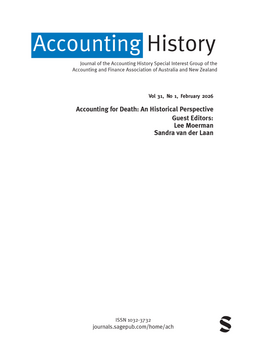




Volume 31 Issue 1, February 2026
Special Issue: Accounting for Death: An Historical Perspective
- Guest Editor: Lee Moerman
- Guest Editor: Sandra van der Laan
Special Issue Articles
Abstract
This article introduces the Special Issue of Accounting History examining the intersection of accounting and death from an historical perspective. Following an initial conceptualisation of death as a social phenomenon and accounting as a practice, we ...Open AccessResearch articleFirst published January 19, 2026pp. 3–8
Abstract
Six million Jews were exterminated during World War II. Not only did Hitler's regime eliminate Jews, it sought to erase evidence of their existence and contributions to society through the organised theft of Jewish art, furniture and cultural and ...Free accessResearch articleFirst published January 29, 2026pp. 9–39
Abstract
This article challenges the narrow confines of traditional accountability by introducing thanatoaccountability as a theoretical framework. Through an analysis of the German company Degussa during the Holocaust, we uncover how accounting metrics and ...Open AccessResearch articleFirst published February 2, 2026pp. 40–67
Abstract
This study compares the systems of accounts of death operating in London and Naples during the cholera epidemic of 1854. It adopts a translation in space and time of the Bourdieusian concepts of field, capital and habitus and analyses secondary sources as ...Free accessResearch articleFirst published September 15, 2025pp. 68–94
Abstract
The US military campaign in Vietnam was supposedly a ‘limited’ war. Calculative practices were vital for military and civilian leaders in managing the conflict and claiming progress against objectives. The most infamous accounting measure was ‘body count’,...Free accessResearch articleFirst published December 1, 2025pp. 95–116
Abstract
In the mid-1660s, London was impacted by the plague, and the period saw important changes in the government's responsibilities around issues of public health. This research studies the Bills of Mortality, the accounting for death and the use of these ...Open AccessResearch articleFirst published January 20, 2026pp. 117–139
Call for Papers
Restricted accessResearch articleFirst published January 19, 2026pp. 140–141
Restricted accessResearch articleFirst published January 20, 2026pp. 142
Restricted accessResearch articleFirst published January 20, 2026pp. 143–144
Restricted accessResearch articleFirst published January 16, 2026pp. 145–147
Export citation
 Facebook
 X
X LinkedIn
 YouTube
 RSS feed
 Email alerts
Also from Sage
- CQ Library Elevating debateopens in new tab
- Sage Data Uncovering insightopens in new tab
- Sage Business Cases Shaping futuresopens in new tab
- Sage Campus Unleashing potentialopens in new tab
- Sage Knowledge Multimedia learning resourcesopens in new tab
- Sage Research Methods Supercharging researchopens in new tab
- Sage Video Streaming knowledgeopens in new tab
- Technology from Sage Library digital servicesopens in new tab