Skip to main content
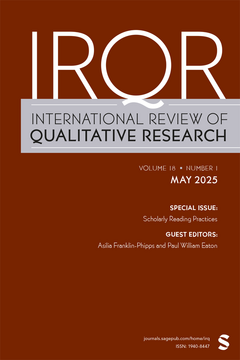





Volume 18 Issue 1, May 2025
Special Issue: Scholarly Reading Practices
- Guest Editor: Asilia Franklin-Phipps
- Guest Editor: Paul William Eaton
Articles
Restricted accessResearch articleFirst published February 13, 2025pp. 3–11
Abstract
ire’ne lara silva wrote “everything must be a little wild.” Reading should also be done with the entirety/wideness of being. In this article—which seeks to showcase/highlight the promise and responsibilities inherent in reading and writing—I chronicle ...Restricted accessResearch articleFirst published February 10, 2025pp. 12–24
Abstract
This visual-verbal essay is a modified version of the script for a virtual performance that I did as part of the “Scholarly Reading Practices” session at the ICQI conference in May 2022. It is a work of “autotheory” (McCrary, 2015) that explores the ...Restricted accessResearch articleFirst published February 11, 2025pp. 25–40
Abstract
This article engages with the intersections of reading, writing, and friendship (between the two authors). Specifically, we (re)trace conversations, presentations, notes, and text messages that have emerged since we (e.g., authors) have become thinking-...Restricted accessResearch articleFirst published September 5, 2024pp. 41–55
Abstract
In this article, I outline the academic life of reading, what it demands, and what it has become for too many—an evasion of thinking. I discuss the crisis that the evasion of reading has caused and how the contemporary university has promoted this crisis. ...Restricted accessResearch articleFirst published February 6, 2025pp. 56–66
Abstract
This paper engages with concepts from Nathan Snaza’s book Animate Literacies: Literature, Affect, and the Politics of Humanism in relation to reading practices as an academic, both as a scholar and as a teacher. This paper thinks with Snaza’s writing on ...Restricted accessResearch articleFirst published February 13, 2025pp. 67–79
Abstract
This paper will examine the role of affect as a key force in the experience of reading. I argue reading is an experience rather than an instrument of cognition. The latter, I suggest, gives way to dehumanizing and violating forms of reading as instrument ...Open AccessResearch articleFirst published February 7, 2025pp. 80–97
Abstract
This article’s contribution utilizes eroticism to re-imagine the meanings of what it is to feel fully and pleasurably as becoming, in tandem with existing, moving through, and/or being present to one’s traumas. Therefore, what possibilities emerge when ...Restricted accessResearch articleFirst published February 8, 2025pp. 98–108
Abstract
This article emerged from curiosity about how we, as white women, might responsibly engage the knowledges of Black women theorists in our reading practices. We briefly consider how whiteness in a white supremacist society has produced (our) reading ...Restricted accessResearch articleFirst published February 10, 2025pp. 109–122
Abstract
This collaboratively written article follows the narratives, memories, and reflections of six Black women and their professor, a White woman, as we read and grappled with theory in a qualitative research course. We explore our shared and individual ...Restricted accessResearch articleFirst published February 17, 2025pp. 123–143
Abstract
In this article, I catalog the lessons I have learned from reading beyond the qualitative inquiry canon. The catalog offers lessons based on seven infinitive verbs and/or verb phrases—to be patient, to tend, to linger, to love, to not say anything and/or ...Restricted accessResearch articleFirst published February 5, 2025pp. 144–149
Abstract
Since ancient times, humor has held an interesting place within philosophical readings describing human life and nature. Laughter and humor often received objections and negative assessments, with the idea that human life would not suffer much loss if ...Restricted accessResearch articleFirst published February 6, 2025pp. 150–162
Abstract
In this article, we engage the tension between the failures and possibilities of theories to which we hold attachments. The failure of theory for us is also the failure of qualitative research because as scholars who engage in philosophically informed and ...Restricted accessResearch articleFirst published February 10, 2025pp. 163–173
Export citation
 Facebook
 X
X LinkedIn
 YouTube
 RSS feed
 Email alerts
Also from Sage
- CQ Library Elevating debateopens in new tab
- Sage Data Uncovering insightopens in new tab
- Sage Business Cases Shaping futuresopens in new tab
- Sage Campus Unleashing potentialopens in new tab
- Sage Knowledge Multimedia learning resourcesopens in new tab
- Sage Research Methods Supercharging researchopens in new tab
- Sage Video Streaming knowledgeopens in new tab
- Technology from Sage Library digital servicesopens in new tab