Skip to main content
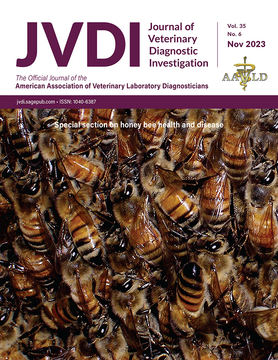





Volume 35 Issue 6, November 2023
Special section on honey bee health and disease
Letter to the Editor
Free accessLetterFirst published August 23, 2023pp. 593–594
Guest Editorial
Open AccessEditorialFirst published October 10, 2023pp. 595–596
Special Section
Abstract
Susceptibility of individuals and groups to toxicants depends on complex interactions involving the host, environment, and other exposures. Apiary diagnostic investigation and honey bee health are truly population medicine: the colony is the patient. Here ...Free accessResearch articleFirst published October 10, 2023pp. 597–616
Abstract
The New York State (NYS) beekeeping industry generated >$11M worth of honey in 2020 and >$300M in pollination services to agriculture annually. Bees are frequently exposed to pesticides through foraging and husbandry practices. Lipophilic pesticides can ...Available accessResearch articleFirst published September 19, 2023pp. 617–624
Abstract
Beekeeping plays a crucial role in biodiversity, pollination, commercial farming, and the worldwide agricultural economy. Histopathology, which is an important tool for the investigation of diseases in vertebrates, is not commonly used in honey bees (Apis ...Open AccessResearch articleFirst published March 12, 2023pp. 625–629
Abstract
The Western honey bee (Apis mellifera) is economically important as the primary managed pollinator of many agricultural crops and for the production of various hive-related commodities. Honey bees are not classically or thoroughly covered in veterinary ...Available accessResearch articleFirst published August 16, 2023pp. 630–638
Abstract
The microsporidian pathogens Vairimorpha apis and V. ceranae are known to cause intestinal infection in honey bees and are associated with decreased colony productivity and colony loss. The widely accepted method for determining Vairimorpha colony ...Open AccessResearch articleFirst published August 28, 2023pp. 639–644
Abstract
American foulbrood (AFB) is an infectious disease of honey bee brood caused by the endospore-forming bacterium Paenibacillus larvae. P. larvae spores are resilient in the environment, thus colonies with clinical signs of AFB are often destroyed by burning ...Open AccessResearch articleFirst published September 13, 2023pp. 645–654
Abstract
The genetic selection of honey bees (Apis mellifera) possessing specific social hygienic behaviors offers the beekeeping industry the possibility of controlling the Varroa destructor parasite and thus reducing its dependence on acaricides. However, the ...Open AccessResearch articleFirst published May 4, 2023pp. 655–663
Full Scientific Reports
Abstract
The Platelet Function Analyzer 200 (PFA-200; Siemens) is an in vitro substitute for in vivo bleeding time that is designed to investigate platelet function in a more physiologic manner than traditional aggregometry. The analyzer reports a closure time (CT)...Open AccessResearch articleFirst published August 30, 2023pp. 664–670
Abstract
Dipylidium caninum infections in dogs and cats are underestimated because of a lack of proglottid observations and poor recovery of parasite elements by centrifugal flotation. We developed an immunoassay that employs a pair of monoclonal antibodies to ...Open AccessResearch articleFirst published July 25, 2023pp. 671–678
Abstract
The vCell 5 (scil Animal Care), a point-of-care hematology analyzer (POCA), was recently introduced to veterinary laboratories. This laser- and impedance-based analyzer is capable of providing a CBC with 5-part WBC differential count (Diff) along with WBC ...Open AccessResearch articleFirst published August 23, 2023pp. 679–697
Abstract
A 4-y-old female and 3-y-old male rhesus macaque (Macaca mulatta), both housed in the same facility, died unexpectedly within 2 wk. Postmortem examination revealed severe gastric dilation in both macaques and gastric emphysema in the female macaque. ...Free accessResearch articleFirst published August 30, 2023pp. 698–703
Abstract
The vector-borne protozoan parasite Trypanosoma cruzi causes Chagas disease in humans, dogs, and many other mammalian hosts. Canine Chagas disease is increasingly diagnosed in dogs of the southern United States where triatomine insect vectors occur, and ...Free accessResearch articleFirst published September 5, 2023pp. 704–709
Abstract
Veterinary glucometers should be correctly coded for the patient species; however, coding errors occur in clinical settings and the impact of such errors has not been characterized. We compared glucose concentrations in 127 canine and 37 feline samples ...Free accessResearch articleFirst published August 23, 2023pp. 710–720
Abstract
The detection of Coxiella burnetii in ruminants remains challenging despite the use of new technology and the accumulation of novel knowledge. Serology tools, the primary methods of infection surveillance in veterinary medicine, have limitations. We used ...Free accessResearch articleFirst published September 13, 2023pp. 721–726
Abstract
The advancement of web-based technologies makes it possible to build user interfaces or web pages that present and summarize complex data in easy-to-read graphical formats that emphasize key information. Taking advantage of this technologic progress, we ...Open AccessResearch articleFirst published August 4, 2023pp. 727–736
Abstract
We determined reference intervals (RIs) for concentrations of trace minerals and toxic elements based on liver samples from 122 apparently healthy horses at 2 slaughter facilities in the Netherlands. Samples were collected during the spring and fall of ...Free accessResearch articleFirst published August 11, 2023pp. 737–741
Abstract
Calf diarrhea results in significant economic loss and is caused by a variety of pathogens, including enteric viruses. Many of these viruses, including bovine norovirus (BNoV), bovine torovirus (BToV), and bovine kobuvirus (BKoV), are recognized as the ...Free accessResearch articleFirst published August 12, 2023pp. 742–750
Abstract
Septic synovitis and peritonitis are routinely diagnosed in horses based on clinical examination findings and laboratory assessment of synoviocentesis and abdominocentesis samples, respectively. Diagnosis is difficult in some cases because of an overlap ...Open AccessResearch articleFirst published September 3, 2023pp. 751–760
Brief Reports
Abstract
We describe here a novel peeling skin condition (PSC) in 2 neonatal Pacific walruses (Odobenus rosmarus subsp. divergens). Macroscopically, calves had various degrees of peeling skin exacerbated by mechanical trauma. Lesions occurred in areas subject to ...Free accessBrief ReportFirst published September 13, 2023pp. 761–765
Abstract
Three Actinobacillus pleuropneumoniae isolates from clinical cases of porcine pleuropneumonia were positive by capsular serovar 12–specific PCR assay, but not reactive to antiserum prepared against serovar 12 using the rapid slide agglutination (RSA) ...Free accessBrief ReportFirst published August 4, 2023pp. 766–771
Abstract
Psittacid alphaherpesvirus 3 (PsAHV-3) is a rarely reported virus that has been associated with pneumonia in psittacine birds. A 5-mo-old Indian ringneck parakeet (syn. rose-ringed parakeet; Psittacula krameri) was euthanized after developing torticollis ...Free accessBrief ReportFirst published September 14, 2023pp. 772–776
Abstract
An 11-y-old hembra alpaca was admitted because of cerebellar and vestibular signs, dysphagia, and aspiration pneumonia; without clinical improvement following empirical therapy, the patient was euthanized. On autopsy, a neoplasm was found incorporating ...Free accessBrief ReportFirst published August 28, 2023pp. 777–781
Abstract
There have been significant changes to Wisconsin agriculture since ~2010, one of which is the growth of commercial farming of white-tailed deer (WTD; Odocoileus virginianus). These high-density populations may lead to the emergence of previously ...Free accessBrief ReportFirst published August 10, 2023pp. 782–788
Abstract
A 9-y-old male Boxer dog developed a mandibular skin tumor, which histologically had a locally invasive growth pattern composed of bilayered structures of inner eosinophilic cuboidal tumor cells and outer clear polygonal tumor cells with cytoplasm ...Free accessBrief ReportFirst published October 2, 2023pp. 789–794
Abstract
Information is limited on the factors that may affect the preputial differential epithelial cell count in healthy intact dogs. Our objectives were to establish RIs of the preputial differential epithelial cell count in dogs and investigate the potential ...Free accessBrief ReportFirst published August 12, 2023pp. 795–799
Abstract
Distinct patterns of local infiltration are a common feature of canine oligodendroglioma and astrocytoma, and typically involve the surrounding neuroparenchyma, ventricles, or leptomeninges. Infiltration of adjacent extraneural sites is rare and has not ...Free accessBrief ReportFirst published August 23, 2023pp. 800–805
Abstract
CNS lesions associated with chronic otitis have not been reported in red kangaroos (Macropus rufus), to our knowledge. Here we describe an intracranial inflammatory polyp secondary to chronic otitis in a 6-y-old female red kangaroo with right auricular ...Free accessBrief ReportFirst published August 24, 2023pp. 806–809
Corrigenda
Free accessCorrectionFirst published February 22, 2023pp. 810
Free accessCorrectionFirst published September 8, 2023pp. 811–812
Free accessCorrectionFirst published September 13, 2023pp. 813
Export citation
 Facebook
 X
X LinkedIn
 YouTube
 RSS feed
 Email alerts
Also from Sage
- CQ Library Elevating debateopens in new tab
- Sage Data Uncovering insightopens in new tab
- Sage Business Cases Shaping futuresopens in new tab
- Sage Campus Unleashing potentialopens in new tab
- Sage Knowledge Multimedia learning resourcesopens in new tab
- Sage Research Methods Supercharging researchopens in new tab
- Sage Video Streaming knowledgeopens in new tab
- Technology from Sage Library digital servicesopens in new tab